
Karpman Drama Triangle Test
How the Scales are Structured
Who Usually Takes This Test?
See How You Compare
Below is a preview of how scores are typically distributed across each scale.
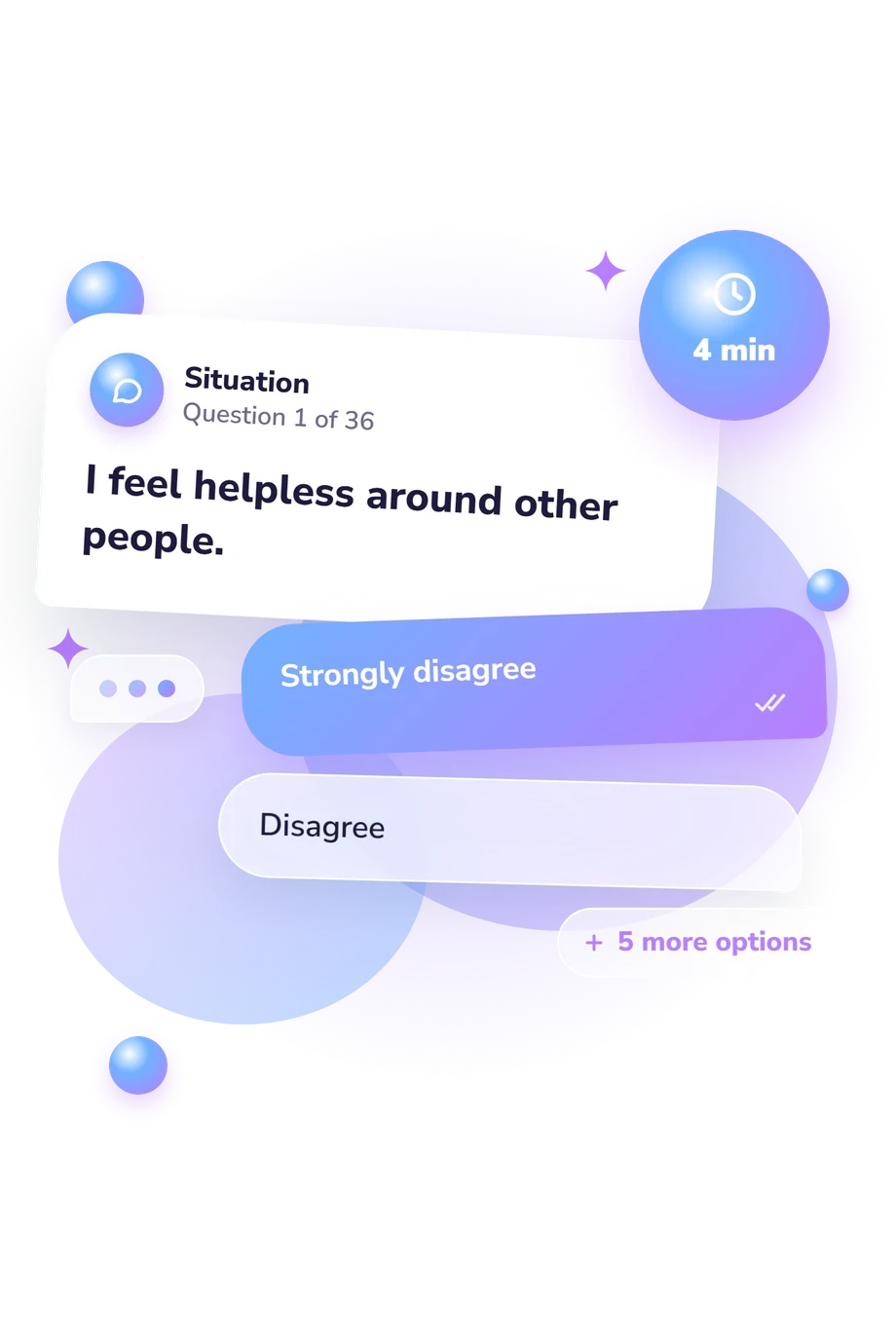
Example Questions From the Test
- Strongly disagree
- Disagree
- Rather disagree
- Cannot decide
- Rather agree
- Agree
- Strongly agree
- Strongly disagree
- Disagree
- Somewhat disagree
- Cannot decide
- Somewhat agree
- Agree
- Completely agree
- Strongly disagree
- Disagree
- Somewhat disagree
- Cannot decide
- Somewhat agree
- Agree
- Strongly agree
Karpman Drama Triangle Test - Description and methodology of the test
People who notice recurring conflict, over-helping, or difficulty accepting responsibility may use the Karpman Drama Triangle Test to examine their interpersonal habits. The test uses the Karpman drama triangle as a lens for people seeking a structured way to reflect on responses when relationships become tense, unequal, or emotionally demanding. Results point to patterns worth considering in everyday interactions, rather than fixed identities or character judgments.
What This Assessment Explores
The assessment examines three recurring positions in interpersonal exchanges. These drama triangle roles describe responses to conflict, dependency, criticism, and another person’s distress; the result reflects the tendency captured by the answers, not a permanent identity. The dimensions are:
- Persecutor (1-7) measures aggression, criticalness, blame, threats, moralizing, and domination, sometimes alongside shame or helplessness; Low 1-3, Moderate 4-5, High 6-7 indicate increasing expression of this role.
- Rescuer (1-7) measures unasked-for helping, self-sacrifice, boundary crossing, guilt, and self-importance; this pattern can be associated with codependent relationships or resource depletion. Low 1-2, Moderate 3-5, High 6-7 indicate increasing expression of this role.
- Victim (1-7) measures helplessness, perceived oppression, shifted responsibility, anxiety, fear, and difficulty solving problems independently; Low 1-3, Moderate 4-5, High 6-7 indicate increasing expression of this role.
Methodology and Scientific Basis
Each statement uses a seven-point agreement response, from strong disagreement to strong agreement, with a neutral or uncertain middle option. Items ask about feelings, beliefs, and actions such as apologizing, dominating, helping, needing support, and putting others first, so they sample situations rather than one global self-description.
Responses are combined into role-specific summaries and displayed as separate profile results. Because the questionnaire gives no documented weighting rule or standardized norm group, each score indicates endorsement within this item set rather than a population-based standing. In this drama triangle questionnaire, the profile can highlight reactions affecting boundaries, responsibility, and reciprocity.
Stephen Karpman’s 1968 transactional-analysis model supplies the theoretical reference, describing shifting interpersonal positions in drama. The closest empirical comparison is the Drama Triangle Scale (Lac & Donaldson, 2022). This questionnaire is conceptually consistent with that work, but is not presented as a digital administration or validated adaptation of the published scale.
Self-report results can reflect current stress, mood, memory, and willingness to acknowledge uncomfortable behavior. The profile is a starting point for comparing reactions across situations, with broader assessment needed for stronger conclusions about enduring functioning.
- Lac, Andrew, and Candice Danae Donaldson. "Development and Validation of the Drama Triangle Scale: Are You a Victim, Rescuer, or Persecutor?" Journal of Interpersonal Violence, 37(7-8), 2022, NP4057-NP4081. 10.1177/0886260520957696
- Karpman, Stephen B. "Fairy Tales and Script Drama Analysis." Transactional Analysis Bulletin, 7(26), 1968, 39-43.
Updated: