
Sibling Questionnaire (BSQ) Test
How the Scales are Structured
Who Usually Takes This Test?
See How You Compare
Below is a preview of how scores are typically distributed across each scale.
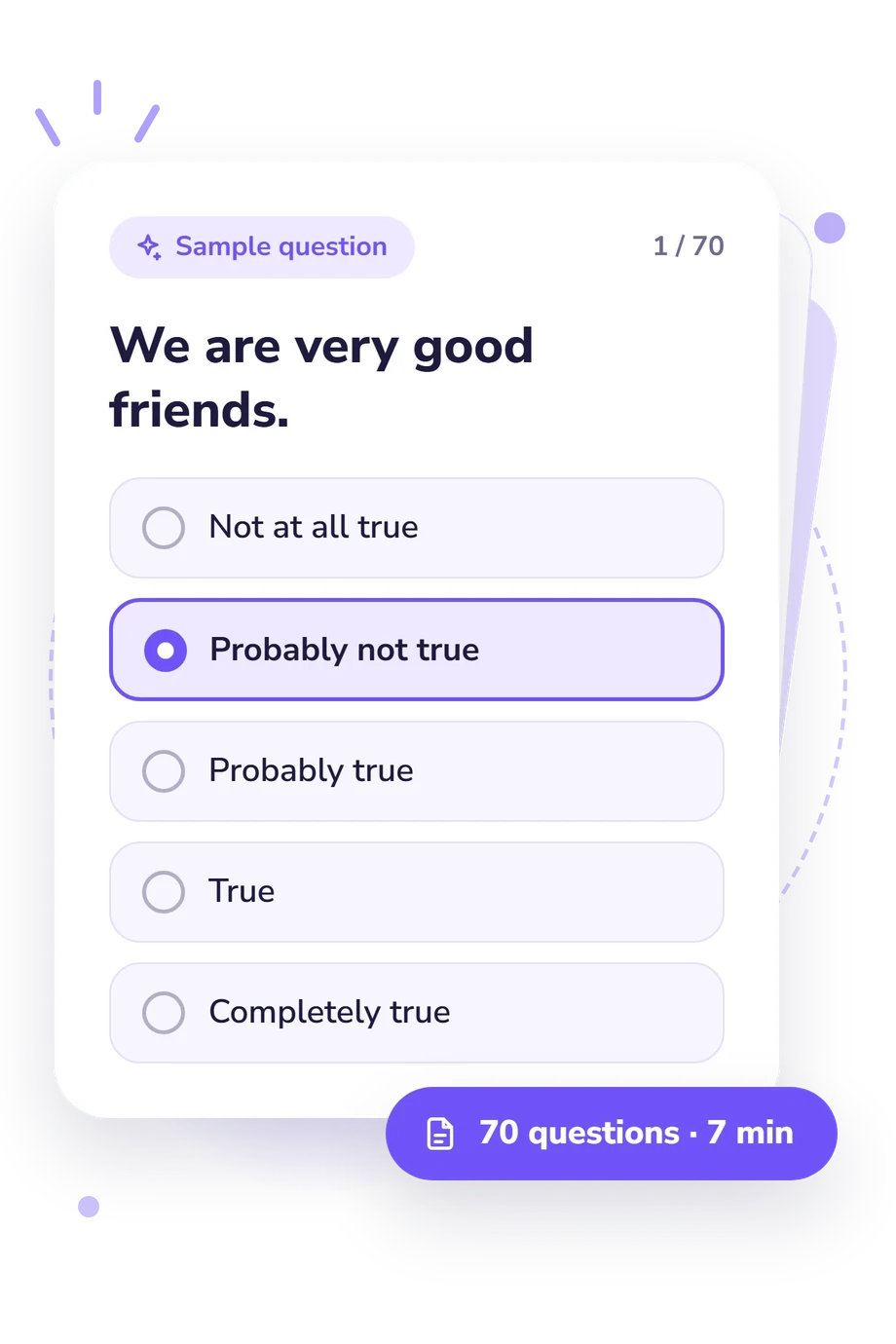
Example Questions From the Test
- Not at all true
- Probably untrue
- Probably true
- True
- Completely true
- Not at all true
- Probably not true
- Probably true
- True
- Completely true
- Not at all true
- Probably not true
- Probably true
- True
- Completely true
Sibling Questionnaire (BSQ) Test - Description and methodology of the test
For readers trying to understand a changing or complicated sibling bond, the Sibling Questionnaire (BSQ) Test offers a structured way to examine how closeness, independence, conflict, and mutual care appear in everyday interactions. As a sibling relationship assessment, it can help a respondent organize impressions of the relationship and identify patterns worth discussing, without reducing a complex family connection to one overall label.
What This Assessment Explores
It separates connection from conflict. The sibling relationship questionnaire examines closeness, independence, conflict, and care; results describe tendencies, not fixed identities.
The dimensions are:
- Coercion (1-5) reflects dominance, control, or exploitation; Low coercion 1-2.3; Moderate coercion 2.4-3.6; High coercion 3.7-5.
- Similarity (1-5) reflects shared interests, life, and emotional experiences; higher scores indicate similarity; lower scores suggest differentiation or deidentification; Low similarity 1-2.4; Moderate similarity 2.5-3.6; High similarity 3.7-5.
- Boundary Maintenance (1-5) reflects respect for material boundaries and siblings’ physical and psychological space; Low boundary respect 1-2.3; Moderate boundary respect 2.4-3.6; High boundary respect 3.7-5.
- Empathy (1-5) reflects care, interest, attachment, and shared time; Low empathy 1-2.4; Moderate empathy 2.5-3.6; High empathy 3.7-5.
Methodology and Evidence Base
The questionnaire uses brief self-report statements about friendship, shared activities, emotion, conflict, imitation, possessions, chores, encouragement, and exclusion. Responses use five truth options from not at all true to completely true, so the respondent rates the relationship rather than recounting one event.
Answers are organized into four displayed dimensions. The result forms a profile across the four dimensions rather than a single total. The questionnaire does not specify how individual answers are weighted or reverse-coded, so its item-level scoring cannot be reconstructed from the response labels. Taken together, the assessment of sibling dynamics is best read as a pattern across dimensions and examples.
The framework is conceptually consistent with the Brother-Sister Questionnaire (BSQ; Graham-Bermann & Cutler, 1994), a published measure of sibling relationship functioning. Relva et al. (2017) examined its construct validity in Portuguese adolescents, but that evidence does not automatically validate this online version. Its digital standardization is not established by those studies. Results may shift with current conflict, memory, self-awareness, or a wish to present the relationship favorably, so they are a starting point for reflection.
- Graham-Bermann, S. A., & Cutler, S. E. (1994). The Brother-Sister Questionnaire: Psychometric Assessment and Discrimination of Well-Functioning From Dysfunctional Relationships. Journal of Family Psychology, 8(2), 224-238. 10.1037/0893-3200.8.2.224
- Relva, I. C., Fernandes, O. M., Alarcão, M., Graham-Bermann, S., & Lopes, P. (2017). Psychometric Proprieties and Construct Validity of the Brother-Sister Questionnaire in a Sample of Portuguese Adolescents. Journal of Family Violence, 32(3), 333-340. 10.1007/s10896-016-9851-x
Updated: