
Spiritual Orientation Inventory Test
How the Scales are Structured
Who Usually Takes This Test?
See How You Compare
Below is a preview of how scores are typically distributed across each scale.
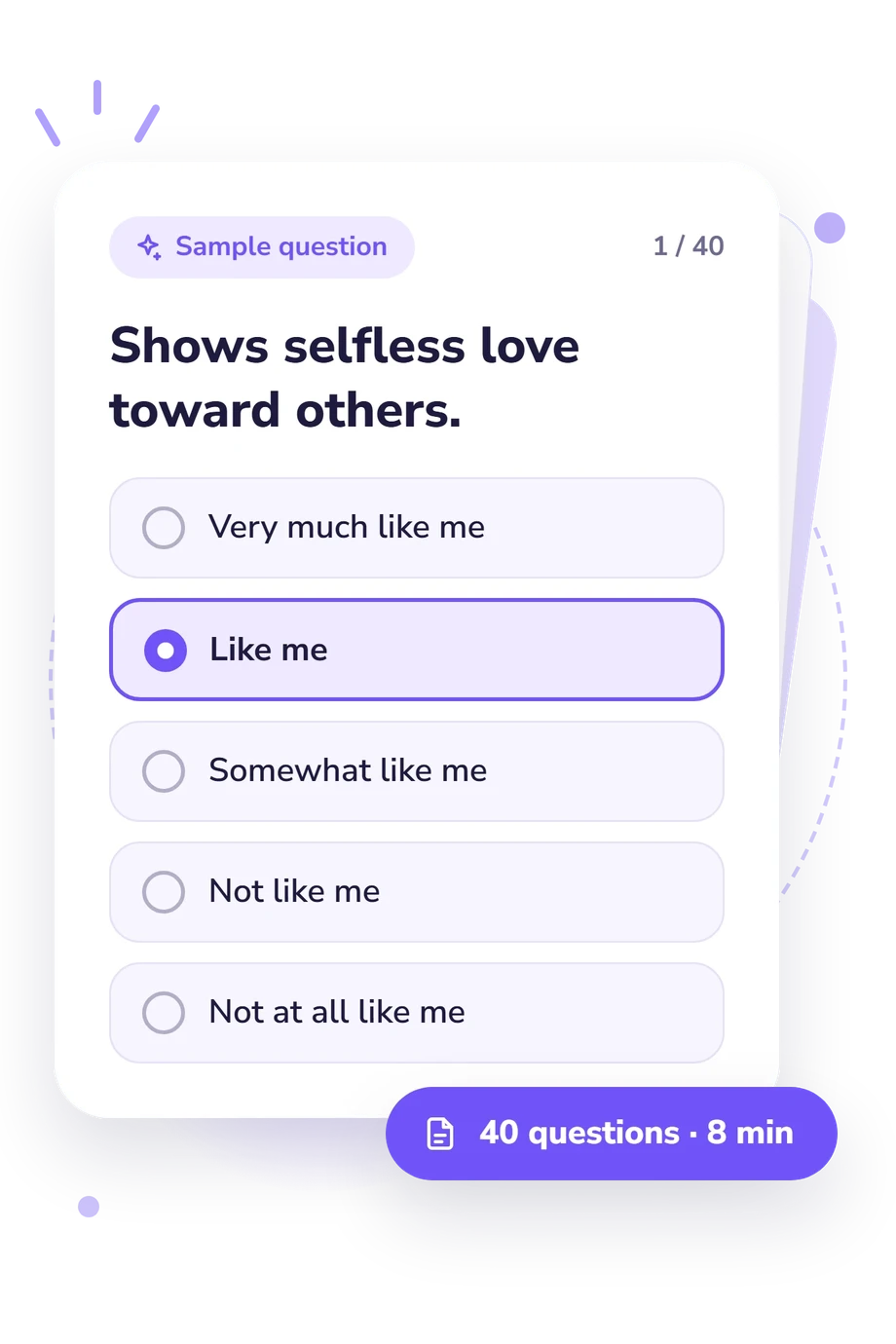
Example Questions From the Test
- Very much like me
- Like me
- Somewhat like me
- Not like me
- Not at all like me
- Very much like me
- Like me
- Somewhat like me
- Not like me
- Not like me at all
- Very much like me
- Like me
- Somewhat like me
- Not like me
- Not at all like me
Spiritual Orientation Inventory Test - Description and methodology of the test
People deciding whether to explore their spiritual priorities may benefit from the Spiritual Orientation Inventory Test when they want to examine how values connect with feelings, intentions, and actions. It considers whether moral ideals are reflected in choices to help, act honestly, pursue meaning, and respond to difficulty. A spiritual values assessment gives these relationships a structure for reflection.
What This Assessment Explores
Spiritual orientation is presented as striving toward higher spiritual and moral values across relationships, conduct, and life meaning. This questionnaire helps readers examine how ideals appear in everyday choices.
The result contains these dimensions:
- Moral Fortitude (10-50) measures courage and persistence. Lower moral fortitude 10-29; Moderate moral fortitude 30-43; High moral fortitude 44-50.
- Inclination Toward Virtue (10-50) measures readiness to do good. Lower inclination 10-31; Moderate inclination 32-45; Higher inclination 46-50.
- Higher Moral Feelings (10-50) measures compassion, gratitude, love, and conscience. Lower 10-30; Moderate 31-44; High 45-50.
- Value-Meaning Aspirations (10-50) measures commitment to higher values and spiritual growth. Low 10-29; Moderate 30-44; High 45-50.
- Spiritual Orientation (40-200) integrates the profile. Lower orientation 40-123; Moderate orientation 124-175; High orientation 176-200.
Methodology and Evidence Base
Each statement uses a five-point self-description format, from ‘Very much like me’ to ‘Not at all like me,’ with intermediate choices. Items cover helping, honesty, compassion, gratitude, resilience, spiritual development, higher meaning, and justice, asking the respondent to compare each statement with typical conduct and priorities.
Responses combine into four component scores and an overall score, producing a spiritual orientation profile rather than one label. The listed bands are the result levels used by the questionnaire. Reading the profile as a pattern across scores shows how the dimensions relate, rather than reducing the result to one label.
The closest published match is the Spiritual Orientation of Personality Questionnaire described in Ozhiganova's 2023 study. This questionnaire is an online translated adaptation of that instrument, rather than an original questionnaire. Ozhiganova's 2019 study and 2016 source on spiritual capacities add context, but findings from those sources cannot automatically transfer to this version.
Self-report scores may reflect current circumstances, self-awareness, or a wish to appear favorable. Consider the profile alongside personal context and other information.
- Ozhiganova, G. V. (2023). Development and Validation of the Questionnaire “Spiritual Orientation of Personality”. Experimental Psychology (Russia), 16(3), 197-213. 10.17759/exppsy.2023160313
- Ozhiganova, G. V. (2019). Adaptation of Spiritual Personality Inventory on the Russian Sample. Experimental Psychology (Russia), 12(4), 160-176. 10.17759/exppsy.2019120413
- Ozhiganova, G. V. (2016). Spiritual Capacities as a Resource of Life Activity. Moscow: Institute of Psychology of the Russian Academy of Sciences.
Updated: