
Jefferson Scale of Empathy (JSE) Test
How the Scales are Structured
Who Usually Takes This Test?
See How You Compare
Below is a preview of how scores are typically distributed across each scale.
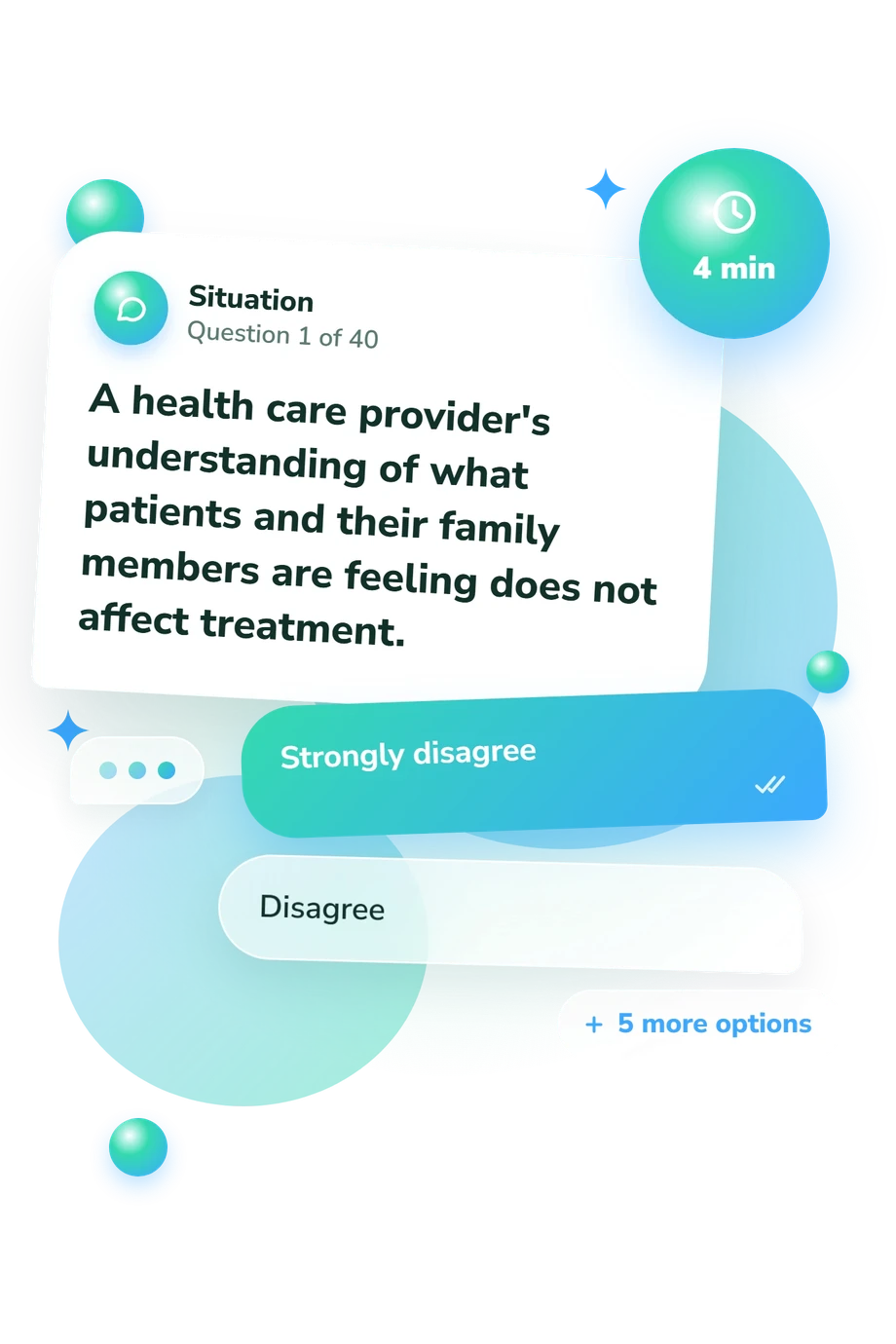
Example Questions From the Test
- Strongly disagree
- Disagree
- Somewhat disagree
- Neither agree nor disagree
- Somewhat agree
- Agree
- Strongly agree
- Strongly disagree
- Disagree
- Somewhat disagree
- Neutral
- Somewhat agree
- Agree
- Strongly agree
- Strongly disagree
- Disagree
- Somewhat disagree
- Neither agree nor disagree
- Somewhat agree
- Agree
- Strongly agree
Jefferson Scale of Empathy (JSE) Test - Description and methodology of the test
Healthcare professionals and students who want to examine how empathy enters clinical communication may use the Jefferson Scale of Empathy (JSE) Test to clarify attitudes that shape interactions with patients. Its profile shows how a practitioner understands a patient’s viewpoint, responds to emotional experience, and accepts responsibility for care. This healthcare empathy test presents these attitudes as a structured profile rather than a single impression.
What This Assessment Explores
Empathy here is treated as a professional capacity expressed in patient care, not only as general concern. The themes cover perspective-taking, verbal and nonverbal cues, personal experience, emotional connection, and the perceived role of empathy in treatment. The clinical empathy questionnaire groups these themes into the displayed scales:
- In the Patient's Role (2–14) measures adopting the patient’s perspective and understanding emotions; Limited perspective-taking 2–6, Developing perspective-taking 7–10, Strong perspective-taking 11–14.
- Compassionate Care (8–56) measures willingness to provide compassionate, emotionally responsive care; Lower compassionate care 8–24, Moderate compassionate care 25–40, Higher compassionate care 41–56.
- Assuming Responsibility (10–70) measures willingness to take responsibility for a patient's treatment and care, supporting recovery; Lower responsibility 10–29, Moderate responsibility 30–49, High responsibility 50–70.
- Overall Empathy Index (20–140) summarizes cognitive and affective empathic ability; Lower empathy 20–79, Moderate empathy 80–109, Higher empathy 110–140.
Methodology and Scientific Basis
Each statement uses a seven-point agreement scale from strongly disagree to strongly agree, including a neutral midpoint. The items address perspective-taking, emotional understanding, communication, and professional responsibility; some use opposite wording, so agreement must be interpreted in context. Responses combine into component scores and a summative index; higher values indicate stronger relevant constructs. The displayed bands are descriptive, not clinical or professional thresholds.
The original JSE instrument (Hojat et al., 2001) is the source instrument most closely aligned with this questionnaire, framing clinical empathy through perspective-taking and concern for patients. Hojat et al. (2002) further describes cognitive, emotional, and behavioral components. Hojat et al. (2018) reports measurement properties, component structure, and national norms for medical students.
This online questionnaire is a JSE empathy assessment that is conceptually consistent with that source instrument, but the source studies’ psychometric findings and norms do not establish the displayed online scoring. Self-report reflects current context and can be shaped by impression management and self-awareness; the profile can show how the respondent views empathic communication, responsibility, and patient-centred care.
- Hojat, M., Mangione, S., Nasca, T. J., Cohen, M. J. M., Gonnella, J. S., Erdmann, J. B., Veloski, J. J., & Magee, M. (2001). The Jefferson Scale of Physician Empathy: Development and preliminary psychometric data. Educational and Psychological Measurement, 61(2), 349–365. 10.1177/00131640121971158
- Hojat, M., Gonnella, J. S., Nasca, T. J., Mangione, S., Vergare, M., & Magee, M. (2002). Physician empathy: Definition, components, measurement, and relationship to gender and specialty. American Journal of Psychiatry, 159(9), 1563–1569. 10.1176/appi.ajp.159.9.1563
- Hojat, M., DeSantis, J., Shannon, S. C., Mortensen, L. H., Speicher, M. R., Bragan, L., LaNoue, M., & Calabrese, L. H. (2018). The Jefferson Scale of Empathy: A nationwide study of measurement properties, underlying components, latent variable structure, and national norms in medical students. Advances in Health Sciences Education, 23(5), 899–920. 10.1007/s10459-018-9839-9
Updated: