
Adolescent Emotional Intelligence Test
How the Scales are Structured
Who Usually Takes This Test?
See How You Compare
Below is a preview of how scores are typically distributed across each scale.
Example Questions From the Test
- Not at all true of me
- Rather not true of me
- Not sure (about 50/50)
- Somewhat true of me
- Definitely true of me
- Not at all true of me
- More untrue of me than true
- Not sure (about 50/50)
- Somewhat true of me
- Completely true of me
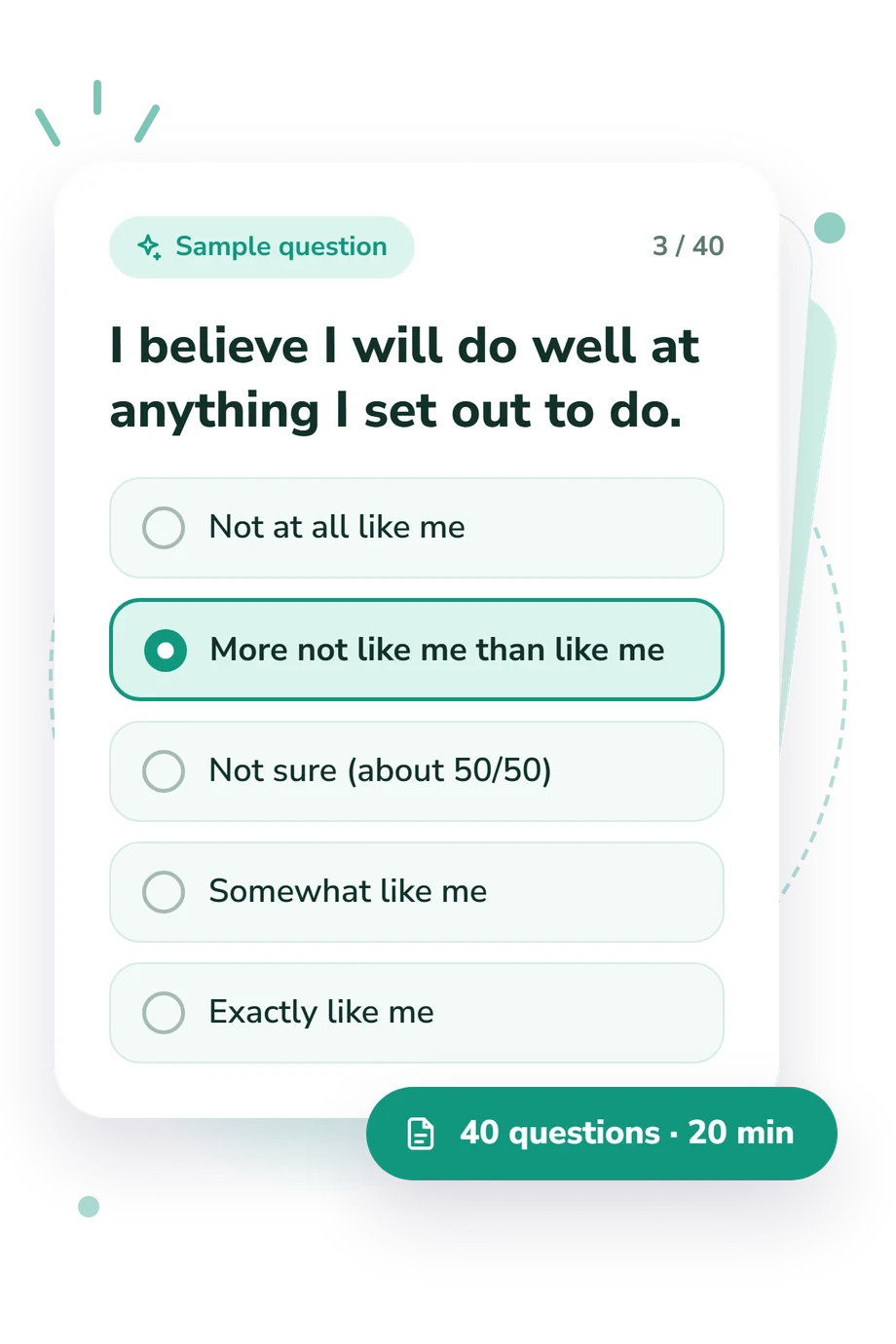
- Not at all like me
- More not like me than like me
- Not sure (about 50/50)
- Somewhat like me
- Exactly like me
Adolescent Emotional Intelligence Test - Description and methodology of the test
Adolescents navigating friendship tensions, school pressures, difficult choices, or unfamiliar situations can use this self-report questionnaire to examine how they respond when emotions run high. The Adolescent Emotional Intelligence Test turns those everyday moments into a profile that can clarify patterns behind reactions, communication, and persistence. This questionnaire works as an emotional intelligence assessment by helping a respondent notice strengths and identify situations where further reflection may be useful.
What This Assessment Explores
The questionnaire uses first-person statements about recognizing emotions, reading facial expressions, recovering after fear, supporting others, using mood to persist, and welcoming unfamiliar experiences. The emotional intelligence questionnaire therefore connects self-awareness with social, motivational, and adaptive behavior.
The result is organized into four catalogue scales:
- Understanding One's Emotions and Empathy (10-50) measures awareness of personal states, their causes, and empathy for others; Developing 10-23, Typical 24-36, Strong 37-50.
- Emotional Regulation Ability (10-50) measures managing feelings, coping with stress, recovering from negativity, and maintaining mood; Developing 10-23, Typical 24-36, Strong 37-50.
- Using Emotions in Activities (10-50) measures using feelings for goals, motivation, decisions, and relationships; Developing 10-23, Moderate 24-36, Strong 37-50.
- Cognitive Flexibility (10-50) measures openness, adaptable thinking, adjustment to change, and new ideas; Lower flexibility 10-23, Moderate flexibility 24-36, Higher flexibility 37-50.
Methodology and Evidence Base
Across the sample, each item asks the respondent to judge whether a statement is true or like them, using five ordered choices from low to high endorsement. The online questionnaire aggregates these ratings into displayed scale scores. Fixed ranges and result labels are provided, but population norms are not established by these outputs.
Mayer and Salovey's ability model supplies the framework, treating emotional intelligence as perceiving, understanding, using, and regulating emotion. This 40-item online questionnaire is an expanded adaptation of the Schutte Self-Report Emotional Intelligence Test (SSEIT), whose original 33-item form was validated by Schutte and colleagues in 1998. Ciarrochi, Chan, and Bajgar's adolescent research offers comparison evidence, but those studies do not validate this expanded version.
This emotional intelligence test for teens relies on honest self-description, so its scores can shift with current mood, recent experiences, self-awareness, and interpretation of each statement. The profile is most useful for identifying patterns to examine in daily life. It should be considered with context and broader assessment rather than read as a diagnosis.
- Ciarrochi, J., Chan, A. Y. C., & Bajgar, J. (2001). Measuring emotional intelligence in adolescents. Personality and Individual Differences, 31(7), 1105-1119. 10.1016/S0191-8869(00)00207-5
- Schutte, N. S., Malouff, J. M., Hall, L. E., Haggerty, D. J., Cooper, J. T., Golden, C. J., & Dornheim, L. (1998). Development and validation of a measure of emotional intelligence. Personality and Individual Differences, 25(2), 167-177. 10.1016/S0191-8869(98)00001-4
- Mayer, J. D., & Salovey, P. (1997). What is emotional intelligence? In P. Salovey & D. J. Sluyter (Eds.), Emotional Development and Emotional Intelligence: Implications for Educators (pp. 3-31). New York: Basic Books.
Updated: