
Aspects of Identity Questionnaire (AIQ-IV) Test
How the Scales are Structured
Who Usually Takes This Test?
See How You Compare
Below is a preview of how scores are typically distributed across each scale.
Example Questions From the Test
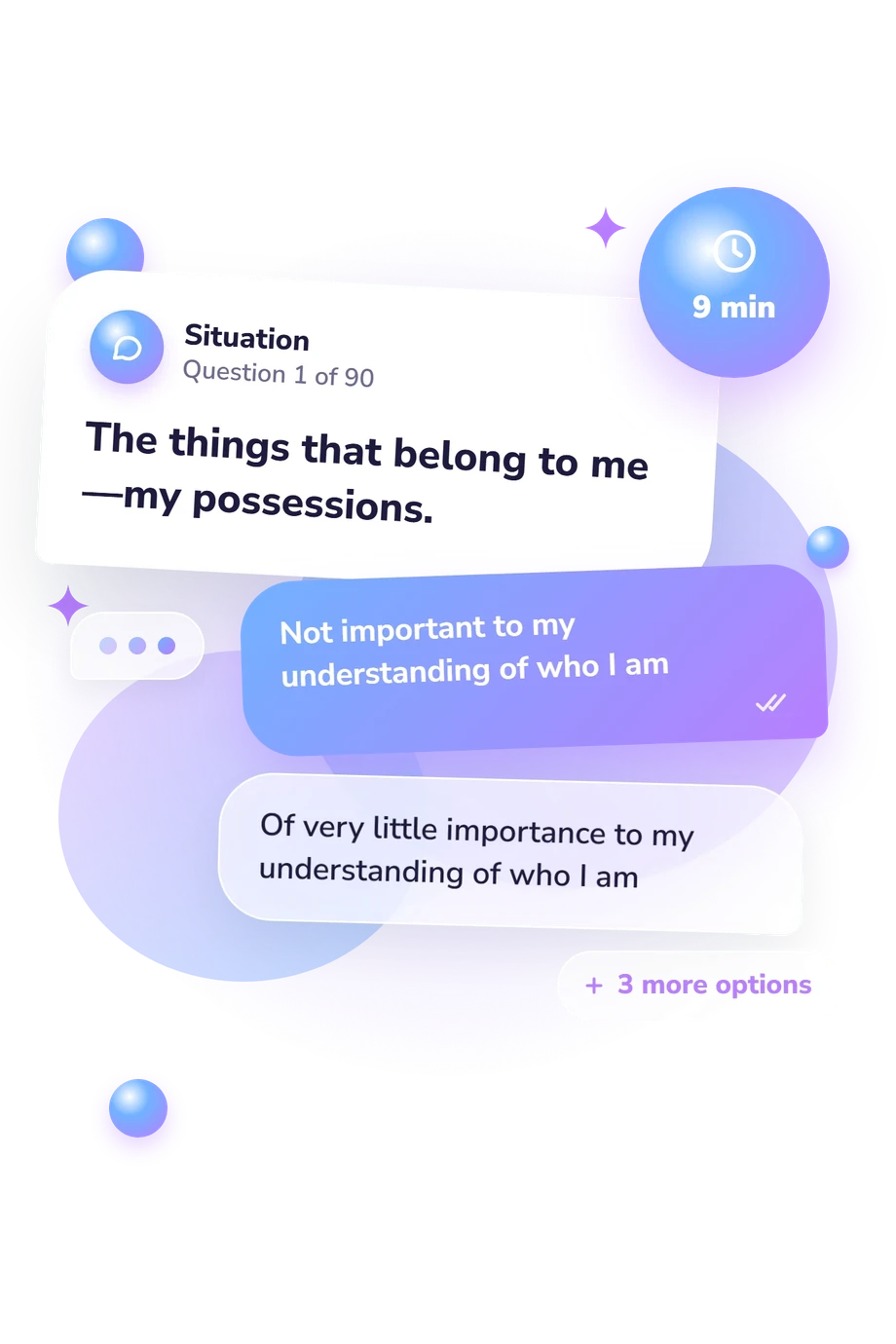
- Not important to my understanding of who I am
- Of very little importance to my understanding of who I am
- Fairly important to my understanding of who I am
- Very important to my understanding of who I am
- Extremely important to my understanding of who I am
- Not important to my sense of who I am
- Of very little importance to my sense of who I am
- Fairly important to my sense of who I am
- Very important to my sense of who I am
- Extremely important to my sense of who I am
- Not important to my sense of who I am
- Of very little importance to my sense of who I am
- Quite important to my sense of who I am
- Very important to my sense of who I am
- Extremely important to my sense of who I am
Aspects of Identity Questionnaire (AIQ-IV) Test - Description and methodology of the test
For anyone wondering why certain relationships, affiliations, or experiences feel central to their sense of self, the Aspects of Identity Questionnaire (AIQ-IV) Test offers a way to examine that pattern. The AIQ-IV questionnaire helps you examine how personal values, relationships, social evaluation, group belonging, and observable characteristics are emphasized in your self-definition. Its result shows the emphasis assigned to these identity domains instead of reducing identity to a single label.
What This Assessment Explores
Items examine possessions, appearance, gender, beliefs, relationships, continuity, uniqueness, and plans. An identity assessment shows which foundations matter.
The displayed scales are:
- Superficial (5-25) measures observable traits, aggregating selected orientation-scale items: Low 5-11; Moderate 12-18; High 19-25.
- Collective Identity Orientation-social categories (10-50) measures age, gender, status, roles: Low 10-23; Moderate 24-36; High 37-50.
- Collective Identity Orientation-group belonging (8-40) measures family, racial, cultural, religious, and political identities: Low 8-18; Moderate 19-29; High 30-40.
- Social (7-35) measures reputation, evaluation, attractiveness, and image: Low 7-16; Moderate 17-25; High 26-35.
- Relational (10-50) measures relational centrality: Lower emphasis 10-23; Moderate emphasis 24-36; Higher emphasis 37-50.
- Personal (10-50) measures values, feelings, continuity, distinctiveness: Low 10-23; Moderate 24-36; High 37-50.
Methodology and Evidence Base
Responses use a five-point importance scale, from low importance to extreme importance. Each item asks how much an identity element matters. The result presents each domain within its displayed score range and band, with the bands indicating levels of emphasis in that domain.
The framework is consistent with Cheek and Cheek’s tetrapartite model of personal, relational, social, and collective orientations. The online assessment is conceptually consistent with the published AIQ-IV study, while the relational dimension also connects with the extension proposed in the 2002 relational-orientation paper by Cheek, Smith, and Tropp. These sources clarify the construct map rather than making this online presentation identical to a published administration.
Published AIQ-IV research includes structural and group-comparison evidence, but it does not establish universal norms for every respondent or guarantee identical measurement properties online. This questionnaire is best read as an identity profile. Self-report results can shift with current circumstances, self-awareness, and the wish to present oneself consistently, so interpret the pattern alongside lived experience rather than as a fixed judgment.
- Jovanović, V., Lazić, M., Gavrilov-Jerković, V., Obradović, V., Šakan, D., Tomašević, A., & Zotović-Kostić, M. (2025). Aspects of Identity Questionnaire-IV: An Examination of Structural Validity, Gender Invariance, and Relationships with Mental Health and Basic Psychological Needs Among Adolescents. Journal of Personality Assessment, 107(1), 28-40. 10.1080/00223891.2024.2367546
- Cheek, N. N., & Cheek, J. M. (2018). Aspects of Identity: From the Inner-Outer Metaphor to a Tetrapartite Model of the Self. Self and Identity, 17(4), 467-482. 10.1080/15298868.2017.1412347
- Cheek, J. M., Smith, S. M., & Tropp, L. R. (2002). Relational Identity Orientation: A Fourth Scale for the AIQ. Paper presented at the meeting of the Society for Personality and Social Psychology, Savannah, Georgia.
Updated: