
Free Will and Determinism Plus Scale (FAD-Plus) Test
How the Scales are Structured
Who Usually Takes This Test?
See How You Compare
Below is a preview of how scores are typically distributed across each scale.
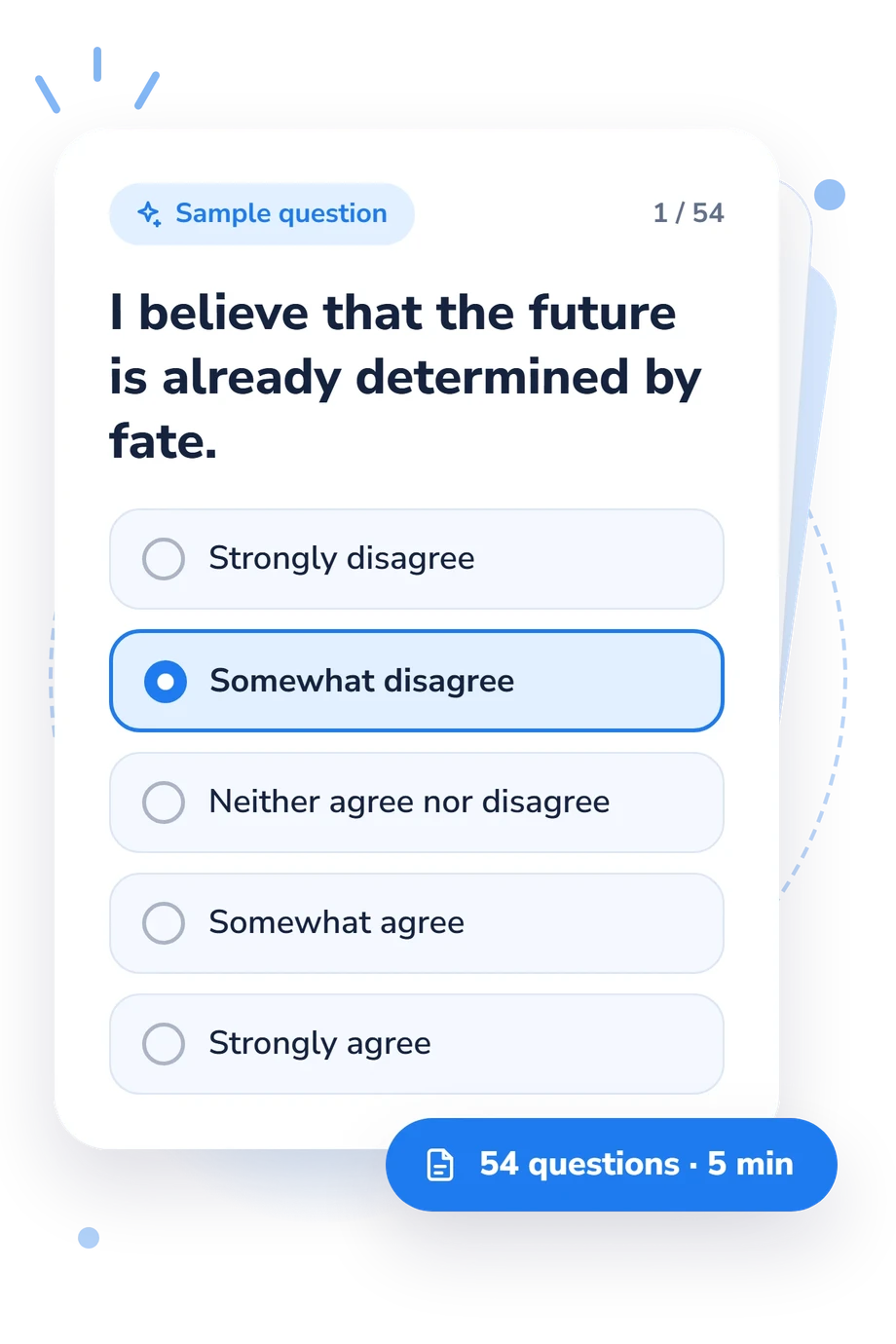
Example Questions From the Test
- Strongly disagree
- Somewhat disagree
- Neither agree nor disagree
- Somewhat agree
- Strongly agree
- Strongly disagree
- Somewhat disagree
- Neither agree nor disagree
- Somewhat agree
- Strongly agree
- Strongly disagree
- Somewhat disagree
- Neither agree nor disagree
- Somewhat agree
- Strongly agree
Free Will and Determinism Plus Scale (FAD-Plus) Test - Description and methodology of the test
For readers who want to examine how they explain choice, responsibility, and events outside personal control, the Free Will and Determinism Plus Scale (FAD-Plus) Test offers a structured profile of those beliefs. This free will and determinism questionnaire can support self-reflection about agency, fate, biological influence, and uncertainty without reducing a complex worldview to one overall label.
What This Assessment Explores
Items examine beliefs about choice, fate, biology, upbringing, chance, predictability, and responsibility. FAD-Plus scale covers four viewpoints:
- Scientific Determinism (1–5) measures beliefs in scientific causes, linked to reduced activity, goal-directedness, and optimism; Low 1–2.3; Moderate 2.4–3.6; High 3.7–5.
- Unpredictability (1–5) measures belief in an unpredictable world, linked to reduced analysis, positive affect, and meaning; More predictable worldview 1–2.4; Mixed/neutral 2.5–3.5; More unpredictable worldview 3.6–5.
- Fatalistic Determinism (1–5) measures fatalistic beliefs, linked to reduced agency and mindfulness with harmony and life satisfaction; Low 1–2.4; Moderate 2.5–3.5; High 3.6–5.
- Free Will (1–5) measures free-will beliefs, linked to well-being, optimism, responsibility, meaning, and resources; Low 1–2.4; Moderate 2.5–3.4; High 3.5–5.
Methodology and Scientific Basis
Each statement uses five-point agreement options from Strongly disagree to Strongly agree. Items cover control, responsibility, biological and environmental influence, fate, luck, and predictability. The profile gives four separate results; no standardized calculation rule is stated.
The questionnaire is conceptually consistent with the published FAD-Plus (Paulhus & Carey, 2011), a measure of lay beliefs about free will and related constructs. Fino and Iliceto (2023) provide psychometric evidence from the Italian FAD-Plus-I, but the cited studies do not establish that this online version has the published instruments’ reliability or norms, or that it is a validated adaptation.
Read the profile across scales rather than treating one result as decisive: scientific explanations can coexist with responsibility, and uncertainty can coexist with agency. No population norms are stated for this online questionnaire, so the displayed bands should be read as descriptive labels.
Because this free will test relies on self-report and abstract statements, scores may reflect response style, current context, or enduring beliefs. Use the result for structured reflection rather than as a standalone measure of personality, mental health, or actual freedom of action.
- Paulhus, D. L., & Carey, J. M. (2011). The FAD-Plus: Measuring lay beliefs regarding free will and related constructs. Journal of Personality Assessment, 93(1), 96–104. 10.1080/00223891.2010.528483
- Fino, E., & Iliceto, P. (2023). Do people have control over the decisions they make? Psychometric properties of the Italian version of the free will and scientific determinism questionnaire (FAD-Plus-I). Current Psychology, 42, 11268–11286. 10.1007/s12144-021-02268-4
Updated: