
Behavior Control Scale Test
How the Scales are Structured
Who Usually Takes This Test?
See How You Compare
Below is a preview of how scores are typically distributed across each scale.
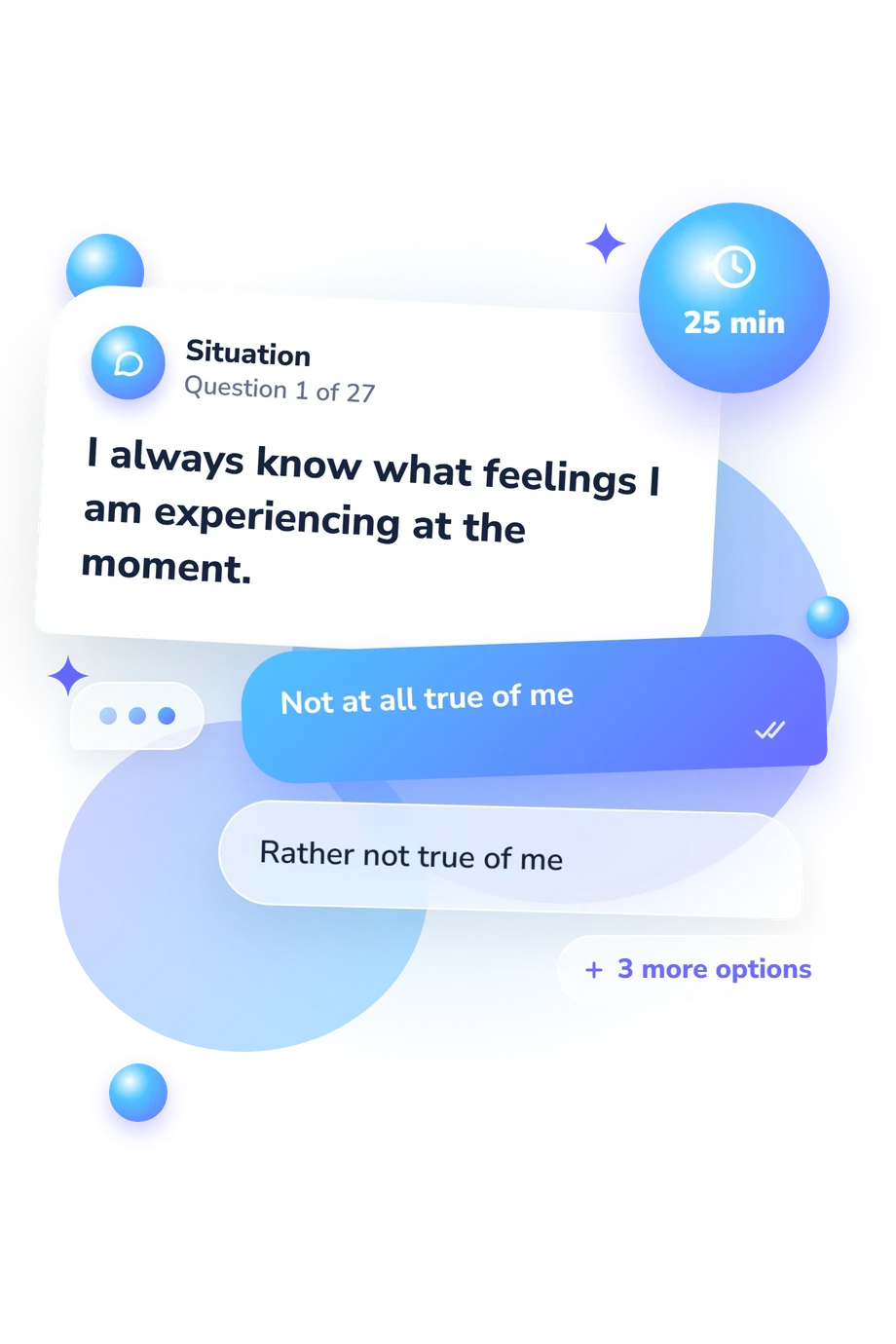
Example Questions From the Test
- Not at all true of me
- Rather not true of me
- Not sure
- Somewhat true of me
- Definitely true of me
- Not at all true of me
- More untrue than true of me
- Not sure
- True of me
- Completely true of me
- Not at all true of me
- More false than true of me
- Not sure
- True of me
- Completely true of me
Behavior Control Scale Test - Description and methodology of the test
For readers who want a clearer framework for reflecting on everyday self-regulation, the Behavior Control Scale Test offers a structured way to organize three areas of experience. This self-control assessment may suit people comparing how their actions, emotions, and goals interact. Its profile can show which area feels steadier and which may deserve closer attention in daily life.
What This Assessment Measures
The questionnaire examines regulation as an interaction between action, emotion, and purposeful direction. Its situations include keeping promises, continuing after setbacks, noticing mood changes, understanding feelings, planning tasks, and resisting distraction. The questions also show how behavior regulation links intentions, emotional states, and everyday decisions.
The displayed dimensions are:
- Behavioral Control (9–45) shows how someone regulates actions, keeps commitments, persists through difficulty, and maintains self-control. Lower control is 9–20; Moderate control is 21–33; Higher control is 34–45.
- Emotional Control (9–45) shows awareness and regulation of feelings, recognition of others’ emotions, and awareness of feelings’ effects on behavior. Low control is 9–21; Moderate control is 22–33; High control is 34–45.
- Volitional Control (9–45) shows planning, goal focus, organization, and resistance to distraction. Low is 9–20; Moderate is 21–33; High is 34–45.
Methodology and Evidence Base
Each statement uses five-option self-report responses. Respondents choose degrees of truth, similarity, or certainty, from disagreement through uncertainty to strong endorsement. This captures tendencies across situations, not performance in one episode.
This questionnaire reports separate results for three scales, so its self-regulation profile keeps action, emotional, and volitional control distinct. Its item-level scoring rule is unstated, so ranges do not establish how options are weighted or whether items are reverse-scored. The bands are interpretation labels, not clinical cutoffs.
Its conceptual basis is consistent with the Behavioral Control Questionnaire (Sergienko et al., 2023), which places behavioral control within a subject-regulation account. A 2010 monograph by Sergienko, Vilenskaya, and Kovaleva supplies context for persistence, emotional regulation, planning, and goal direction. This online questionnaire concerns related constructs but is distinct from the published instrument, and the cited works do not establish validation or norms for its scores.
No standardized norms are specified for this version. Current mood can color responses, self-awareness may limit accurate appraisal, and favorable self-presentation can shift self-report endorsements; these influences should be considered when reading the profile in context.
- Sergienko, E.A., Vilenskaya, G.A., Vetrova, I.I. (2023). A New Method for Assessing Mental Regulation - the Questionnaire "Behavioral Control". Experimental Psychology (Russia), 16(1), 182-200. 10.17759/exppsy.2023160111
- Sergienko, E.A., Vilenskaya, G.A., Kovaleva, Yu.V. (2010). Behavioral Control as Subject Regulation. Moscow: Institute of Psychology of the Russian Academy of Sciences, 352 pp.
Updated: