
Love Is Like War Test
How the Scales are Structured
Who Usually Takes This Test?
See How You Compare
Below is a preview of how scores are typically distributed across each scale.
Example Questions From the Test
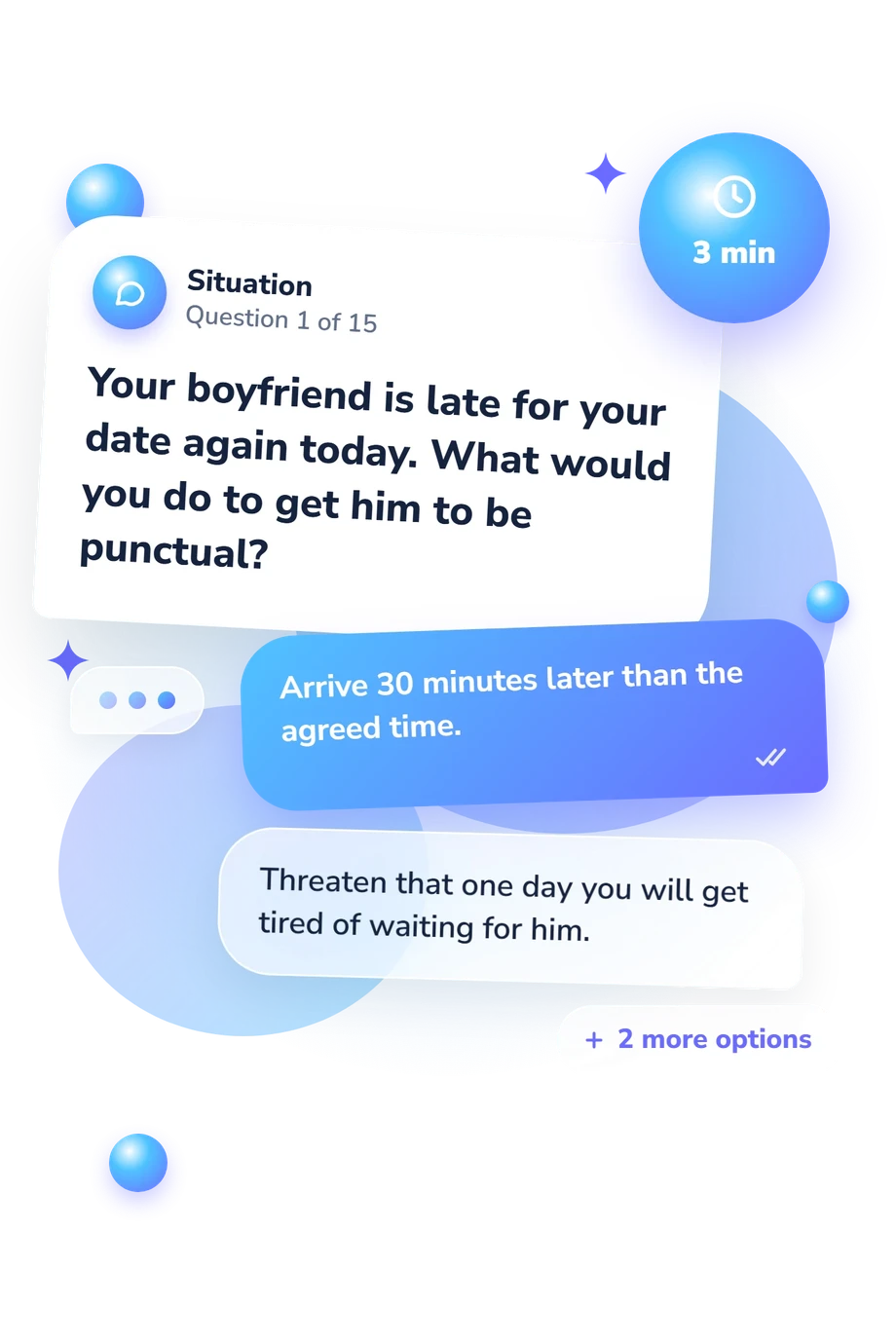
- Arrive 30 minutes later than the agreed time.
- Threaten that one day you will get tired of waiting for him.
- Give him a watch.
- Behave the same way yourself.
- You would be happy for her.
- You would ask whether she has something to wear it with.
- You would lie and say it does not fit her well.
- You would ask where she got the money for it.
- Look through them, then throw them away.
- Ask what they are not getting from you.
- Hide them away and not think about them.
- Give them a porn film and leave.
Love Is Like War Test - Description and methodology of the test
For readers reflecting on intimacy, fairness, and social pressure, the Love Is Like War Test offers a structured way to examine choices across varied scenarios. Viewed as a Love Is Like War quiz, the responses can help someone notice whether they lean toward cooperation, retaliation, secrecy, loyalty, or rigid judgments. The result is most useful as a starting point for discussing personal patterns and the standards guiding them.
What This Test Measures
This relationship values test covers relationship behavior and social decisions as someone balances self-interest with consideration for others amid jealousy, competing interests, boundaries, rejection, loyalty, and unfairness. The focus is judgment: how principles apply when emotions and expectations collide.
These are thematic examples within the scenarios, not separate scales or profile scores:
- Reciprocity and fairness appear when choices involve honesty, consideration, or conflicting interests.
- Boundaries and loyalty arise in situations involving secrecy, privacy breaches, advances, or competing commitments.
- Social perception and self-protection appear in responses to rejection, embarrassment, suspicion, or ridicule.
- Support and responsibility emerge through choices about help, direct communication, retaliation, or avoidance.
Total Score (15-60) is labelled Imbalanced (15-29), Balanced (30-49), or Rigid/Extreme (50-60). The scale measures moderation and adherence to principles: average scores suggest balance, fairness, and willingness to help, while either extreme may indicate polarized behavior or perception.
Methodology and Evidence Base
Methodologically, this relationship self-assessment uses brief self-report scenarios with four response options. Each option presents a different way of handling the situation, making the task comparative and choice-based rather than narrative. The displayed result combines the selected responses into one total, but no item-by-item weighting rule is stated; detailed point allocation should not be inferred.
It is broadly related to romantic relationship themes, while its emphasis on fairness, loyalty, and willingness to help overlaps most with the Moral Foundations Questionnaire's care, fairness, and loyalty domains; the questionnaire's displayed total remains a summary of these scenario responses. Here, the format is an online self-report questionnaire: it presents relationship scenarios for reflection on situational choices and returns one displayed total.
Because answers are self-reported, current mood, self-awareness, personal ideals, and relationship context can influence the pattern, so interpret the result alongside actual circumstances and repeated behavior, which the questions only sample.
- Hendrick, Clyde, and Susan S. Hendrick. “A Theory and Method of Love.” Journal of Personality and Social Psychology, 50(2), 392-402, 1986. 10.1037/0022-3514.50.2.392
- Rubin, Zick. “Measurement of Romantic Love.” Journal of Personality and Social Psychology, 16(2), 265-273, 1970. 10.1037/h0029841
- Hendrick, Clyde, Susan S. Hendrick, and Amy Dicke. “The Love Attitudes Scale: Short Form.” Journal of Social and Personal Relationships, 15(2), 147-159, 1998. 10.1177/0265407598152001
Updated: