
Cognitive Style Assessment Test
How the Scales are Structured
Who Usually Takes This Test?
See How You Compare
Below is a preview of how scores are typically distributed across each scale.
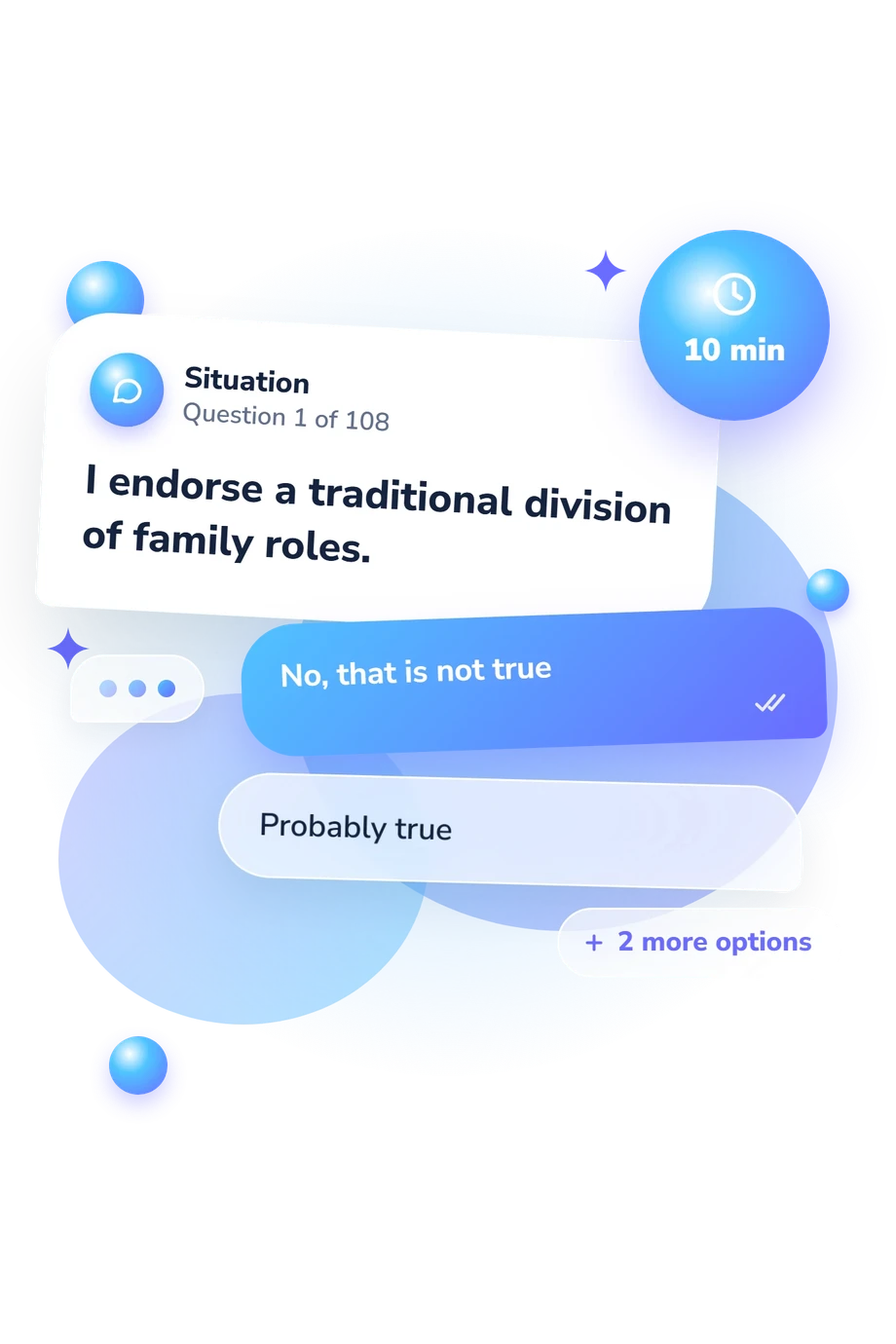
Example Questions From the Test
- No, that is not true
- Probably true
- True
- Completely true
- Not true
- Somewhat true
- True
- Completely true
- No, not true
- Probably true
- True
- Completely true
Cognitive Style Assessment Test - Description and methodology of the test
People who want to examine how social context shapes judgments, choices, and relationships can use the Cognitive Style Assessment Test as a structured self-report profile. A cognitive style questionnaire can help clarify patterns of autonomy, conformity, openness, and coping across ordinary situations. Its result is most useful as a starting point for self-reflection, not as a fixed description of identity.
What This Assessment Explores
The questionnaire examines how independence, social influence, traditions, work, innovation, family life, and coping appear in ordinary judgments and relationships. This cognitive profile assessment describes tendencies rather than intelligence or fixed personality traits. The result areas are:
- Lie Scale (6-24) indicates response credibility: Low 6-12, Moderate 13-18, High 19-24; Social Environment (6-24) shows autonomy: More field-dependent 6-12, Balanced 13-18, More field-independent 19-24.
- Ideology and Political Attitudes (6-24) reflects independence of views: Externally oriented 6-12, Moderately independent 13-18, Highly independent 19-24; Stereotypes and Social Attitudes (6-24) shows stereotype influence: More independent 6-11, Balanced 12-18, More stereotype-influenced 19-24.
- Attitudes Toward Material Possessions (6-24) shows property self-direction: More norm-guided 6-12, Balanced 13-18, More self-directed 19-24; Professional Activity (6-24) reflects work autonomy: More field-dependent 6-12, Balanced 13-18, More field-independent 19-24.
Methodology and Evidence Base
Items use four responses: No, Probably true, True, or Completely true. They cover family, norms, politics, appearance, work, novelty, possessions, coping, and relationships.
Psychological Defense (6-24) covers coping: Lower defenses / more independent coping 6-11; Moderate defenses / balanced coping 12-18; Higher defenses / more externally driven coping 19-24. Attitudes Toward Innovation (6-24) covers change readiness: Low openness to innovation 6-11; Moderate openness to innovation 12-18; High openness to innovation 19-24.
Family Relationships (6-24) covers tradition and autonomy: More tradition-oriented 6-12; Balanced autonomy 13-18; More self-directed 19-24. Field Independence-Field Dependence (48-192) covers the autonomy-influence continuum: More field-independent 48-96; Balanced / mixed 97-143; More field-dependent 144-192.
Scores combine domains with an overall continuum, but ranges do not show response weighting. TSOV-4 (Selivanov & Osokina, 2015) is the closest source; this online cognitive style test is conceptually consistent with it, not a documented adaptation or validation. Witkin et al. (1977) explain field dependence, while Riding and Cheema (1991) provide a broader framework. Context and socially desirable responding may affect results, so bands indicate tendencies rather than norms or diagnosis.
- Selivanov, V. V., & Osokina, K. A. (2015). Diagnostics of cognitive style using the TSOV-4 questionnaire. Bulletin of Practical Psychology of Education, 12(4), 31-35.
- Witkin, H. A., Moore, C. A., Goodenough, D. R., & Cox, P. W. (1977). Field-dependent and field-independent cognitive styles and their educational implications. Review of Educational Research, 47(1), 1-64. 10.3102/00346543047001001
- Riding, R. J., & Cheema, I. (1991). Cognitive styles-an overview and integration. Educational Psychology, 11(3-4), 193-215. 10.1080/0144341910110301
Updated: