
Fantasy Proneness Coefficient (QF) Test
How the Scales are Structured
Who Usually Takes This Test?
See How You Compare
Below is a preview of how scores are typically distributed across each scale.
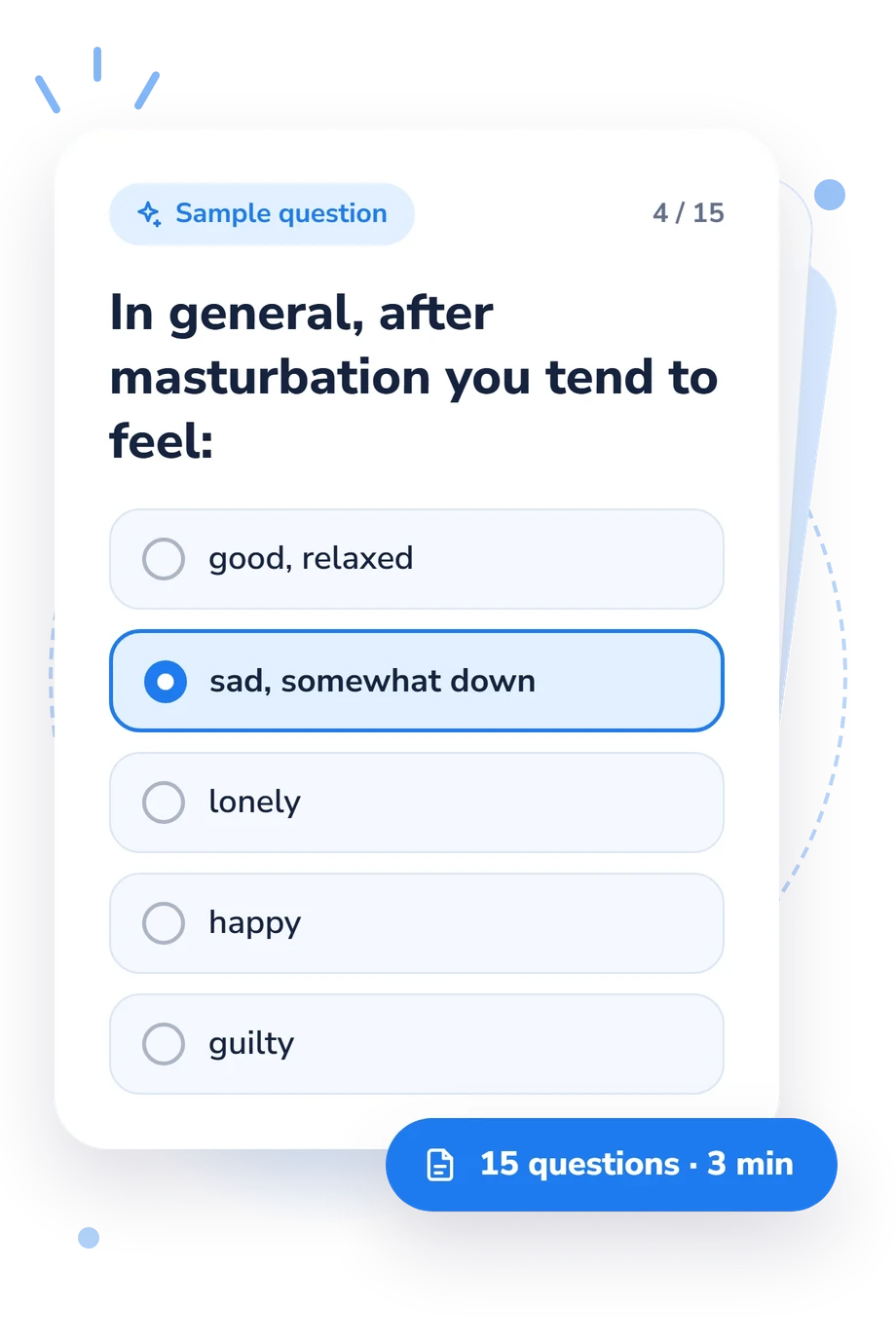
Example Questions From the Test
- with two or more women at the same time
- with your steady partner’s best female friend
- with a sex worker
- with your steady partner’s sister
- with your best friend’s partner
- with several women and several men
- none of these
- take her by force
- wear her panties
- have her caress you in front of a mirror
- tie her up to make love
- have her tie you up
- spank her as part of play
- from time to time
- only when there is no woman in your life
- almost every day
- almost never
Fantasy Proneness Coefficient (QF) Test - Description and methodology of the test
People who want a structured way to examine their own imaginative life may use the Fantasy Proneness Coefficient (QF) Test to clarify how often imagination arises and how vivid, rich, or varied it feels. It is suited to readers seeking a structured fantasy profile without treating imagined content as a direct account of conduct.
What This Assessment Explores
Results describe themes and activity. Items cover observation, self-exposure, submission, dominance, aggression, variety, and feelings.
Results cover:
- Voyeuristic (0-8) measures fantasies of observing others; Low 0-3, Moderate 4-4, High 5-8.
- Exhibitionistic (0-8) measures self-exposure or performance fantasies; Low 0-3, Moderate 4-4, High 5-8.
- Masochistic (0-8) measures submission or passive-role fantasies; Low 0-3, Moderate 4-4, High 5-8.
- Sadistic (0-8) measures fantasies of dominance, power, or aggression; Low 0-3, Moderate 4-4, High 5-8.
- Polymorphic (0-8) measures varied fantasies without one dominant theme; More uniform 0-3, Mixed 4-4, Highly polymorphic 5-8.
- Fantasy Proneness Coefficient (0-27) summarizes fantasy activity: low scores indicate infrequent or inhibited fantasizing; high scores indicate vivid, rich, diverse imagination; Low 0-5, Moderate 6-20, High 21-27.
Methodology and Scientific Basis
Questions use mixed forced-choice formats rather than one agreement scale. Respondents choose scenarios, report frequency, or select feelings and preferences; this structure samples fantasy content from several angles. This sexual fantasy questionnaire produces a profile from selected responses, not a single global judgment. The scoring is profile-based: answers contribute to displayed dimensions, but the ranges do not reveal how many points an option adds.
The methodology is conceptually consistent with the Sex Fantasy Questionnaire (Wilson, 1988) and with Arndt, Foehl, and Good’s multidimensional study, which examines distinct fantasy themes. The questionnaire is not presented as an adaptation of these works.
Results are best read as a snapshot of self-reported imaginative life and thematic variety. The displayed bands are descriptive categories for this questionnaire. Responses may shift with mood, memory, self-awareness, and social desirability, so the outcome should be considered alongside personal context rather than used to infer conduct from imagery alone.
- Wilson, G. D. (1988). Measurement of sex fantasy. Sexual and Marital Therapy, 3(1), 45-55. 10.1080/02674658808407692
- Arndt, W. B., Foehl, J. C., & Good, F. E. (1985). Specific sexual fantasy themes: A multidimensional study. Journal of Personality and Social Psychology, 48(2), 472-480. 10.1037/0022-3514.48.2.472
- Wilson, G. D. (2010). The Sex Fantasy Questionnaire: an update. Sexual and Relationship Therapy, 25(1), 68-72. 10.1080/14681990903505799
- Guilford, J. P., & Zimmerman, W. S. (1949). Manual for the Guilford-Zimmerman Temperament Survey. Beverly Hills, CA: Sheridan Supply Company.
Updated: