
Emotional Dysregulation Test
How the Scales are Structured
Who Usually Takes This Test?
See How You Compare
Below is a preview of how scores are typically distributed across each scale.
Example Questions From the Test
- Strongly disagree
- Disagree
- Agree
- Strongly agree
- Strongly disagree
- Disagree
- Agree
- Strongly agree
- Strongly disagree
- Disagree
- Agree
- Strongly agree
Emotional Dysregulation Test - Description and methodology of the test
People who want to examine recurring difficulties with intense feelings, unclear inner states, or prolonged distress may find the emotional dysregulation test a useful starting point. It is suited to anyone seeking a clearer picture of how emotional experiences are understood, avoided, or prolonged. The questions organize self-observation around these patterns, which may otherwise feel confusing or disconnected. As an emotional regulation test, it frames those patterns for practical self-reflection.
What This Assessment Explores
Rather than reducing distress to one label, the questionnaire examines how someone understands feelings, responds to intensity, and remains caught in negative states. The profile helps reveal difficulty naming emotions, reading others, prolonged hurt, or attempts to escape distress. Some items address acute distress, impulsive or harmful reactions, and coping through alcohol, medication, or self-harm. The result from this emotional dysregulation questionnaire is organized into three dimensions:
- Mentalizing Difficulties (0-36) shows difficulty identifying feelings and understanding experiences: Low difficulties 0-13; Moderate difficulties 14-24; High difficulties 25-36.
- Avoidance (0-24) shows disengagement from intense negative experiences: Low avoidance 0-6; Moderate avoidance 7-14; High avoidance 15-24.
- Rumination (0-32) shows repetitive focus on negative states and emotional persistence: Low 0-12; Moderate 13-22; High 23-32.
Together, these scores indicate which tendencies are most prominent, rather than defining the person or explaining their cause.
Methodology and Evidence Base
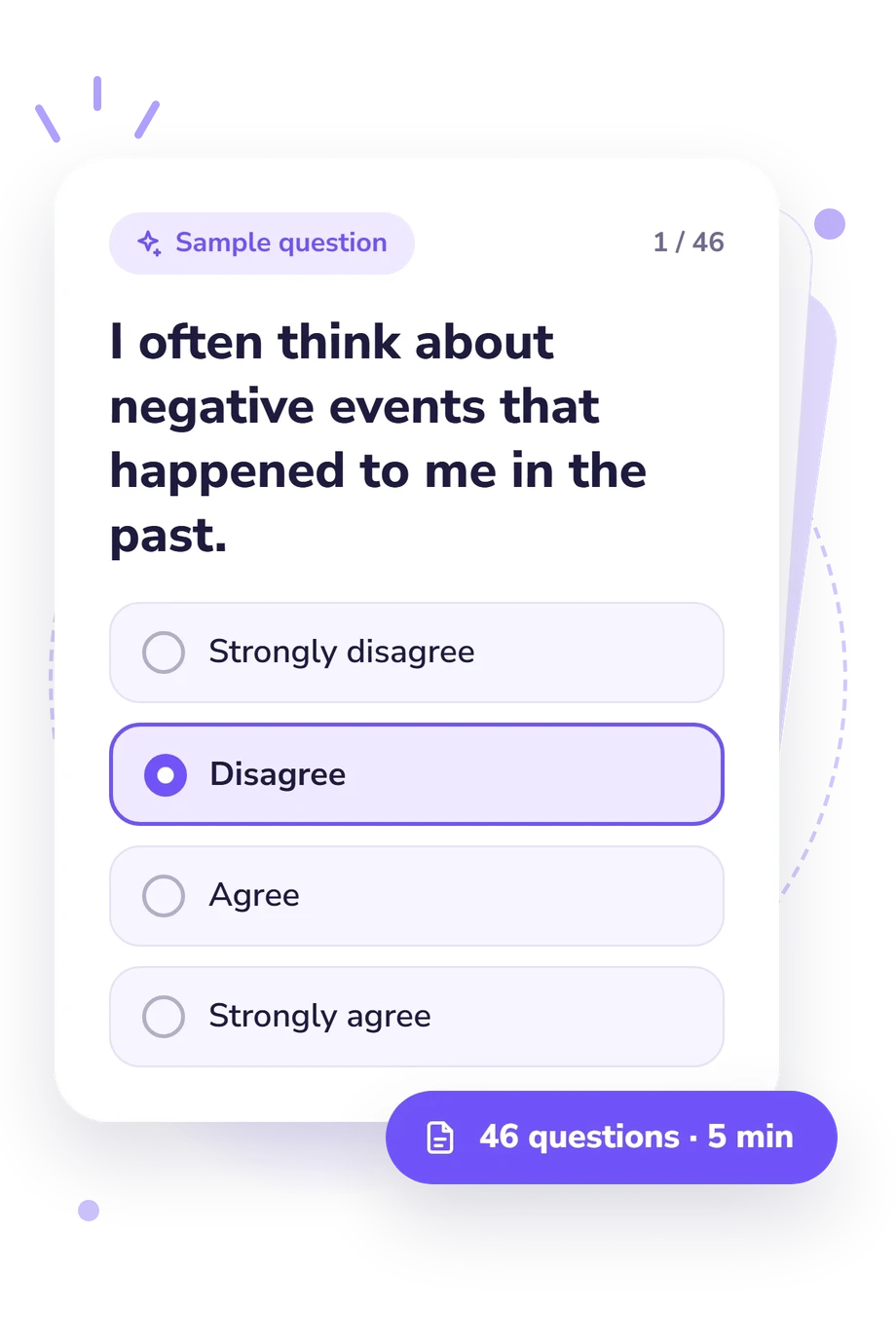
Each statement uses a four-point agreement scale: Strongly disagree, Disagree, Agree, or Strongly agree. The items ask about recurring experiences, and the selected ratings produce three displayed scale scores. The questionnaire provides their ranges and bands but does not specify item assignment, weighting, or any further scoring algorithm.
The structure is conceptually consistent with the published Emotion Dysregulation Questionnaire (Polskaya & Razvaliaeva, 2017), which provides conceptual context for these domains. Kiriukhina and Polskaya (2021) examine the construct alongside body dissatisfaction, while Gross’s 2001 model explains regulation as a process shaped by when a response is noticed and managed. These sources support interpretation of the construct, not authorship of this online version.
As an emotional self-assessment, this version has no established clinical norms or standardization. The displayed bands are descriptive rather than clinical thresholds. A higher band may reflect current stress, learned coping habits, limited self-awareness, or answers shaped by a particularly difficult period. The scores cannot establish a clinical condition and are best considered alongside context, functioning, and professional support when needed.
- Polskaya, N. A., & Razvaliaeva, A. Yu. (2017). The Development of the “Emotion Dysregulation” Questionnaire. Counseling Psychology and Psychotherapy, 25(4), 71-93. 10.17759/cpp.2017250406
- Kiriukhina, N. A., & Polskaya, N. A. (2021). Emotion Dysregulation and Body Dissatisfaction in Female Population. Clinical Psychology and Special Education, 10(3), 126-147. 10.17759/cpse.2021100308
- Gross, J. J. (2001). Emotion Regulation in Adulthood: Timing Is Everything. Current Directions in Psychological Science, 10(6), 214-219. 10.1111/1467-8721.00152
Updated: