
Emotion Understanding (Situations) Test
How the Scales are Structured
Who Usually Takes This Test?
See How You Compare
Below is a preview of how scores are typically distributed across each scale.
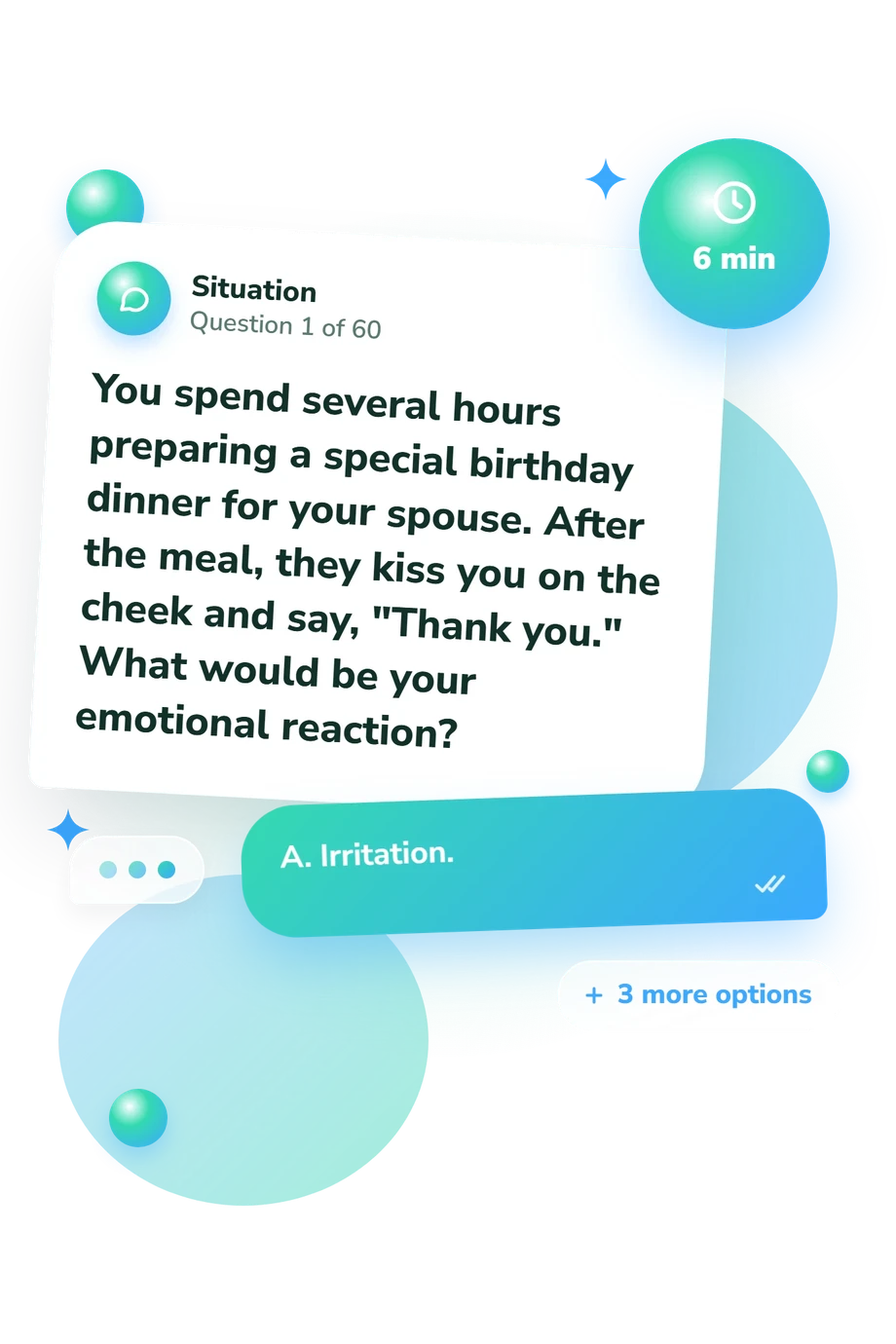
Example Questions From the Test
- Loss of appetite.
- Inability to fall asleep.
- Improved concentration.
- Loss of interest in sex.
- Increased appetite.
- Increased optimism.
- Difficulty sleeping.
- Feeling jittery or shaky.
- A feeling of calm well-being.
- Irritability toward other people.
- Frequent thoughts about this person.
- You are more productive at work.
Emotion Understanding (Situations) Test - Description and methodology of the test
People exploring emotional reactions in relationships and work can use the Emotion Understanding (Situations) Test as structured self-reflection. It focuses on why the respondent’s own emotional reactions arise and how emotional states may shape conduct, communication, and decisions. The result can highlight areas of emotional awareness. An emotional intelligence assessment is most useful when answered from typical experience rather than an idealized self-image.
What This Assessment Explores
The scenarios ask the respondent to infer an emotion, its likely behavioral consequence, or the cause of the respondent’s own emotional reaction. They cover family, friendship, workplace, financial, and social situations. The test is an understanding emotions questionnaire because its scenarios link emotional information with behavior, so each answer requires more than naming a feeling.
The three result dimensions are:
- Understanding the Consequences of Others' Emotions (0-100) measures recognition of how other people's emotions influence their behavior and reactions: Limited insight (0-40), Developing insight (41-70), Strong insight (71-100).
- Understanding the Consequences of One's Own Emotions (0-100) measures awareness of how one's emotions influence behavior and decisions: Limited awareness (0-40), Developing insight (41-85), Strong insight (86-100).
- Understanding the Causes of One's Own Emotions (0-100) measures recognition of why one's own emotional reactions arise and supports self-regulation: Limited insight (0-40), Developing insight (41-70), Strong insight (71-100).
Methodology and Scientific Basis
Each item presents a social or work situation with possible emotional reactions or behavioral outcomes. The respondent selects the option that best fits. This format tests judgment about causes and consequences rather than agreement with a statement, requiring attention to another person's perspective as well as one's own.
The questionnaire groups responses into separate dimension scores, but it does not provide the exact point contribution of each answer or population norms. Its bands organize the profile for reflection, while a selected option may reflect judgment about a scenario as much as a stable tendency.
The scenario format is conceptually consistent with the Situational Test of Emotional Understanding, but this questionnaire is not identified as an adaptation of it. Mayer, Salovey, and Caruso’s emotional-intelligence theory offers a broader framework for its focus on identifying and applying emotional information. Choosing a best-fitting option means the profile reflects judgment about each situation as well as emotional understanding. Responses in this emotional awareness quiz can reflect current mood, memory, cultural expectations, and self-knowledge, so the profile is a snapshot of these situations.
- Davis, Mark H. (2005). Test Your EQ: Find Out How Emotionally Intelligent You Really Are. New York: New American Library.
- Mayer, John D., Peter Salovey, and David R. Caruso. (2004). Emotional intelligence: Theory, findings, and implications. Psychological Inquiry, 15(3), 197-215. 10.1207/S15327965PLI1503_02
- MacCann, Carolyn, and Richard D. Roberts. (2008). New paradigms for assessing emotional intelligence: Theory and data. Emotion, 8(4), 540-551. 10.1037/a0012746
Updated: