
Emotion Regulation (Situations) Test
How the Scales are Structured
Who Usually Takes This Test?
See How You Compare
Below is a preview of how scores are typically distributed across each scale.
Example Questions From the Test
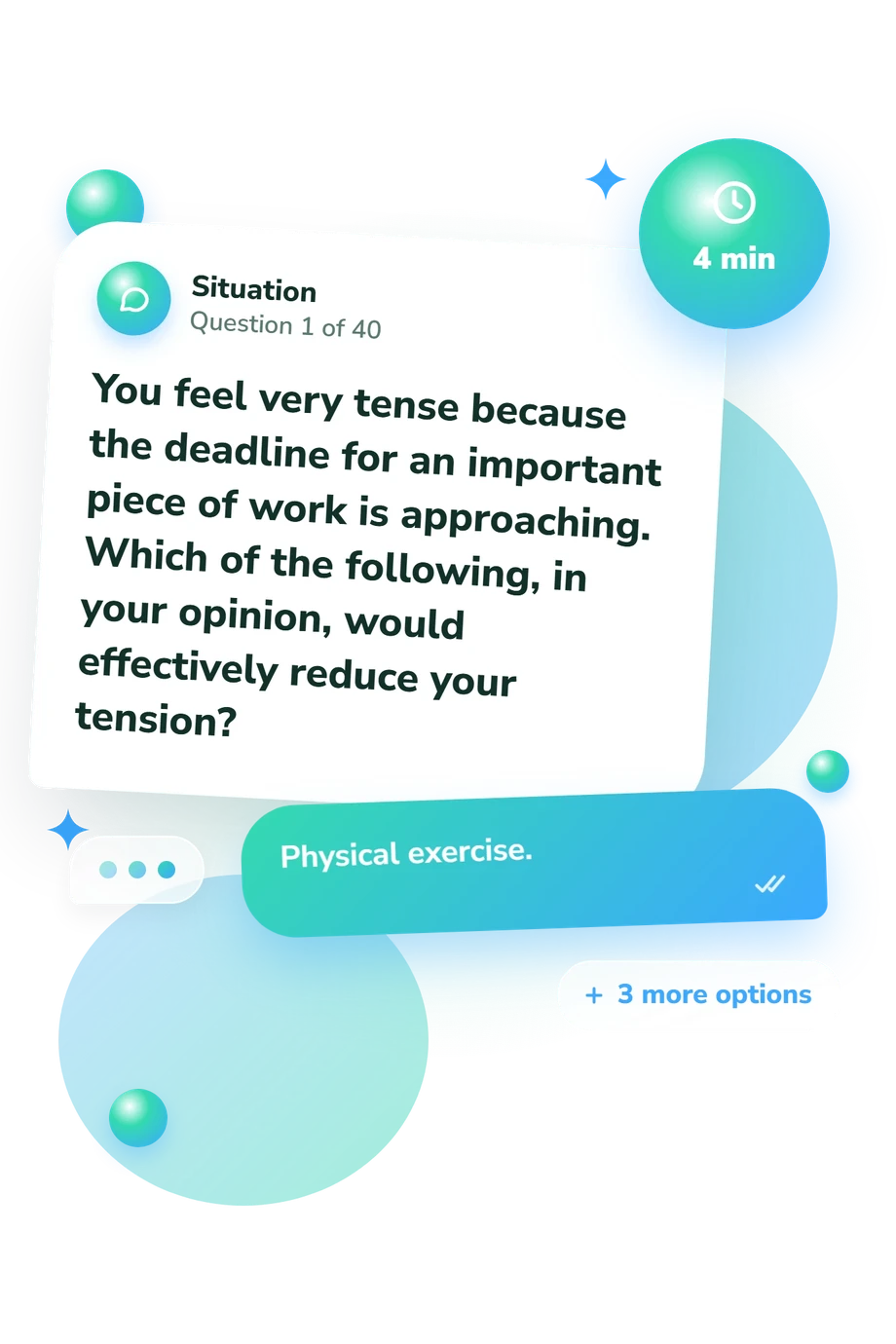
- Physical exercise.
- Doing more work.
- Meditation.
- Distraction by doing an enjoyable activity.
- Yell at the person to vent your anger.
- Ask the person for forgiveness.
- Try to understand why the person said those words.
- Make a list of this person's good qualities.
- Spend some time alone to reflect.
- Go to a party with friends.
- Have a couple of cocktails.
- Tell your best friend about it.
Emotion Regulation (Situations) Test - Description and methodology of the test
People may choose this assessment when they want to examine how they respond to pressure, conflict, disappointment, and everyday strain, especially when deciding what might ease distress or improve a difficult interaction. The Emotion Regulation (Situations) Test presents situations involving personal and interpersonal emotions, allowing a narrower comparison between self-regulation and regulation of others' emotions. This emotion regulation questionnaire uses situational choices to support self-observation and examine preferred responses.
What This Assessment Explores
The scenarios cover deadline tension, anger, sadness, shame, jealousy, fatigue, conflict, and positive mood. Other items ask how you would support a distressed friend, partner, child, employee, or colleague. They examine responses that may reduce distress, restore balance, repair relationships, or improve another person's mood.
The profile reports two dimensions:
- Regulation of Others' Emotions runs from 0-100 and reflects your ability to comfort, support, motivate, or help people manage stress, anxiety, or disappointment. Bands are Limited (0-40), Developing (41-70), and Strong (71-100).
- Self-Emotion Regulation runs from 0-100 and reflects managing feelings, controlling impulses, maintaining balance, pursuing goals, and acting by personal values under pressure. Bands are Needs strengthening (0-40), Developing (41-70), and Strong (71-100).
This emotion regulation assessment can show whether your choices lean toward self-management, interpersonal support, or both, while leaving room for context and individual differences.
Methodology and Scientific Basis
Each item presents a social or emotional situation with four possible responses. You choose the option you consider most effective, so the questionnaire examines beliefs about useful strategies rather than performance during a live emotional event. The scenarios move between self-management and influencing someone else.
The scoring summarizes these choices as a two-part profile; you do not calculate points. Read the result as a tendency suggested by your answers. The result is a profile of preferred emotion regulation strategies, highlighting preferences for planning, perspective-taking, apology, support, or calm communication.
The closest conceptual reference is Emotion Regulation (Situations) (Davis, 2005). The questionnaire is conceptually consistent with that work, but it is not a direct reproduction or validated adaptation. Gross's 1998 review and Gross and Thompson's 2007 chapter supply the broader framework for understanding regulation as shaping emotional experience, expression, and behavior in relation to goals and context.
This online self-report questionnaire has no stated norms. Answers may reflect current mood, self-awareness, social desirability, and the gap between recognizing an effective response and using it under emotional pressure.
- Davis, Mark H. Test Your EQ: Find Out How Emotionally Intelligent You Really Are. New York: New American Library, 2005.
- Gross, James J., and Ross A. Thompson. Emotion Regulation: Conceptual Foundations. In Handbook of Emotion Regulation, edited by James J. Gross, 3-24. New York: Guilford Press, 2007.
- Gross, James J. The Emerging Field of Emotion Regulation: An Integrative Review. Review of General Psychology, 2(3), 271-299, 1998. 10.1037/1089-2680.2.3.271
Updated: