
Emotion Understanding (Critic Ratings) Test
How the Scales are Structured
Who Usually Takes This Test?
See How You Compare
Below is a preview of how scores are typically distributed across each scale.
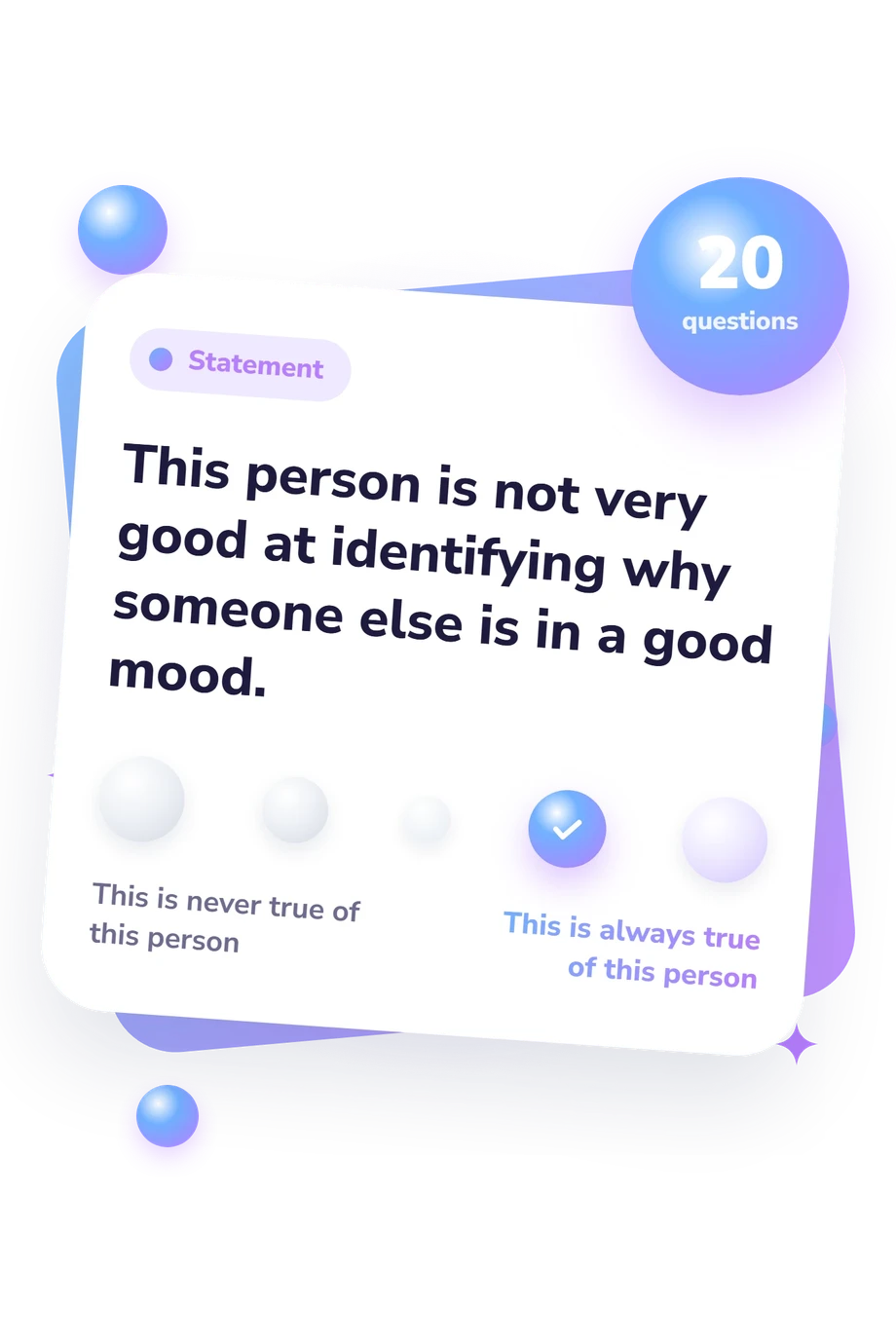
Example Questions From the Test
- This is never true of this person
- This is rarely true of this person
- This is sometimes true of this person
- This is often true of this person
- This is always true of this person
- This is never true of this person
- This is rarely true of this person
- This is sometimes true of this person
- This is often true of this person
- This is always true of this person
- This is never true of this person
- This is rarely true of this person
- This is sometimes true of this person
- This is often true of this person
- This is always true of this person
Emotion Understanding (Critic Ratings) Test - Description and methodology of the test
People who want a structured view of how someone reads emotional situations may use the Emotion Understanding (Critic Ratings) Test to examine observable social-cognitive tendencies. A familiar person can be rated by an observer, so this is an observer rating questionnaire rather than a direct self-report. The questions examine how people infer emotional causes and predict behavioural consequences in social relationships.
What This Assessment Explores
At the centre are two linked abilities: identifying why another person feels a certain way and anticipating what that feeling may lead them to do.
The items use situations involving anger, jealousy, sadness, depression, mood changes, and subtle triggers; the scores concern understanding emotional causes and anticipating effects on behaviour and relationships.
The wording examines another person's emotional experience as a pattern of interpreting causes and anticipating consequences, rather than emotional vocabulary alone.
The result profile contains two dimensions:
- Understanding the Consequences of Other People’s Emotions: -20-20. This score reflects how well the respondent anticipates emotional effects on behaviour and relationships; Limited foresight is -20-0, while Strong foresight is 1-20.
- Understanding the Causes of Other People's Emotions: -20-20. This score reflects recognition of motives and triggers; Needs development is -20-0, Typical is 1-5, and Strong is 6-20.
Methodology and Evidence Base
Each item in the emotion understanding questionnaire uses a five-point scale from “never true of this person” to “always true of this person,” so the respondent rates how consistently each statement fits the person described. Strength-oriented statements sit beside statements about difficulty or confusion, covering emotional causes and predicted effects.
Responses are combined into a two-part profile; the displayed band identifies the reported level or category for each tendency.
The observer-rating study by Elfenbein, Barsade, and Eisenkraft addresses socially visible emotional abilities. Castro and colleagues’ emotion-understanding model covers causes, states, and consequences. Mayer and colleagues’ MSCEIT offers a related comparison, but this questionnaire is not that instrument or its standardized administration. Russell’s core affect framework distinguishes changing affective states from their meanings.
The questionnaire is conceptually consistent with these works, but it is not an adaptation of the MSCEIT and has not been validated by the cited studies. Because another person supplies the ratings, results can vary with the respondent's knowledge of the person, context, and candour; they describe a perspective rather than a fixed capacity.
- Elfenbein, H. A., Barsade, S. G., & Eisenkraft, N. (2015). The social perception of emotional abilities: Expanding what we know about observer ratings of emotional intelligence. Emotion, 15(1), 17-34. 10.1037/a0038436
- Castro, V. L., Cheng, Y., Halberstadt, A. G., & Grühn, D. (2016). EUReKA! A conceptual model of emotion understanding. Emotion Review, 8(3), 258-268. 10.1177/1754073915580601
- Mayer, J. D., Salovey, P., Caruso, D. R., & Sitarenios, G. (2003). Measuring emotional intelligence with the MSCEIT V2.0. Emotion, 3(1), 97-105. 10.1037/1528-3542.3.1.97
- Russell, J. A. (2003). Core affect and the psychological construction of emotion. Psychological Review, 110(1), 145-172. 10.1037/0033-295X.110.1.145
Updated: