
Understanding the Causes and Consequences of Emotions Test
How the Scales are Structured
Who Usually Takes This Test?
See How You Compare
Below is a preview of how scores are typically distributed across each scale.
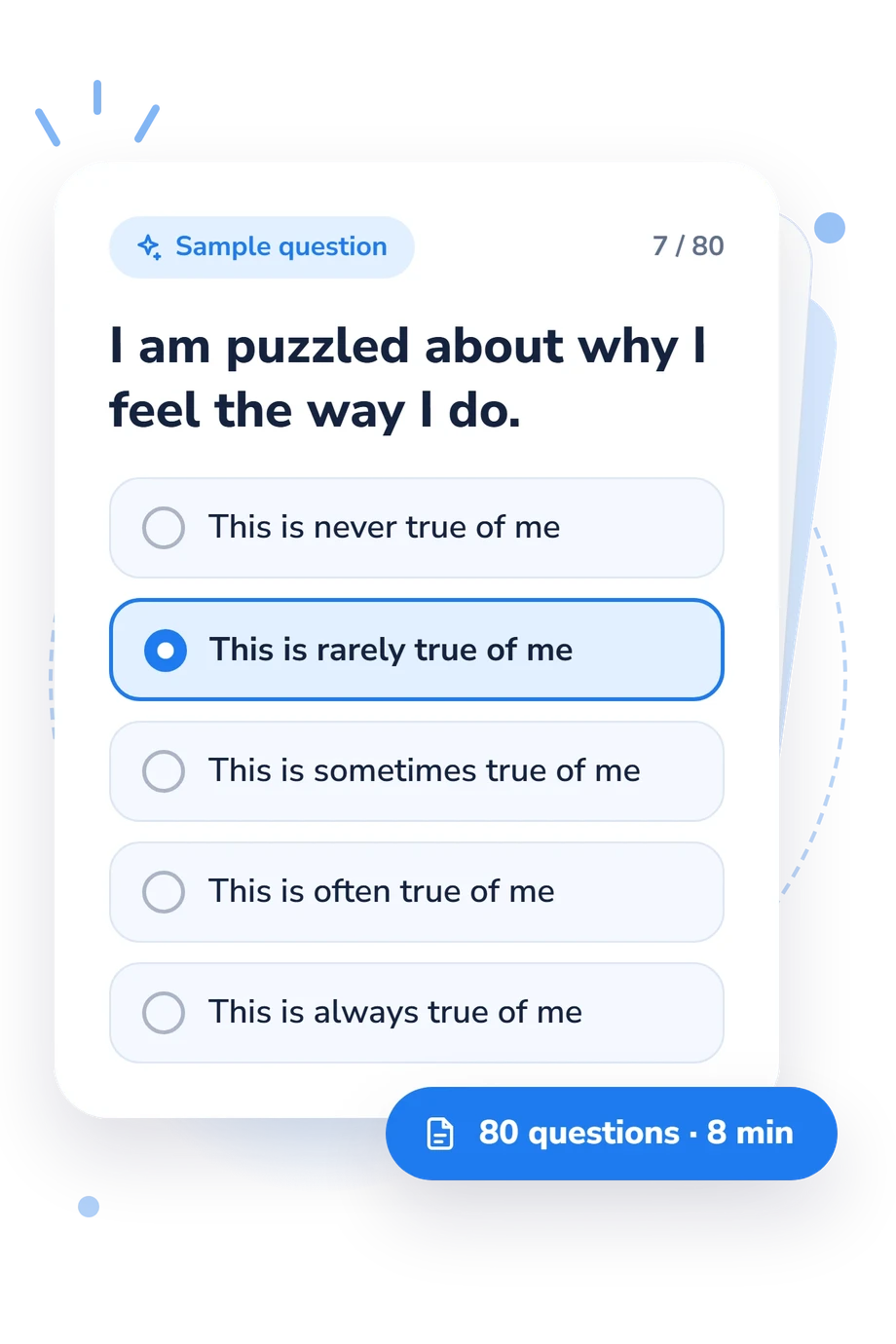
Example Questions From the Test
- This is never true of me
- This is rarely true of me
- This is sometimes true of me
- This is often true of me
- This is always true of me
- This is never true of me
- This is rarely true of me
- This is sometimes true of me
- This is often true of me
- This is always true of me
- This is never true of me
- This is rarely true of me
- This is sometimes true of me
- This is often true of me
- This is always true of me
Understanding the Causes and Consequences of Emotions Test - Description and methodology of the test
People seeking clarity about how emotions shape interactions can use the Understanding the Causes and Consequences of Emotions Test to examine the causes of their own and other people’s emotional states and anticipate their consequences for behavior and relationships. It suits readers reflecting on emotional self-awareness, communication, decisions, and relationships. The profile covers four areas: causes and consequences involving one’s own and other people’s emotional states.
What This Assessment Explores
By linking perceived emotional triggers with likely effects on conduct, decisions, and relationships, the assessment helps readers understand emotional causes in personal and social situations. It suits readers exploring self-awareness, communication, decision-making, and recurring interpersonal patterns. The four profile dimensions are:
- Understanding the Causes of One’s Own Emotions (-20-20) measures recognition of personal triggers: Limited insight -20-0; Developing insight 1-9; Strong insight 10-20.
- Understanding the Causes of Other People’s Emotions (-20-20) measures recognition of others’ triggers: Limited insight -20-0; Developing insight 1-14; Strong insight 15-20.
- Understanding the Consequences of One's Own Emotions (-20-20) measures how feelings affect behavior and decisions: Limited insight -20-0; Moderate insight 1-14; Strong insight 15-20.
- Understanding the Consequences of Other People’s Emotions (-20-20) measures anticipated effects on behavior and relationships: Limited insight -20-0; Developing insight 1-14; Strong insight 15-20.
Methodology and Scientific Basis
Each item uses a five-point self-report format, from “This is never true of me” to “This is always true of me.” Questions rate recognition of emotional causes and anticipated effects across the four domains, including analysis, explanation, and prediction of effects on behavior. Four displayed scores result, rather than one overall label. Since the point-by-point scoring rule is not specified, the stated bands show higher or lower insight, with limited, developing, or moderate ranges.
Conceptually, this questionnaire about how emotions affect behavior can be compared with the Mayer-Salovey-Caruso Emotional Intelligence Test (MSCEIT), a related performance-based measure of understanding and using emotion. That comparison is conceptual only: this questionnaire uses self-report ratings and is not presented as adapted from or validated by the MSCEIT. It is also conceptually consistent with Scherer’s account of emotional causes and consequences and Frijda and Mesquita’s analysis of emotional experience; no norming sample or published standardization is stated.
The four bands describe reported tendencies in particular domains. Because this is self-report, mood, memory, self-awareness, and self-presentation can influence answers, so personal context matters when interpreting the profile.
- Mayer, John D., Peter Salovey, David R. Caruso, and Gill Sitarenios. “Measuring Emotional Intelligence With the MSCEIT V2.0.” Emotion 3, no. 1 (2003): 97-105. 10.1037/1528-3542.3.1.97
- Mayer, John D., Peter Salovey, and David R. Caruso. “Emotional Intelligence: Theory, Findings, and Implications.” Psychological Inquiry 15, no. 3 (2004): 197-215. 10.1207/s15327965pli1503_02
- Scherer, Klaus R. “What Are Emotions? And How Can They Be Measured?” Social Science Information 44, no. 4 (2005): 695-729. 10.1177/0539018405058216
- Frijda, Nico H., and Batja Mesquita. “The Analysis of Emotions: Dimensions of Variation.” In What Develops in Emotional Development?, edited by Michael F. Mascolo and Sharon Griffin, 273-295. Plenum Press, 1998. 10.1007/978-1-4899-1939-7_11
Updated: