
Barratt Impulsiveness Scale (BIS-11) Test
How the Scales are Structured
Who Usually Takes This Test?
See How You Compare
Below is a preview of how scores are typically distributed across each scale.
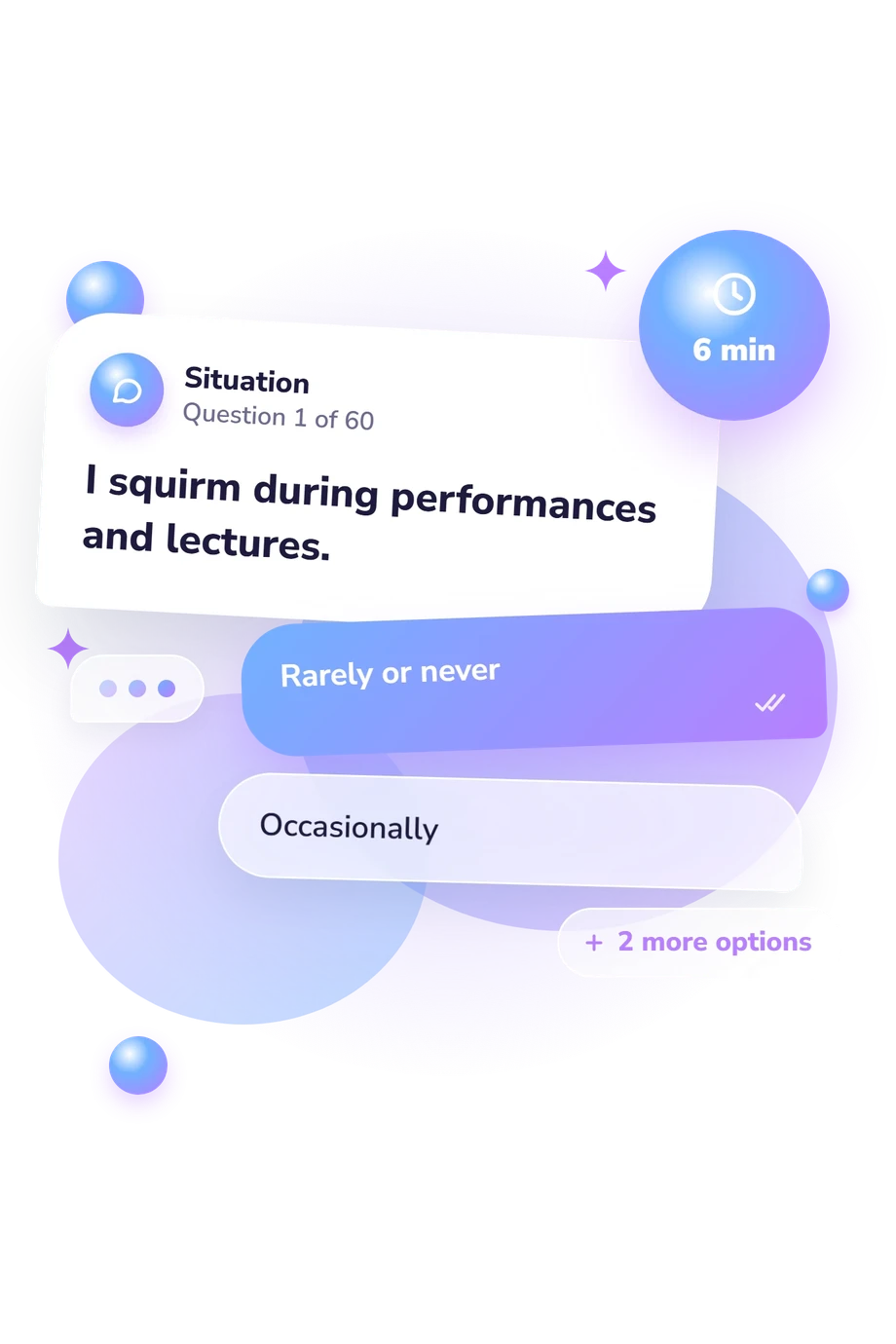
Example Questions From the Test
- Rarely or never
- Sometimes
- Often
- Always or almost always
- Rarely or never
- Sometimes
- Often
- Always or almost always
- Rarely or never
- Occasionally
- Often
- Always or almost always
Barratt Impulsiveness Scale (BIS-11) Test - Description and methodology of the test
People who want to examine patterns of quick action, divided attention, or difficulty with planning can use the Barratt Impulsiveness Scale (BIS-11) Test as a structured self-report exercise. This BIS-11 impulsivity test turns everyday observations about decisions, concentration, and self-control into a profile across several dimensions. It suits personal reflection when the aim is to notice recurring tendencies rather than seek a single explanation.
What This Assessment Explores
Acting quickly here extends beyond simple haste. Items address restlessness, distractibility, racing thoughts, spending, unplanned speech, future planning, saving, self-control, and changes in work, residence, or hobbies. Together, they show how attention, present-focused choices, motor activity, and planning shape decisions.
The impulsivity profile covers four dimensions. This questionnaire is conceptually consistent with the published BIS-11, while its displayed scales and scoring belong to this online form.
The displayed dimensions are:
- Inconsistency (0-100) measures motor impulsivity and hasty action; higher scores suggest weaker behavioral consistency. Low 0-33, Moderate 34-66, High 67-100.
- Attentional Distraction (0-100) measures sustained attention and distractibility. Low distractibility 0-39, Moderate distractibility 40-69, High distractibility 70-100.
- Lack of Self-Control (0-100) measures spur-of-the-moment action and planning difficulty. Strong self-control 0-33, Mixed self-control 34-66, Low self-control 67-100.
- Impulsivity (30-120) measures spontaneous action, planning, and self-control. Low 30-51, Moderate 52-71, High 72-120.
Methodology and Scientific Basis
Each item is a first-person statement about behavior, thought, or decision style. Four frequency choices run from Rarely or never to Always or almost always, with wording variants such as Sometimes or Occasionally. The respondent chooses the option that best reflects usual experience rather than an isolated moment.
The result combines responses into the displayed profile, but the online questionnaire does not specify how many points each answer contributes. Its score ranges therefore cannot reconstruct an unlisted formula; interpretation should focus on the pattern across dimensions.
Conceptually, the questionnaire aligns with Barratt Impulsiveness Scale (BIS-11; Patton et al., 1995). Stanford et al. (2009) reviewed the measure’s development and applications, while Reise et al. (2013) reassessed its factor structure in a community sample. The published studies do not establish norms or psychometric properties for this online scoring form, so its profile should be interpreted as a description of current tendencies rather than a published BIS-11 norm. Compare the pattern across dimensions in the online impulsivity assessment to see what stands out; current context, memory, self-awareness, and response style can influence answers.
- Patton, Jim H., Matthew S. Stanford, and Ernest S. Barratt. “Factor structure of the Barratt impulsiveness scale.” Journal of Clinical Psychology, 51(6), 768-774 (1995). 10.1002/1097-4679%28199511%2951%3A6%3C768%3A%3AAID-JCLP2270510607%3E3.0.CO%3B2-1
- Stanford, Matthew S., Charles W. Mathias, Donald M. Dougherty, Sarah L. Lake, Nathaniel E. Anderson, and Jim H. Patton. “Fifty years of the Barratt Impulsiveness Scale: An update and review.” Personality and Individual Differences, 47(5), 385-395 (2009). 10.1016/j.paid.2009.04.008
- Reise, Steven P., Tyler M. Moore, Fred W. Sabb, Amira K. Brown, and Edythe D. London. “The Barratt Impulsiveness Scale-11: Reassessment of its structure in a community sample.” Psychological Assessment, 25(2), 631-642 (2013). 10.1037/a0032161
Updated: