
Academic Resilience Scale (ARS) Test
How the Scales are Structured
Who Usually Takes This Test?
See How You Compare
Below is a preview of how scores are typically distributed across each scale.
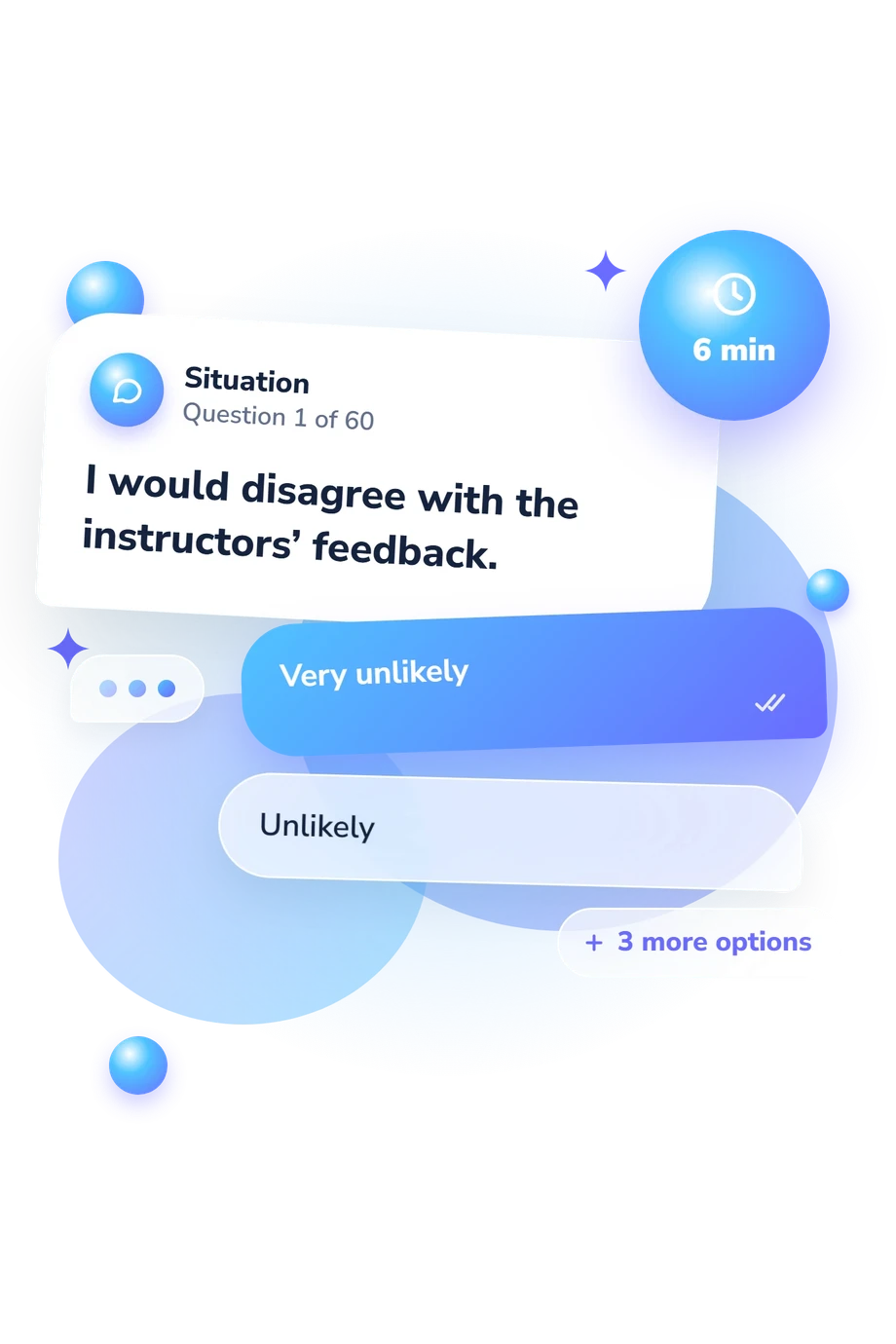
Example Questions From the Test
- Very unlikely
- Unlikely
- Possibly
- Likely
- Very likely
- Very unlikely
- Unlikely
- Possibly
- Likely
- Very likely
- Very unlikely
- Unlikely
- Possibly
- Likely
- Most likely
Academic Resilience Scale (ARS) Test - Description and methodology of the test
For students and learners deciding how to respond to academic pressure, the Academic Resilience Scale (ARS) Test provides a structured prompt for noticing patterns in reactions to setbacks, feedback, and uncertainty. This academic resilience assessment can help identify which coping responses, study adjustments, or sources of support deserve closer attention when planning next steps.
What This Assessment Explores
Questions place learners in situations involving critical feedback, disappointing grades, threatened plans, or negative thoughts. This academic resilience questionnaire examines persistence, help-seeking, strategy changes, and emotional coping. The profile presents three component dimensions plus an overall score for academic resilience, which integrates persistence, reflection, and emotional response:
- Emotional Response (7-35) measures anxiety, catastrophizing, and emotional coping: Lower emotional resilience (7-19), Moderate emotional resilience (20-31), Higher emotional resilience (32-35).
- Reflection (9-45) measures self-analysis, adaptive help-seeking, and learning changes: Low (9-27), Moderate (28-39), High (40-45).
- Perseverance (14-70) measures sustained effort, goal direction, and constructive feedback use: Low (14-47), Moderate (48-63), High (64-70).
- Academic Resilience (30-150) measures integrated coping across persistence, reflection, and emotional response: Lower resilience (30-99), Moderate resilience (100-129), Higher resilience (130-150).
Methodology and Scientific Basis
Each item presents an academic situation and asks how likely a response would be, using five ordered likelihood choices whose wording varies slightly by item. The options include labels such as Very unlikely, Unlikely, Possibly, Likely or Probably, and Very likely or Most likely. The situations cover feedback, emotional strain, disrupted goals, changes in study methods, self-encouragement, and support from instructors, family, or friends.
Scoring combines item responses into dimension scores and an overall score. The questionnaire displays the listed score bands for each component and overall score. As an academic resilience measure, it is most useful when the result is considered alongside recent experiences and specific study behaviors.
The closest published evidence is Academic Resilience Scale (ARS-30), a multidimensional measure developed and examined by Simon Cassidy. The present questionnaire is an online presentation of the ARS-30's three-factor structure; Cassidy's validation findings belong to the published instrument and do not automatically validate this version. Masten, Best, and Garmezy's resilience framework supports viewing resilience as positive adaptation during adversity rather than as a fixed personal trait.
Because responses are self-reported and can shift with mood, memory, perceived stakes, or candour, they are best read alongside actual performance and feedback.
- Cassidy, Simon. (2016). The Academic Resilience Scale (ARS-30): A New Multidimensional Construct Measure. Frontiers in Psychology, 7, Article 1787. 10.3389/fpsyg.2016.01787
- Masten, Ann S., Karin M. Best, and Norman Garmezy. (1990). Resilience and Development: Contributions from the Study of Children Who Overcome Adversity. Development and Psychopathology, 2(4), 425-444. 10.1017/S0954579400005812
Updated: