
Freudly+971 508685814hello@freudly.ai
Freudly
class climate

Level of Self-Governance Development in the Student Group Test
Take the online Level of Self-Governance Development in the Student Group Test - AI psychologist FreudlyYou can take Level of Self-Governance Development in the Student Group Testhere. Online version of a simple and accurate psychological test with interpretation.en
Understand how well students self-manage and work as a group in just 5 minutes. A quick 24-item check that pinpoints strengths and gaps to guide support and build a stronger classroom culture.
Start Online Test
Questions: 245 minutes
08:30
October 2, 2025
October 2, 2025
Material has been updated
October 2, 2025
Material has been published
13,386 views
1,086 completions
910 likes
Verified by Daniel Hall
Psychologist with 25 years of experience
Share
Scale Explorer

How the Scales are Structured

example score
1/1
Responsibility (R)
Responsibility measures how actively students take on and fulfill school-wide duties and how clearly they understand their role in the life of the educational institution.
Low
Moderate
High
00.55: Low | 0.560.85: Moderate | 0.861: High
A score of 1.00 indicates a high level of responsibility, with students consistently taking on school-wide duties and showing clear awareness of their role in the school community.
example score
0/1
Relationships (R)
This scale measures how positively and constructively the class interacts with other student communities in the school.
Limited connections
Developing cooperation
Strong constructive relationships
00.55: Limited connections | 0.550.85: Developing cooperation | 0.851: Strong constructive relationships
A score of 0 indicates very limited or absent constructive ties with other student communities, suggesting interaction is minimal or fragmented.
example score
1/1
Engagement (E)
Engagement measures how actively the class participates in school-wide activities and initiatives.
Low engagement
Moderate engagement
High engagement
00.54: Low engagement | 0.550.84: Moderate engagement | 0.851: High engagement
A score of 1.00 indicates the class is highly engaged and consistently participates in school-wide initiatives.
example score
1/1
School Self-Governance Level (SSGL)
Measures how strongly the class is engaged in school life, maintains constructive relationships, and shares responsibility for institutional activities.
Low
Medium
High
00.54: Low | 0.550.85: Medium | 0.861: High
A score of 1.00 indicates a high level of institutional self-governance, reflecting very strong engagement, relationships, and shared responsibility in overall school activities.
example score
0/1
Responsibility (R)
Measures how clearly students understand and reliably fulfill their roles and duties in support of the class’s shared goals.
Low
Moderate
High
00.5: Low | 0.50.8: Moderate | 0.81: High
A score of 0 indicates a low level of shared responsibility, with group members rarely recognizing or taking ownership of duties for the common class tasks.
example score
0/1
Organization (O)
Organization measures how well the class structures and coordinates shared activities with clear order and routines.
Low organization
Moderate organization
High organization
00.5: Low organization | 0.50.8: Moderate organization | 0.81: High organization
A score of 0 indicates very low organization, suggesting the group currently has minimal structure and weak coordination of joint activities without external guidance.
example score
0/1
Engagement (E)
Engagement measures how actively students participate in and contribute to their class’s self-governance activities and decisions.
Low engagement
Moderate engagement
High engagement
00.5: Low engagement | 0.50.8: Moderate engagement | 0.81: High engagement
A score of 0 indicates very low engagement, suggesting minimal student participation in collective self-governance initiatives and decision-making.
example score
1/1
Class Self-Governance Level (CSGL)
Measures how effectively a class self-organizes through engagement, organization, and shared responsibility without external prompting.
Low
Medium
High
00.5: Low | 0.50.8: Medium | 0.81: High
A score of 1.0 indicates a high level of class self-governance, suggesting strong engagement, organization, and responsibility within the group.
Start Online Test
just completed the test
DATA-BASED USER COHORTS

Who Usually Takes This Test?

Homeroom teachers
41%OF USERS
They use it to quickly see how well a class can plan, share responsibility, and make decisions without constant adult direction.
School psychologists
34%OF USERS
They administer it to assess group dynamics and identify where students need support in communication, leadership, and conflict resolution.
Student council coordinators
25%OF USERS
They take it to understand how ready students are for self-governance projects and what skills to develop for effective participation.
BASED ON AGGREGATED, ANONYMIZED DATA FROM TENS OF THOUSANDS OF FREUDLY USERS.
Benchmarking

See How You Compare

Once you complete the test, your results are compared with real-world data from people in your country.
Below is a preview of how scores are typically distributed across each scale.
Responsibility (R)
Responsibility (R)
Average
0.5
Normal range
0.30.6
min.
0
max.
1
This curve shows how scores are typically distributed.
Once you complete the test, your result will appear on the scale so you can see how you compare.
Relationships (R)
Relationships (R)
Average
0.5
Normal range
0.40.7
min.
0
max.
1
This curve shows how scores are typically distributed.
Once you complete the test, your result will appear on the scale so you can see how you compare.
Engagement (E)
Engagement (E)
Average
0.3
Normal range
0.20.5
min.
0
max.
1
This curve shows how scores are typically distributed.
Once you complete the test, your result will appear on the scale so you can see how you compare.
Level of Institutional Self-Governance (LoIS)
Average
0.7
Normal range
0.50.9
min.
0
max.
1
This curve shows how scores are typically distributed.
Once you complete the test, your result will appear on the scale so you can see how you compare.
Responsibility (R)
Responsibility (R)
Average
0.6
Normal range
0.40.7
min.
0
max.
1
This curve shows how scores are typically distributed.
Once you complete the test, your result will appear on the scale so you can see how you compare.
Organization (O)
Organization (O)
Average
0.6
Normal range
0.50.7
min.
0
max.
1
This curve shows how scores are typically distributed.
Once you complete the test, your result will appear on the scale so you can see how you compare.
Engagement (E)
Engagement (E)
Average
0.3
Normal range
0.10.5
min.
0
max.
1
This curve shows how scores are typically distributed.
Once you complete the test, your result will appear on the scale so you can see how you compare.
Class self-governance level (Csl)
Average
0.6
Normal range
0.50.8
min.
0
max.
1
This curve shows how scores are typically distributed.
Once you complete the test, your result will appear on the scale so you can see how you compare.
Featured On
SAMPLE QUESTIONS

Example Questions From the Test

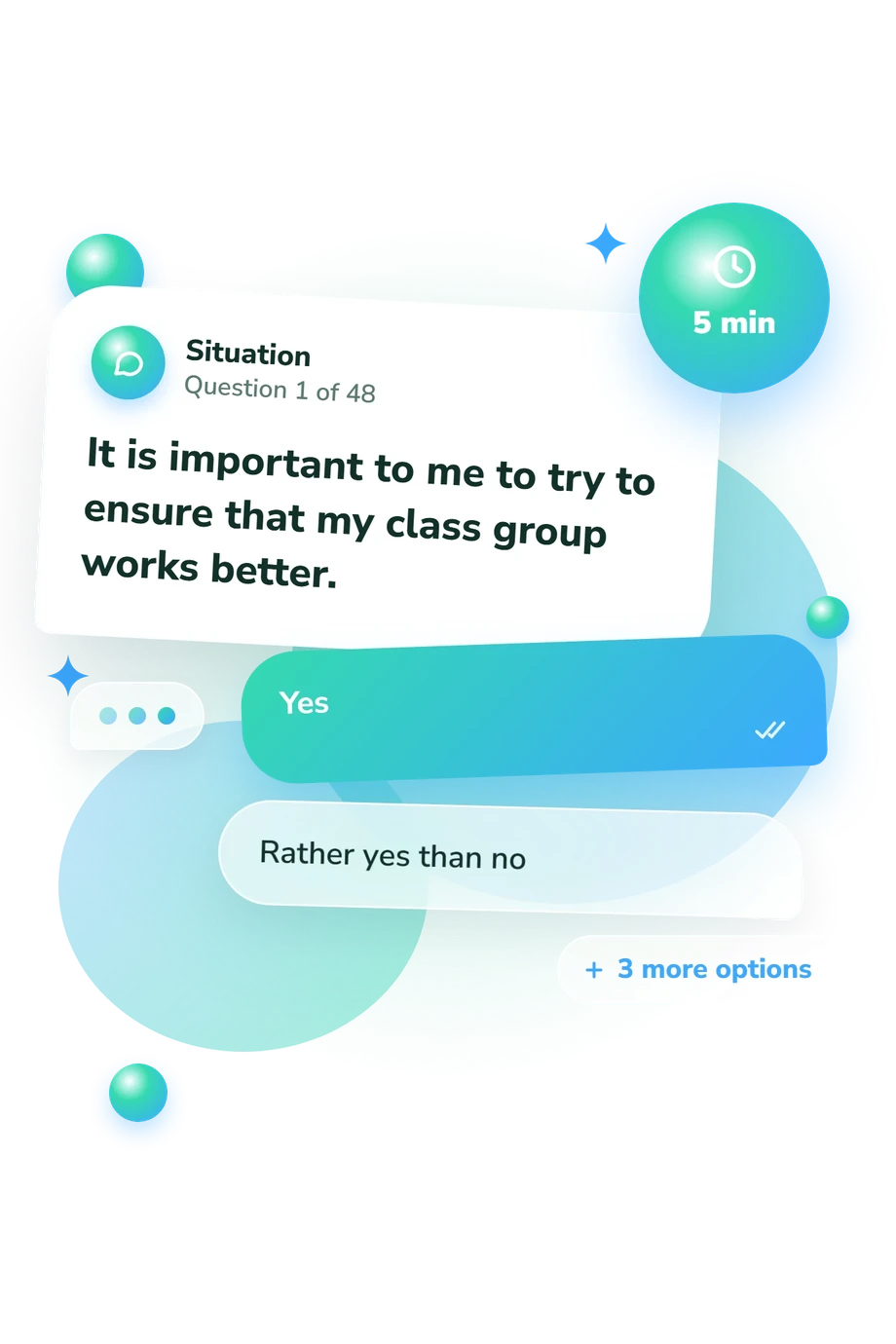
    • Yes
    • Rather yes than no
    • Hard to say
    • Rather no than yes
    • No
    • Yes
    • Rather yes than no
    • Hard to say
    • Rather no than yes
    • No
    • Yes
    • More yes than no
    • Hard to say
    • More no than yes
    • No
WHAT THE TEST MEASURES
About This Assessment
The level of self-governance development in the student community Test

Level of Self-Governance Development in the Student Group Test - Symptoms and Signs

class climate

This measure is used to evaluate how effectively students regulate their own behavior and coordinate as a group. The Level of Self-Governance Development in the Student Group provides a brief snapshot of perceived self-management and collective organization within a classroom or student group.

It consists of 24 items and typically requires about 5 minutes to complete. Responses can help identify relative strengths and areas for support in group planning, shared responsibility, decision-making, and conflict management in educational settings.

The Level of Self-Governance Development in the Student Group is described as authored by Albert Bandura; however, interpretation should be guided by the instrument’s specific scoring instructions and the local context in which it is administered.

Author: Albert Bandura
Literature: Zimmerman, B. J. Attaining self-regulation: a social cognitive perspective. In Boekaerts, M., Pintrich, P. R., & Zeidner, M. (Eds.), Handbook of self-regulation. Academic Press. 2000.
Popular tests
Comments
Leave a Comment