
Fear of Missing Out Scale (FoMOs) Test
How the Scales are Structured
Who Usually Takes This Test?
See How You Compare
Below is a preview of how scores are typically distributed across each scale.
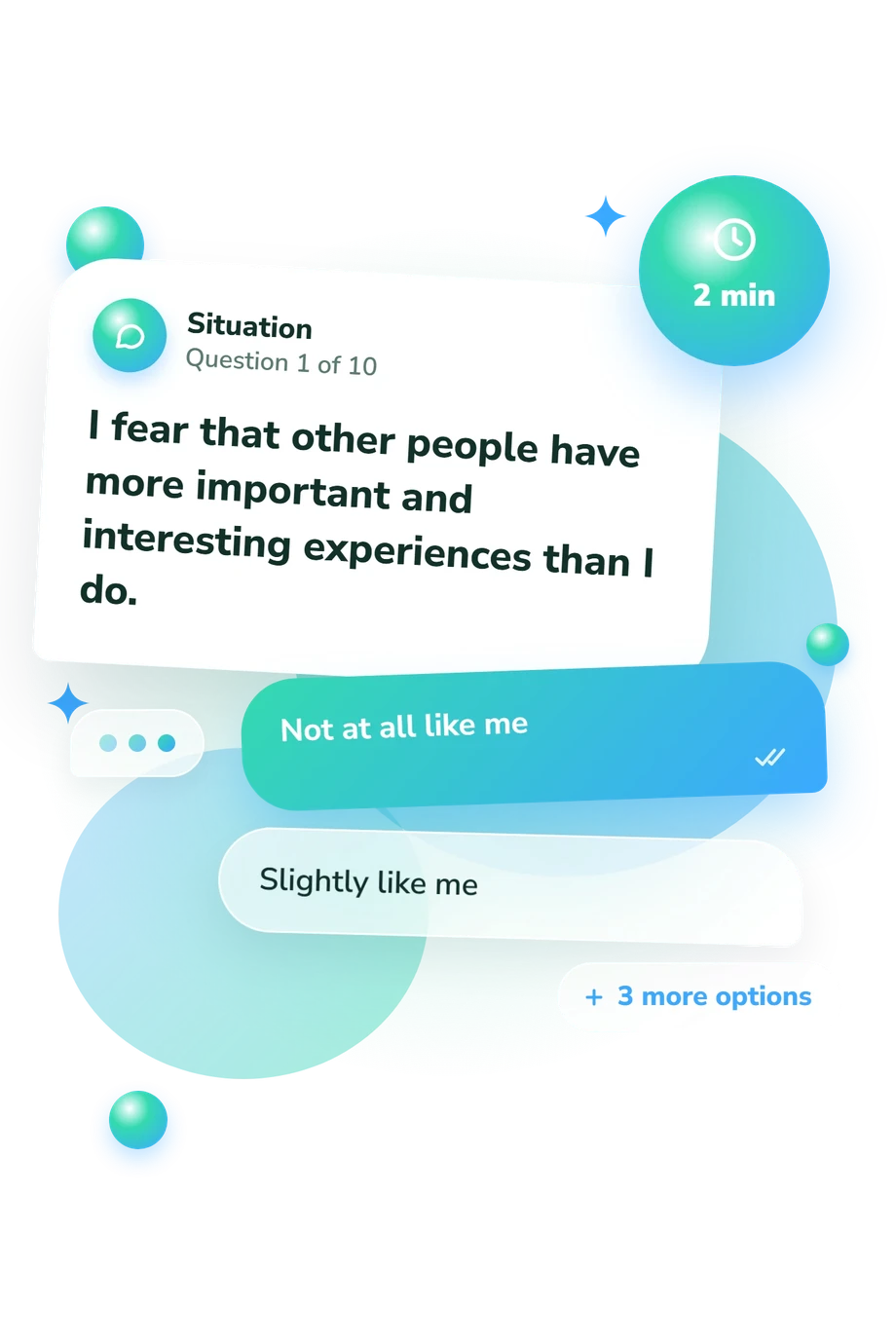
Example Questions From the Test
- Not at all like me
- Slightly like me
- Somewhat like me
- Very much like me
- Exactly like me
- Not at all like me
- Slightly like me
- More or less like me
- Very much like me
- Exactly like me
- Not at all like me
- A little like me
- Somewhat like me
- Quite a lot like me
- Exactly like me
Fear of Missing Out Scale (FoMOs) Test - Description and methodology of the test
For readers who want to understand how social comparison and online updates relate to their sense of connection, this fear of missing out questionnaire focuses on monitoring friends’ plans, online updates, and missed social opportunities. The Fear of Missing Out Scale (FoMOs) Test can help you examine the emotional pull of being included, informed, and available without reducing the result to a judgment about how much you use technology.
What This Test Measures
This FoMO assessment reads anxiety about potentially missing important social events, information, or updates, especially in social-media contexts. The items reflect social comparison, exclusion, and monitoring: believing others have better experiences, feeling uneasy when friends meet without you, wanting access to shared jokes, and tracking plans or updates. Sharing good moments online and following friends while away also appear, making the result relevant to people reflecting on social connection and mood.
The main themes are:
- Social comparison shows whether others’ experiences seem more important or rewarding.
- Inclusion anxiety indicates how strongly being left out troubles you.
- Connection monitoring reflects the urge to follow plans, references, and online updates.
One displayed scale, Fear of Missing Out, runs from 1-5: Low FoMO 1-1.14, Moderate FoMO 1.15-2.64, High FoMO 2.65-5. The result describes this tendency, not a fixed personality label.
Methodology and Evidence Base
Each item uses a five-point self-report response, from low to strong resemblance or truth. Choose the option that best matches your experience, not the answer that seems socially desirable. The questionnaire reports one displayed FoMO score, but its online presentation documents neither a scoring formula nor how responses are combined; the 1-5 range alone does not establish a sum or average, and no separate subscale breakdown is provided.
The questionnaire is an online presentation of the ten-item FoMOs content examined by Przybylski et al. (2013), a measure linking FoMO with psychological needs, mood, life satisfaction, and online engagement. Debb, Haschke, and McClellan (2022) examined the scale with African American adults, so that evidence concerns a specific population rather than every online version. These studies do not validate this online format or its displayed scoring, nor establish population norms or standardization for this version.
The online FoMO score can highlight a current tendency, but it is sensitive to context, self-awareness, and response style. The displayed bands are descriptive categories, not diagnostic thresholds. Read the result alongside circumstances, offline relationships, and online behavior.
- Andrew K. Przybylski, Kou Murayama, Cody R. DeHaan, and Valerie Gladwell. Motivational, emotional, and behavioral correlates of fear of missing out. Computers in Human Behavior, 29(4), 1841-1848, 2013. 10.1016/j.chb.2013.02.014
- Scott M. Debb, Katelyn J. Haschke, and Marnee K. McClellan. Validation of the Fear of Missing Out Scale for Use with African Americans in the United States. Cyberpsychology, Behavior, and Social Networking, 25(7), 439-449, 2022. 10.1089/cyber.2021.0151
Updated: