
Freudly+971 508685814hello@freudly.ai
Freudly
irrational thinking

Revised Paranormal Belief Scale (RPBS) Test
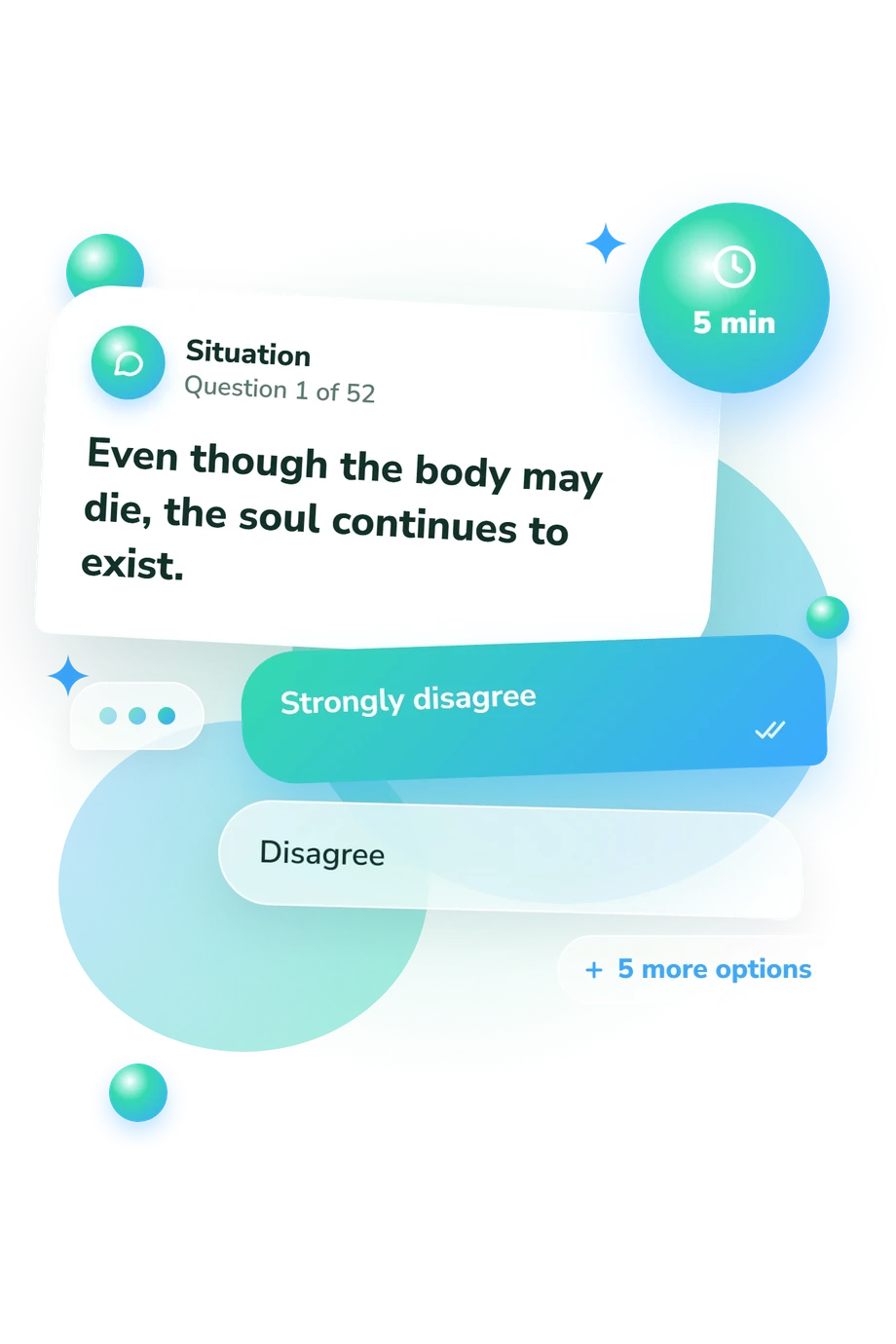
Take the online Revised Paranormal Belief Scale (RPBS) Test - AI psychologist FreudlyYou can take Revised Paranormal Belief Scale (RPBS) Test here. Online version of a simple and accurate psychological test with interpretation.en
Understand how strongly someone believes in paranormal claims in about 5 minutes. A 26 item, research-ready scale built to psychometric standards for reliable results and cross-cultural comparison.
Start Online Test
Questions: 265 minutes
08:30
October 2, 2025
October 2, 2025
Material has been updated
October 2, 2025
Material has been published
17,668 views
2,031 completion
1,656 likes
Verified by Daniel Hall
Psychologist with 25 years of experience
Share
Scale Explorer

How the Scales are Structured

example score
17/28
Precognition (P)
Measures the extent to which a person believes they can predict future events through methods like astrology or divination.
Low belief
Moderate belief
High belief
412: Low belief | 1320: Moderate belief | 2128: High belief
A score of 17 falls in the Moderate belief range, suggesting a noticeable but not strong endorsement of predicting the future through such methods.
example score
10/21
Extraordinary Life Forms (ELF)
Measures the degree of belief in the existence of extraordinary life forms such as aliens, Bigfoot, and similar phenomena.
Low belief
Moderate belief
High belief
38: Low belief | 915: Moderate belief | 1621: High belief
A score of 10 falls in the Moderate belief range, suggesting some openness to extraordinary life forms without strong endorsement.
example score
6/28
Spiritualism (S)
Measures belief in communicating with the spirits of the deceased and in the existence of an afterlife.
Low
Moderate
High
411: Low | 1220: Moderate | 2128: High
A score of 6 falls in the Low range, suggesting relatively low endorsement of spiritualism-related beliefs compared with the rest of the scale.
example score
12/21
Superstition (S)
Measures the tendency to endorse everyday superstitions such as omens, signs, and lucky or unlucky rituals.
Low
Moderate
High
39: Low | 1015: Moderate | 1621: High
A score of 12 falls in the Moderate range, suggesting a noticeable but not strong inclination toward believing in common superstitions.
example score
12/28
Witchcraft (W)
Measures the degree of belief in witchcraft, including spells, magical practices, and supernatural influence over events.
Low belief
Moderate belief
High belief
411: Low belief | 1219: Moderate belief | 2028: High belief
A score of 12 falls in the Moderate belief range, suggesting some openness to the idea of witchcraft and magical influence without strongly endorsing it.
example score
13/28
Psi Abilities (PA)
Measures the degree to which a person endorses the existence of extrasensory and telepathic abilities (e.g., mind reading or predicting the future).
Low belief
Moderate belief
High belief
412: Low belief | 1320: Moderate belief | 2128: High belief
A score of 13 falls in the Moderate belief range, suggesting some endorsement of psi abilities without strong conviction.
example score
26/28
Traditional Religious Belief (TRB)
Measures the strength of adherence to traditional religious beliefs and elements of organized religion (e.g., belief in God, angels).
Low
Moderate
High
412: Low | 1320: Moderate | 2128: High
A score of 26 falls in the High range, suggesting a strong endorsement of traditional religious faith statements on this scale.
example score
134/182
Paranormal Belief (PB)
Measures a person's overall tendency to endorse beliefs in paranormal and supernatural phenomena across multiple domains.
Low
Moderate
High
2678: Low | 79130: Moderate | 131182: High
A score of 134 falls in the High range, indicating a stronger-than-average endorsement of paranormal beliefs on this scale.
Start Online Test
just completed the test
DATA-BASED USER COHORTS

Who Usually Takes This Test?

Curious paranormal explorers
41%OF USERS
People who enjoy ghost stories, ESP, astrology, or other mysterious topics and want to see how strongly they actually believe.
Psychology students and researchers
34%OF USERS
Students and academics who need a quick, reliable measure of paranormal belief for surveys, experiments, and cross-cultural comparisons.
Skeptics checking themselves
25%OF USERS
People who identify as rational or doubtful but take the test to spot any hidden superstitions or inconsistent beliefs.
BASED ON AGGREGATED, ANONYMIZED DATA FROM TENS OF THOUSANDS OF FREUDLY USERS.
Benchmarking

See How You Compare

Once you complete the test, your results are compared with real-world data from people in your country.
Below is a preview of how scores are typically distributed across each scale.
Predictions (P)
Predictions (P)
Average
17.2
Normal range
14.320.2
min.
4
max.
28
This curve shows how scores are typically distributed.
Once you complete the test, your result will appear on the scale so you can see how you compare.
Extraordinary Forms of Life (EFoL)
Average
14.1
Normal range
11.816.4
min.
3
max.
21
This curve shows how scores are typically distributed.
Once you complete the test, your result will appear on the scale so you can see how you compare.
Spiritualism (S)
Spiritualism (S)
Average
15.7
Normal range
1219.3
min.
4
max.
28
This curve shows how scores are typically distributed.
Once you complete the test, your result will appear on the scale so you can see how you compare.
Superstitions (S)
Superstitions (S)
Average
14.2
Normal range
11.816.6
min.
3
max.
21
This curve shows how scores are typically distributed.
Once you complete the test, your result will appear on the scale so you can see how you compare.
Witchcraft (W)
Witchcraft (W)
Average
18.9
Normal range
15.422.4
min.
4
max.
28
This curve shows how scores are typically distributed.
Once you complete the test, your result will appear on the scale so you can see how you compare.
Psi Abilities (PA)
Psi Abilities (PA)
Average
15.3
Normal range
12.318.2
min.
4
max.
28
This curve shows how scores are typically distributed.
Once you complete the test, your result will appear on the scale so you can see how you compare.
Traditional Religious Faith (TRF)
Average
21.7
Normal range
18.724.7
min.
4
max.
28
This curve shows how scores are typically distributed.
Once you complete the test, your result will appear on the scale so you can see how you compare.
Belief in the Paranormal Scale (BitPS)
Average
106.6
Normal range
82.9130.2
min.
26
max.
182
This curve shows how scores are typically distributed.
Once you complete the test, your result will appear on the scale so you can see how you compare.
Featured On
SAMPLE QUESTIONS

Example Questions From the Test

    • Strongly disagree
    • Disagree
    • Somewhat disagree
    • Don't know / not sure
    • Somewhat agree
    • Agree
    • Strongly agree
    • Strongly disagree
    • Disagree
    • Somewhat disagree
    • Don't know / not sure
    • Somewhat agree
    • Agree
    • Strongly agree
    • Strongly disagree
    • Disagree
    • Somewhat disagree
    • Don't know / not sure
    • Somewhat agree
    • Agree
    • Strongly agree
WHAT THE TEST MEASURES
About This Assessment
Paranormal Belief Scale, RPBS Test

Revised Paranormal Belief Scale (RPBS) Test - Symptoms and Signs

irrational thinking
superstition

This self-report measure assesses the extent to which an individual endorses beliefs in paranormal and related phenomena. The Revised Paranormal Belief Scale (RPBS) was developed by Jerome E. Tobacyk and is commonly used in research contexts to quantify paranormal belief as a psychological construct.

The instrument contains 26 items and typically requires about 5 minutes to complete. Items are presented as statements reflecting different domains of paranormal belief, allowing for estimation of overall endorsement patterns that may be examined within or across cultural groups. The Revised Paranormal Belief Scale (RPBS) is intended for non-diagnostic use and should be interpreted in conjunction with study aims, sampling considerations, and standard psychometric practice.

Author: Jerome E. Tobacyk
Literature: Tobacyk, J. J. A revised paranormal belief scale. International Journal of Transpersonal Studies. 2004.
Popular tests
Comments
Leave a Comment