
Differential Emotions Scale (DES) Test
How the Scales are Structured
Who Usually Takes This Test?
See How You Compare
Below is a preview of how scores are typically distributed across each scale.
Example Questions From the Test
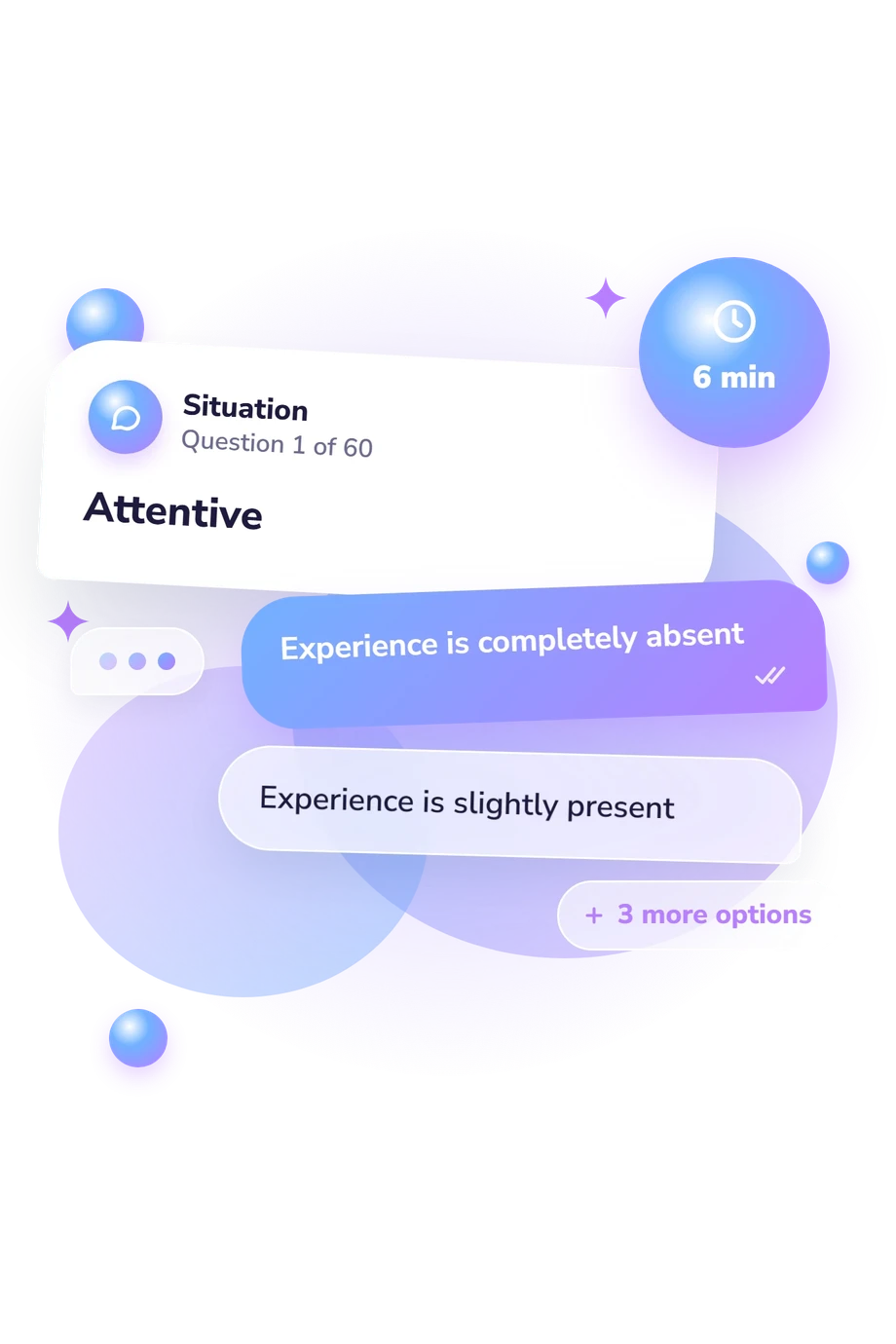
- Experience is completely absent
- Experience is slightly present
- Experience is moderately present
- Experience is strongly present
- Experience is present to the greatest extent
- Experience is completely absent
- Experience is present to a slight degree
- Experience is present to a moderate degree
- Experience is present to a strong degree
- Experience is present to the maximum degree
- Experience is completely absent
- Experience is present slightly
- Experience is present moderately
- Experience is present strongly
- Experience is present to the maximum degree
Differential Emotions Scale (DES) Test - Description and methodology of the test
For readers interested in how situational appraisal can involve differentiated emotional experience, the Differential Emotions Scale (DES) Test offers a focused way to examine it. It is intended for people who want to consider how positive, negative, and discrete emotions may shape their interpretation of a situation. This emotional self-assessment can make a complex experience easier to reflect on without reducing it to one mood label.
What the Questionnaire Measures
This discrete emotions test examines current emotional appraisal:
- Anxious Depressive Emotions Index (9-45; Low 9-20, Moderate 21-30, High 31-45) measures stable anxious-depressive experience; Negative Emotions (NEM) (12-60; Low 12-24, Moderate 25-32, High 33-60) measures acute negativity; Positive Emotions Index (9-45; Low 9-19, Moderate 20-28, High 29-45) measures positive affect.
- Guilt (X) and Shame (IX) (each 3-15; Low 3-7, Moderate 8-11, High 12-15) separate responsibility for wrongdoing from distress over standards.
- Fear (VIII), Contempt (VII), Disgust (VI), Anger, Grief (IV), Surprise (III), and Interest (I) (each 3-15; Low 3-7, Moderate 8-11, High 12-15) cover threat, interpersonal conflict, principles, blocked needs, loss, novelty, learning; Joy (3-15; Low joy 3-7, Moderate joy 8-11, High joy 12-15) reflects fulfilment.
Methodology and Scientific Basis
Each item presents a short emotional descriptor-such as happy, surprised, sad, angry, fearful, shame, or guilty-and asks how strongly the experience is present. Five response points move from complete absence to the greatest or maximum degree, with minor wording variation. It is a DES self-report test using intensity ratings.
The result displays separate scores for the named emotional dimensions and broader indices rather than one global total; displayed ranges organize the result for each named scale.
This questionnaire is conceptually consistent with the Differential Emotions Scale and Izard’s theoretical account of discrete emotions, but it is not documented as an adaptation of the published instrument. Published research on Izard’s scale examined reliability and validity, while DES-III is a separate revision focused on higher-order factors. Those findings do not establish standardized norms for this online version.
Interpretation should stay contextual. Current circumstances, memory, self-awareness, and the wish to present oneself favorably can influence self-report. The bands describe reported emotional intensity within this questionnaire, not clinical thresholds or a diagnosis.
- Izard, C. E., Dougherty, F. E., Bloxom, B. M., & Kotsch, W. E. (1974). The Differential Emotions Scale: A method of measuring the subjective experience of discrete emotions. Unpublished manuscript, Department of Psychology, Vanderbilt University, Nashville, Tennessee.
- Boyle, G. J. (1984). Reliability and validity of Izard's differential emotions scale. Personality and Individual Differences, 5(6), 747-750. 10.1016/0191-8869(84)90124-7
- Boyle, G. J. (1986). Higher-order factors in the differential emotions scale (DES-III). Personality and Individual Differences, 7(3), 305-310. 10.1016/0191-8869(86)90005-X
- Izard, C. E. (1977). Human emotions. Plenum Press. 10.1007/978-1-4899-2209-0
Updated: