
Altruistic Investment Scale Test
How the Scales are Structured
Who Usually Takes This Test?
See How You Compare
Below is a preview of how scores are typically distributed across each scale.
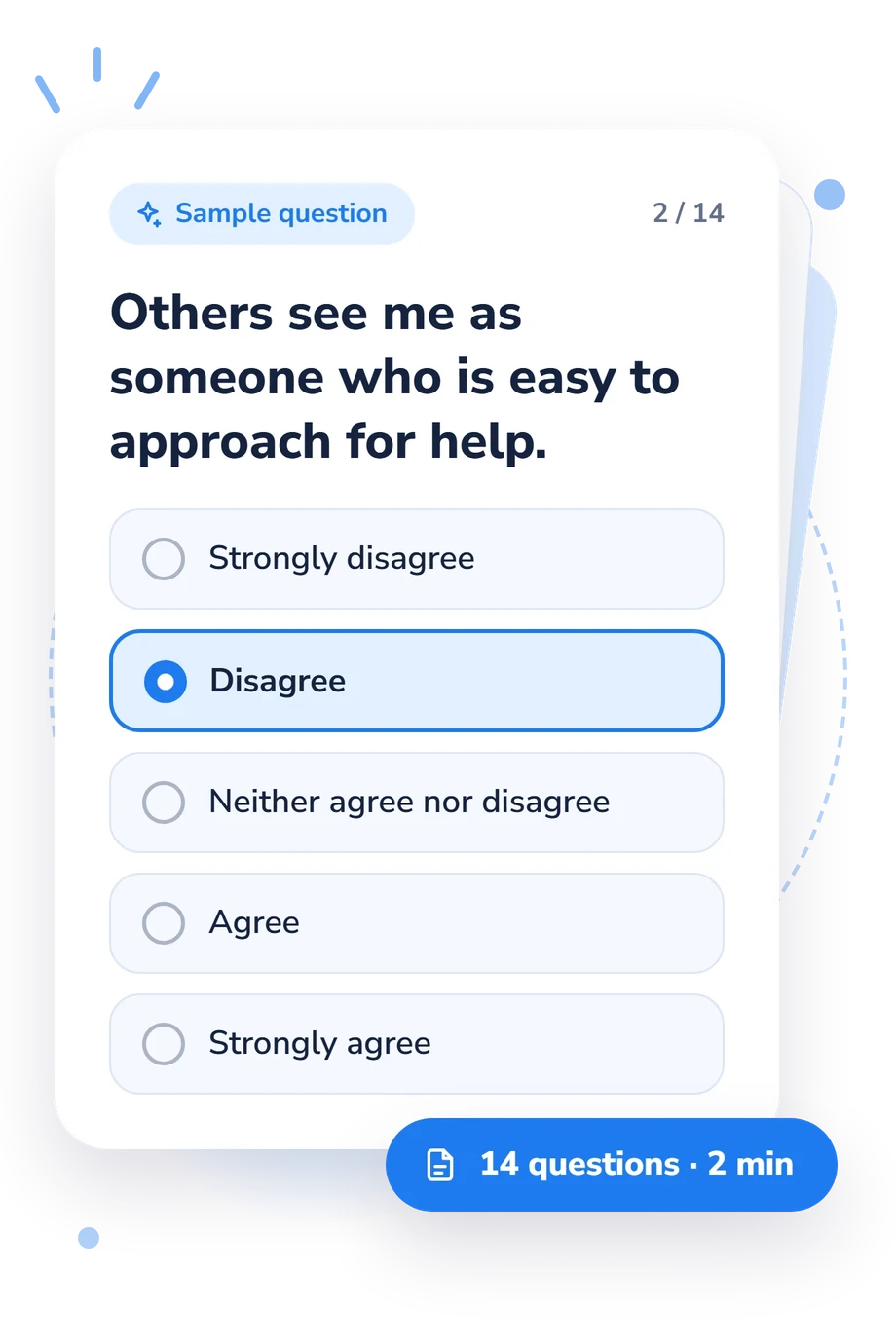
Example Questions From the Test
- Strongly disagree
- Disagree
- Neither agree nor disagree
- Agree
- Strongly agree
- Strongly disagree
- Disagree
- Neither agree nor disagree
- Agree
- Strongly agree
- Strongly disagree
- Disagree
- Neither agree nor disagree
- Agree
- Strongly agree
Altruistic Investment Scale Test - Description and methodology of the test
People who want to examine how they contribute to supportive social relationships may find this assessment useful. The Altruistic Investment Scale Test focuses on a pattern in which concern for others is expressed through approachability, fairness, and constructive participation in shared social life. The questionnaire asks how prosocial motives are expressed through relationship-building, making this altruistic investment test useful for reflecting on how people can improve social conditions.
What This Assessment Explores
The assessment examines whether concern for others appears in everyday social behavior. Statements address approachability, finding friendship in others, improving situations, responding to unfairness, caring about well-being, building helpful relationships, and accepting a reputation for kindness.
Together, these items portray altruistic investment as more than a single act of generosity: they express concern for others while the scale reads a broader tendency to invest in social relationships as a strategy for improving social interaction and producing indirect benefits.
For a respondent, the resulting altruistic investment score supports reflection on social capital, mutual support, constructive connection, and ways relationship-building can improve conditions for interaction.
The following result scale shows how strongly this tendency is endorsed:
- Altruistic Investment: 7-35 measures the tendency overall. Low altruistic investment covers 7-16, Moderate altruistic investment 17-25, and High altruistic investment 26-35; higher bands indicate stronger endorsement.
Methodology and Scientific Basis
Methodologically, this altruistic investment assessment is a self-report questionnaire with statements rated from Strongly disagree to Strongly agree on a five-point scale. The format captures degree of endorsement rather than assigning a fixed personality type; the displayed interpretation treats higher scores as stronger endorsement of the construct.
The framework is conceptually consistent with the Altruistic Investment Scale (Mararitsa et al., 2019), which connects prosocial orientation with building social capital through relationships. A related 2018 study from the same group examines how individual contributions support constructive interaction. These sources support the construct and evidence base, but this online questionnaire should not be presented as the published instrument or as a validated adaptation.
Results can be influenced by current relationships, moral ideals, social desirability, and self-awareness. A respondent may answer according to how they wish to be seen, the relationships they have in mind, or their present understanding of their own motives. Compare the profile with concrete examples of how you offer help, respond to unfairness, and build relationships.
- Mararitsa, Larisa V., Tatiana V. Kazantseva, Ludmila G. Pochebut, and Anatoliy L. Sventsitskiy. “Altruistic investment as a personal networking strategy: The development of scale and testing its constructive validity.” Social Psychology and Society, 2019, 10(3), 157-176. 10.17759/sps.2019100310
- Mararitsa, Larisa V., Tatiana V. Kazantseva, Ludmila G. Pochebut, and Anatoliy L. Sventsitskiy. “The contribution of the individual to the group’s social capital: The structure of altruistic investment.” Social Psychology and Society, 2018, 9(1), 43-66. 10.17759/sps.2018090104
Updated: