
GRIT Scale Test
How the Scales are Structured
Who Usually Takes This Test?
See How You Compare
Below is a preview of how scores are typically distributed across each scale.
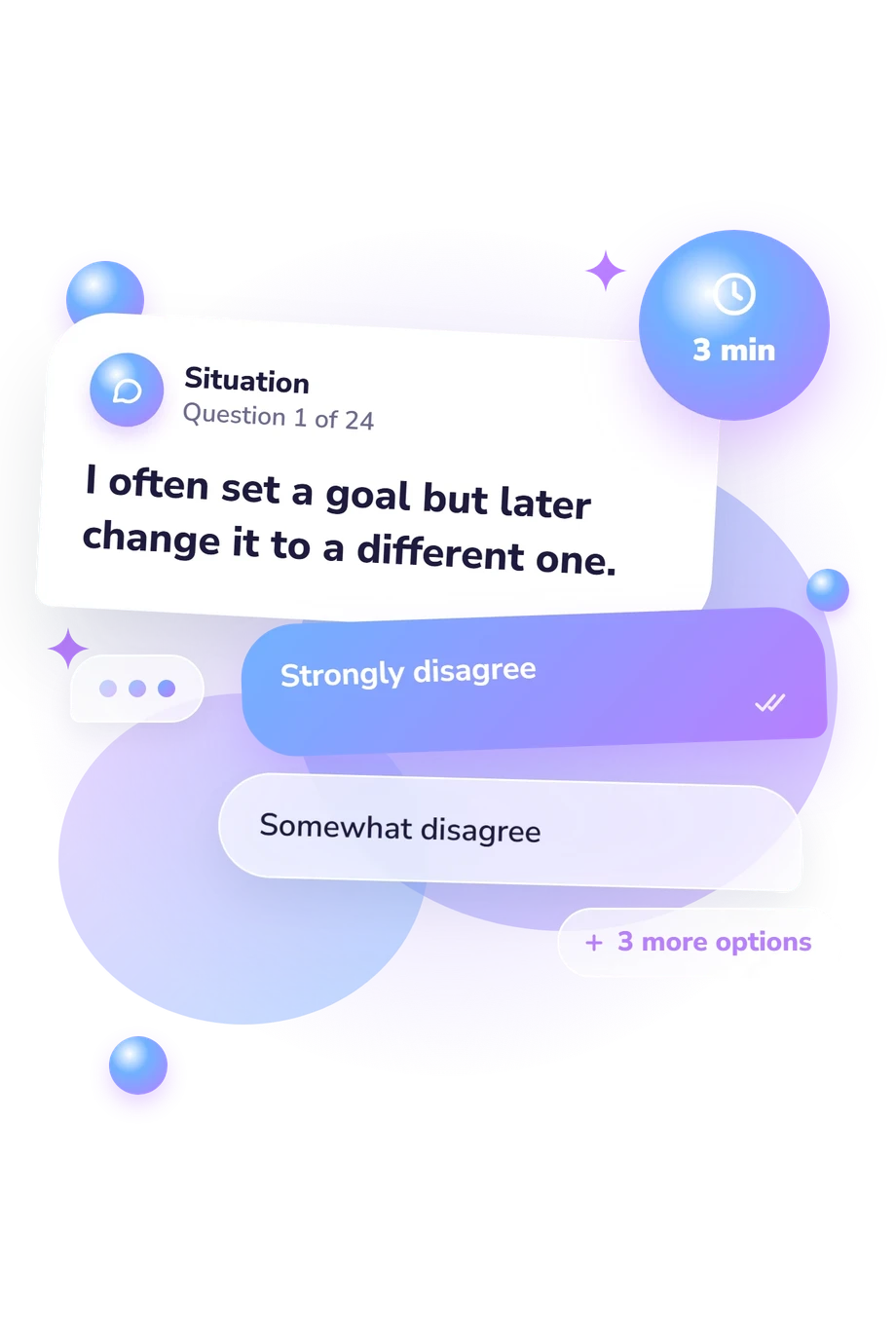
Example Questions From the Test
- Strongly disagree
- Somewhat disagree
- Neither agree nor disagree
- Somewhat agree
- Strongly agree
- Strongly disagree
- Somewhat disagree
- Neither agree nor disagree
- Somewhat agree
- Strongly agree
- Strongly disagree
- Mostly disagree
- Neither agree nor disagree
- Mostly agree
- Strongly agree
GRIT Scale Test - Description and methodology of the test
People who want to examine their approach to demanding goals may use the GRIT Scale Test as a concise self-report profile. It can help them compare the three parts of the result and reflect on which aspects of their self-described approach appear more or less prominent. Used as a grit scale, it gives a structured way to interpret the profile as a whole.
What This Assessment Explores
Long-term goal pursuit is central. The questions address continuing after failure, finishing tasks, working hard, and responding when progress slows. They also examine whether new projects or interests displace earlier commitments. For a reader considering a grit questionnaire, the key distinction is between sustained effort and stable interests: a person may work intensely yet change direction often, or remain focused while setbacks feel discouraging.
The result is organized around three dimensions:
- Perseverance of Effort (1-5) measures sustained work despite obstacles: Low persistence (1-2.3), Moderate persistence (2.4-3.6), High persistence (3.7-5).
- Consistency of Interests (1-5) measures stable goals over time: Low stability (1-2.4), Moderate stability (2.5-3.9), High stability (4-5).
- Grit (1-5) measures sustained effort and passion: Lower grit (1-2.4), Moderate grit (2.5-3.7), Higher grit (3.8-5).
Methodology and Evidence Base
Each statement uses a five-point agreement response, from Strongly disagree to Strongly agree, with wording such as somewhat, mostly, or neither. Items address persistence, goal switching, discouragement, completion, and projects lasting many months. Because statements describe both strengths and obstacles, scoring must account for item direction; a higher response is not automatically a stronger result on every statement.
The closest published reference is Grit-O (Duckworth et al., 2007), which distinguishes sustained effort from consistency of interests. The later short form (Grit-S) offers a related brief measurement approach. This online form is separate from those published instruments; their validation evidence and population norms should not automatically be transferred to this version unless that transfer is documented.
The displayed bands are easiest to use as categories, not as universal or clinical cutoffs. Self-report scores can vary with current demands, mood, recall, and self-presentation. Interpreting the profile alongside repeated real-world behavior gives a more grounded picture of how persistence and changing interests operate over time.
This grit assessment is scored from the displayed bands.
- Duckworth, A. L., Peterson, C., Matthews, M. D., & Kelly, D. R. (2007). Grit: Perseverance and passion for long-term goals. Journal of Personality and Social Psychology, 92(6), 1087-1101. 10.1037/0022-3514.92.6.1087
- Duckworth, A. L., & Quinn, P. D. (2009). Development and validation of the Short Grit Scale (Grit-S). Journal of Personality Assessment, 91(2), 166-174. 10.1080/00223890802634290
Updated: