
Anxiety Scale Test
How the Scales are Structured
Who Usually Takes This Test?
See How You Compare
Below is a preview of how scores are typically distributed across each scale.
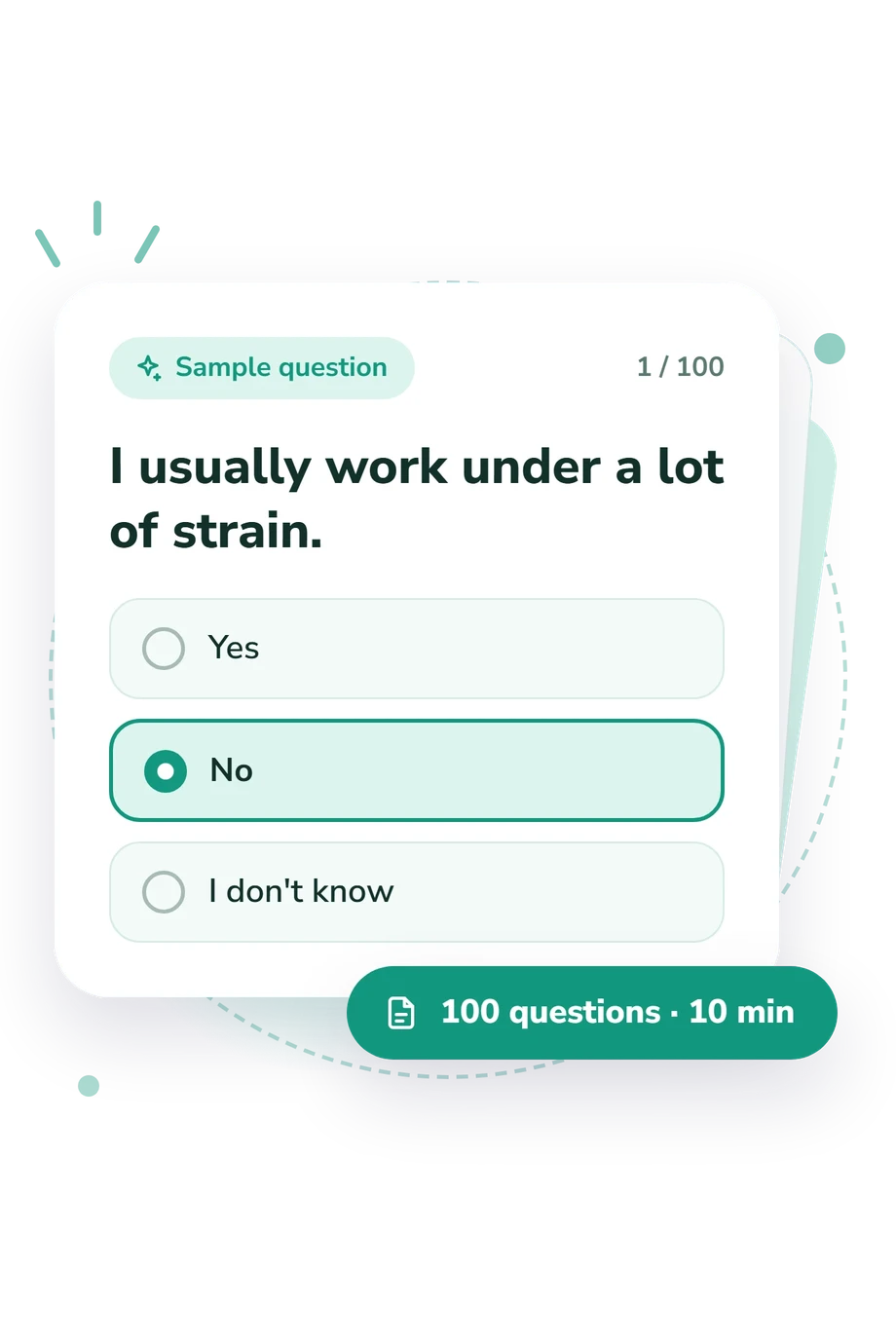
Example Questions From the Test
- Yes
- No
- I don't know
- Yes
- No
- I don't know
- Yes
- No
- I don’t know
Anxiety Scale Test - Description and methodology of the test
For anyone seeking a clearer view of persistent tension, the Anxiety Scale Test offers a structured way to consider how worry, fear, bodily arousal, sleep disruption, and self-confidence appear in everyday experience. It suits respondents who want an anxiety assessment for personal reflection, especially when they are unsure whether their unease is occasional or more pervasive.
What This Assessment Explores
Representative statements touch on three descriptive themes rather than separate result dimensions:
- Worry and anticipation show how strongly health concerns, possible failures, waiting, and future difficulties occupy attention.
- Emotional and bodily arousal covers fear, embarrassment, confusion, tearfulness, sweating, palpitations, sleep disruption, and other tension signals.
- Inner steadiness reflects confidence, courage, calmness, happiness, and recovery after unpleasant events.
Together, these themes contribute to one displayed measure, not separate scores.
On this anxiety questionnaire, respondents compare its statements with their usual experience. Each statement offers Yes, No, or I don’t know, allowing direct self-report without forcing an uncertain judgment.
The single displayed measure is Anxiety and Worry Scale (0-10). It assesses anxiety and worry severity: Low 0-3 indicates calmness, Moderate 4-7 a moderate level, and High 8-10 pronounced worry.
Methodology and Evidence Base
The format is a brief self-report questionnaire rather than an interview or performance task. Statements address anxiety-related experiences alongside composure and confidence. Responses produce the displayed result, but individual response weights are not specified, so the displayed result should be used rather than manually calculated from the answer choices.
Conceptually, the content is consistent with the Taylor Manifest Anxiety Scale, the closest named comparison for manifest anxiety. Work by O’Connor, Lorr, and Stafford helps situate related content. This questionnaire is not presented as a direct adaptation of, or as validated by, either published work.
The result should be read as this questionnaire’s worry assessment of the single anxiety-and-worry tendency represented by the answers. The displayed categories are the questionnaire’s interpretive categories. Self-awareness, honesty, and current circumstances can affect responses, so the result is not a diagnosis and is best considered alongside broader assessment when concerns persist.
- Taylor, J. A. (1953). A personality scale of manifest anxiety. The Journal of Abnormal and Social Psychology, 48(2), 285-290. 10.1037/h0056264
- O'Connor, James P., Lorr, Maurice, and Stafford, John W. (1956). Some patterns of manifest anxiety. Journal of Clinical Psychology, 12(2), 160-163. 10.1002/1097-4679(195604)12:2<160::AID-JCLP2270120212>3.0.CO;2-K
- Spielberger, Charles D. (1958). On the relationship between manifest anxiety and intelligence. Journal of Consulting Psychology, 22(3), 220-224. 10.1037/h0044773
Updated: