
Attitude Toward the Upcoming Competition Scale Test
How the Scales are Structured
Who Usually Takes This Test?
See How You Compare
Below is a preview of how scores are typically distributed across each scale.
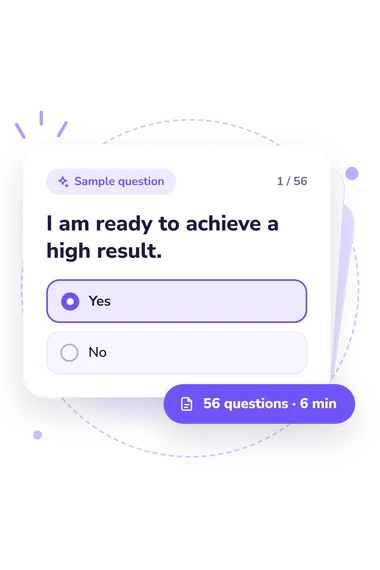
Example Questions From the Test
- Yes
- No
- Yes
- No
- Yes
- No
Attitude Toward the Upcoming Competition Scale Test - Description and methodology of the test
Athletes preparing for an important event can use the Attitude Toward the Upcoming Competition Scale Test to examine how they currently view the demands around competing. This competition readiness profile organizes reflection on the event’s significance, perceived evaluation, opponent comparison, and confidence. It helps an athlete identify aspects of the current competitive outlook that deserve attention before stepping into competition.
What This Assessment Explores
Statements cover motivation, physical and technical preparation, coach and teammate reactions, fear of disappointment, opponent familiarity, and ability beliefs. These situations form an assessment of competition readiness across four dimensions, not separate constructs.
The dimensions are:
- Reflected Self-Esteem (0-7) measures perceived evaluation of ability: higher scores mean lower self-esteem; 0-2 High mirror self-esteem; 3-4 Moderate mirror self-esteem; 5-7 Low mirror self-esteem.
- Competition Importance (0-7) measures desire and perceived importance: higher scores mean stronger desire to compete; 0-2 Low importance; 3-5 Moderate importance; 6-7 High importance.
- Perception of Opponents (0-7) compares athlete’s abilities with competitors’ capabilities: higher scores mean higher appraisal of opponents’ readiness; 0-2 Underestimates opponents; 3-4 Balanced view; 5-7 Highly rates opponents.
- Self-Confidence (0-7) reflects self-evaluation of success: higher scores indicate lower confidence, self-esteem, and desire to compete; 0-2 High readiness; 3-5 Moderate readiness; 6-7 Low readiness.
Methodology and Scientific Basis
Each first-person statement is answered Yes or No and refers to preparation, coach or teammate reactions, fear of failure, opponent familiarity, or desire to perform. Results are shown separately for the four dimensions; the answer-to-score mapping is unspecified, so no point value for Yes or No can be inferred from the displayed ranges. The format is a structured self-report method, and no norm-referenced scoring system is specified.
As a pre-competition questionnaire, the online version is conceptually consistent with Hanin’s published Attitude Toward Upcoming Competition Scale, but it is not an equivalent standardized edition of that instrument. Work by Lyashko on volleyball preparation and Hanin’s discussion of fear of failure provide only topic-specific background; they do not validate this digital version or establish every listed dimension.
Read the result as a profile of the athlete’s current perspective, which may shift after recent performance or changes in team relationships, physical condition, opponent knowledge, or event importance. Honest self-report and self-awareness affect the pattern. The bands are descriptive, and the profile alone cannot establish a diagnosis or predict competitive success.
- Hanin, Yuri L. Psychology of Communication in Sport. Moscow: Fizkultura i Sport, 1980, 209 pp.
- Lyashko, I. A. Features of Psychological Preparation of “Libero” in Volleyball in Corporate Sports of the Rosneft Concern. In Atomic Energy of Sport: Proceedings of an Educational and Methodological Seminar. Smolensk, 2023, pp. 82-85.
- Hanin, Yuri L. Fear of Failure in the Context of Competitive Sport: A Commentary. International Journal of Sports Science & Coaching, 2008, 3(2), 185-188. 10.1260/174795408785100770