
Emotionality Characteristics Questionnaire Test
How the Scales are Structured
Who Usually Takes This Test?
See How You Compare
Below is a preview of how scores are typically distributed across each scale.
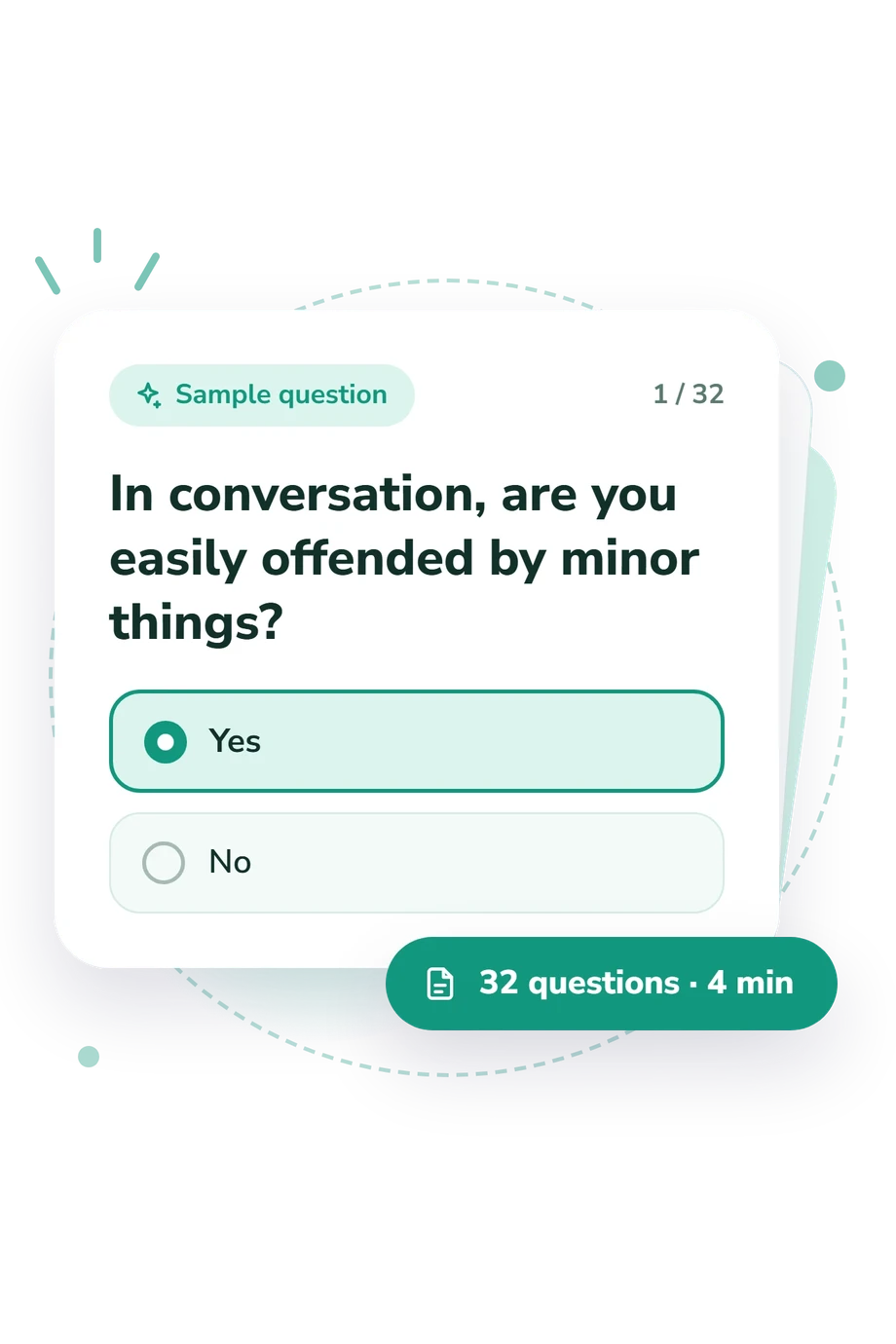
Example Questions From the Test
- Yes
- No
- Yes
- No
- Yes
- No
Emotionality Characteristics Questionnaire Test - Description and methodology of the test
People who want to understand their emotional response patterns can use this questionnaire to organize personal reflection. The Emotionality Characteristics Questionnaire Test offers a structured profile that can help a respondent name difficult situations, compare patterns across its dimensions, and decide which experiences deserve closer attention. It is especially useful for people who want a clearer starting point for examining habits of response in relationships, study, work, and demanding conversations.
What This Assessment Explores
Examples from the questionnaire touch on criticism, unfairness, worry, anger, fear, empathy, admiration, disappointment, and recovery after upsetting events. These examples show how the questionnaire invites an emotional self-assessment through recurring reactions: how readily feelings arise, how deeply they are felt, how long they remain, and whether they disrupt concentration or behavior.
The result is organized into four dimensions:
- Negative Impact of Emotions (0-8) indicates interference with effective performance: Low impact 0-2, Moderate impact 3-5, High impact 6-8.
- Emotion Duration (0-8) reflects persistence after a stimulus: Short-lived 0-2, Moderate 3-5, Prolonged 6-8.
- Emotional Intensity (0-8) measures the strength and depth of reactions: Lower intensity 0-2, Moderate 3-5, Higher intensity 6-8.
- Emotional Reactivity (0-8) describes quick, intense responses and sensitivity to outside influences: Low 0-2, Moderate 3-5, High 6-8.
Methodology and Scientific Basis
The displayed questions in this emotionality questionnaire use Yes-or-No responses and include concrete emotional situations or tendencies. Examples group around sensitivity to criticism, anxious arousal, anger, resentment, lingering distress, recovery, empathy, and emotional control. This self-report format captures contrasts in responding rather than treating strong emotion as automatically harmful.
The result is presented as four scale scores. Individual answer weights and population norms are not specified, so the bands are descriptive indications of reported tendencies rather than standardized clinical cutoffs. Current stress, memory, interpretation, and self-presentation can influence the result.
This questionnaire is an online self-report tool with four displayed descriptive scales. No specific source instrument, theoretical model, or standardization is stated for this version, so the profile should be read as a structured description of reported tendencies rather than as a restandardized published measure.
The profile can guide further reflection on situations that repeatedly trigger, intensify, or prolong feelings. It cannot establish a disorder or explain a reaction’s causes by itself; those questions require broader context and, when needed, professional assessment.
- Schmieschek, H. (1970). Questionnaire for the Determination of Accentuated Personalities. Psychiatry, Neurology and Medical Psychology, 22(10), 378-381.
- Zaharia, I., Cofas, E., & Constantin (Oprea), D. M. (2016). Analysis of Tendencies and Pronounced Predispositions of Nascent Managers Based on Smiescheck's Personality Questionnaire. Agriculture and Agricultural Science Procedia, 10, 598-603. 10.1016/j.aaspro.2016.09.041
- Leonhard, K. (1968). Accentuated Personalities. Berlin: Verlag Volk und Gesundheit.
Updated: