
Depersonalization Test

Understand how strongly detachment from yourself or your surroundings is affecting you in about 3 minutes. Take this Depersonalization Test — the validated 16-item Nuller Scale — to get a clear severity score across both depersonalization and derealization experiences.
Start Online Test
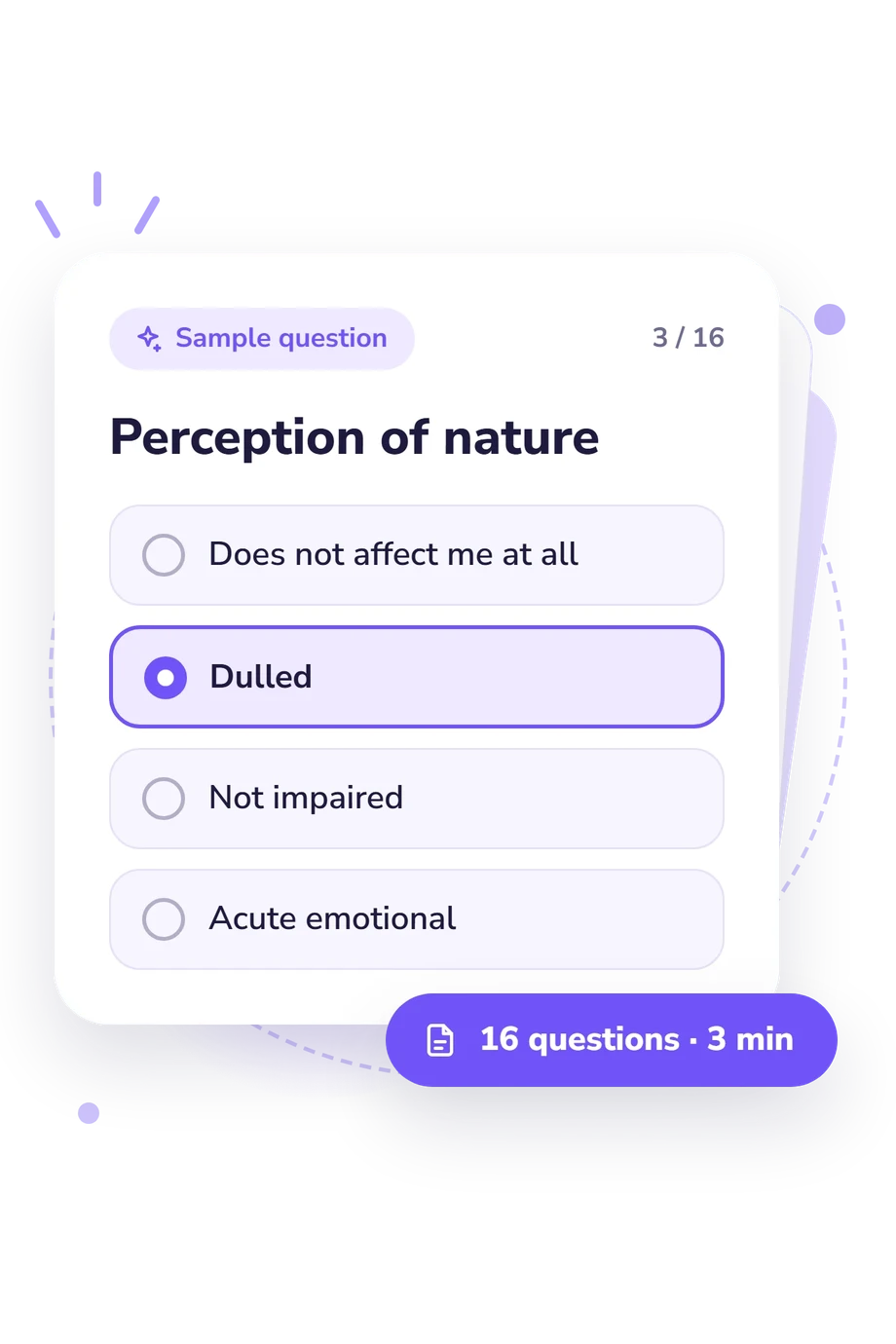
Questions163 minutes
Hi! My name is Freudly, i am an AI therapist, I will give you an interpretation of the test after you complete it.
08:30
October 2, 2025
October 2, 2025
Material has been updated
22,847 views
2,885 completions
1,790 likes
Verified by Daniel Hall
Psychologist with 25 years of experience
Share
Scale Explorer

How the Scales are Structured

example score
15/16
Pervasiveness (P)
Measures how many interview items show depersonalization/derealization-related disturbances, reflecting how widespread the experiences are across domains.
Limited
Moderate
Subtotal/Total
05Limited612Moderate1316Subtotal/Total
A score of 15 falls in the Subtotal/Total range, indicating disturbances were noted on nearly all items and the experiences are widespread.
example score
19/37
Depersonalization Severity (DS)
Measures the overall severity of depersonalization and derealization experiences based on the total interview-derived score.
Low
Moderate
High
012Low1324Moderate2537High
A score of 19 falls in the Moderate range, suggesting a noticeable but not maximal burden of depersonalization-related experiences during the interview.
Start Online Test
just completed the test
DATA-BASED USER COHORTS

Who Usually Takes This Test?

Patients with dissociative symptoms
46%OF USERS
People describing feeling unreal, detached from their body, or as if the world is dreamlike are assessed to gauge symptom severity.
Complex anxiety or trauma cases
34%OF USERS
Individuals with panic, chronic anxiety, PTSD, or high stress who report numbness or disconnection are evaluated to clarify what’s driving their distress.
Mood or psychotic spectrum evaluation
20%OF USERS
Patients being assessed for depression, bipolar disorder, or psychotic symptoms may be interviewed to distinguish depersonalization from related experiences.
BASED ON AGGREGATED, ANONYMIZED DATA FROM TENS OF THOUSANDS OF FREUDLY USERS.
Benchmarking

See How You Compare

Once you complete the test, your results are compared with real-world data from people in your country.
Below is a preview of how scores are typically distributed across each scale.
Massiveness (M)
Average
9.2
Normal range
6.811.6
min.
0
max.
16
Majority
This curve shows how scores are typically distributed.
Once you complete the test, your result will appear on the scale so you can see how you compare.
The Burden of Depersonalization (TBoD)
Average
27.1
Normal range
21.732.6
min.
0
max.
37
Majority
This curve shows how scores are typically distributed.
Once you complete the test, your result will appear on the scale so you can see how you compare.
Featured On
CLEAR ANSWERS TO COMMON QUESTIONS

Frequently Asked Questions

What does this Depersonalization Test measure?
It measures the severity of depersonalization (feeling detached from your own body, thoughts, or emotions) and derealization (perceiving your surroundings as unreal, foggy, or dreamlike). Scores reflect both how widespread these experiences are across different symptom areas and their overall intensity.
What is the difference between depersonalization and derealization?
Depersonalization involves feeling detached from your own self — your body, thoughts, or emotions, as though observing yourself from outside. Derealization involves feeling detached from your surroundings — the world seeming distant, foggy, or unreal despite knowing objectively that it is real. This derealization test and depersonalization scale assesses both experiences, since they frequently occur together.
How long does it take and how many items are included?
The scale contains 16 items and typically takes about 3 minutes to complete. Administration is generally clinician-directed through structured interview to support consistent rating, though self-report responses can also help clarify the nature and severity of your experiences.
Is this the same as a DPDR test?
Yes — DPDR is a common abbreviation for depersonalization-derealization, and this depersonalization disorder test screens for exactly these combined experiences. It does not diagnose depersonalization-derealization disorder specifically but characterizes the presence and severity of the underlying symptoms.
Is this Depersonalization Test a diagnostic tool?
No. This scale supports screening and severity characterization but does not establish a diagnosis on its own. Depersonalization and derealization symptoms can occur transiently under acute stress or as part of several distinct psychiatric conditions, including anxiety, panic disorder, depression, and psychotic disorders. Formal differential diagnosis requires evaluation by a qualified clinician.
What conditions are commonly associated with depersonalization and derealization?
These symptoms are frequently seen in anxiety disorders, panic disorder, depression, PTSD, and dissociative disorders, and are often triggered or intensified by acute stress, sleep deprivation, or substance use. Patients being assessed for depression, bipolar disorder, or psychotic symptoms are sometimes interviewed with this test for depersonalization to help distinguish it from related experiences.
What should I do if my Depersonalization Test results indicate significant symptoms?
We recommend discussing your results with a psychiatrist or psychologist, who can conduct a fuller clinical evaluation to identify any underlying condition and appropriate treatment approach. Depersonalization and derealization can feel frightening, but they are well-documented, treatable experiences — and clarifying the pattern is an important first step toward relief.
WHAT THE TEST MEASURES
About This Assessment
Nuller's Depersonalization Scale Test

Symptoms of detachment from self or surroundings can be clinically relevant across a range of psychiatric presentations. The Depersonalization Test uses the Nuller Depersonalization Scale to screen and characterize the severity of depersonalization and derealization experiences in a time-efficient manner. It contains 16 items and typically requires about 3 minutes to complete.

Why Take a Depersonalization Test

Depersonalization and derealization are among the most disorienting and hardest-to-describe experiences in mental health — a persistent sense of being detached from one's own body, thoughts, or emotions, or of the surrounding world feeling unreal, foggy, or dreamlike. Because these experiences don't fit neatly into everyday language, many people who go through them struggle for years to find the words, and often fear they are "going crazy" rather than recognizing a well-documented clinical phenomenon.

A structured test for depersonalization gives language and validation where none previously existed. Rather than vaguely describing a sense of unreality, the Nuller Scale asks about specific, recognizable experiences — feeling like an outside observer of one's own thoughts or body, or perceiving the environment as strange or unfamiliar despite knowing it objectively is not. This specificity matters clinically, since depersonalization and derealization can occur across a wide range of conditions, including anxiety, panic disorder, depression, and dissociative disorders, and are often triggered or worsened by acute stress.

This derealization test is especially useful for people who have experienced sudden or intense stress, panic attacks, or trauma and have since noticed persistent feelings of unreality or detachment — helping clarify whether these experiences meet a recognizable clinical pattern.

What the Assessment Measures

The Nuller Scale assesses depersonalization and derealization experiences across several dimensions:

  • Detachment from self — feeling disconnected from one's own body, thoughts, emotions, or sense of identity, as though observing oneself from outside
  • Detachment from surroundings — perceiving the environment as unreal, distant, foggy, or dreamlike despite recognizing it objectively
  • Breadth of disturbance — how many distinct symptom areas show noticeable disruption, reflecting how widespread the experience is
  • Overall severity — a total score summarizing the combined intensity of depersonalization and derealization symptoms

Administration is generally clinician-directed, typically through structured interview, to support clarification of subjective experiences and consistent rating. Higher scores indicate more pronounced and widespread depersonalization-derealization symptoms.

Who This Assessment Is For

This Depersonalization Test is appropriate for anyone who has experienced persistent feelings of detachment from themselves or their surroundings and wants to understand how severe these experiences are. It is often used with patients being assessed for depression, bipolar disorder, or psychotic symptoms to help distinguish depersonalization from related experiences, and by clinicians documenting baseline symptom burden and tracking change during treatment.

Clinical Validity and Use in Practice

The Nuller Depersonalization Scale may be used to document baseline symptom burden, support differential clinical formulation, and monitor change over time; it should be interpreted in the context of the broader diagnostic assessment. Results from this DPDR test do not establish a diagnosis on their own — depersonalization and derealization symptoms can occur transiently under stress or as part of several distinct psychiatric conditions, and differential evaluation by a qualified clinician is needed to clarify the underlying cause and appropriate treatment approach.

Author: D. Simeon, J. R. T. Davidson
Literature: Simeon, D., & Abugel, J. Feeling unreal: Depersonalization disorder and the loss of the self. Oxford University Press. 2006.
Test Question Form
You Might Also Like
Cambridge Depersonalization Scale (CDS)
The measure is a self-report instrument designed to assess depersonalizatio…
Start Test
Organizational Socialization Questionnaire
Entering a new organization often requires adjustment to new norms, relatio…
Start Test
Personal Identity Questionnaire
This brief self-report measure is designed to screen aspects of personal id…
Start Test
Popular tests
Narcissistic Personality Inventory (NPI)
This self-report measure is used to assess narcissism as a personality trai…
Start Test
Yale-Brown Obsessive Compulsive Scale (Y-BOCS)
This measure is used to rapidly quantify the current severity of obsessive…
Start Test
CRAFFT Screening Test (CRAFFT 2.1)
This brief screening measure is designed to identify potential alcohol and…
Start Test
Patient Health Questionnaire-9 (PHQ-9)
This measure is commonly used to quickly screen for the presence and severi…
Start Test
Maslach Burnout Inventory (MBI)
This self-report measure is used to assess occupational burnout symptoms in…
Start Test
Adolescent Anxiety Questionnaire
This measure is designed to support a brief appraisal of anxiety symptoms a…
Start Test
Emotional Creativity Inventory (ECI)
This self-report measure assesses individual differences in the originality…
Start Test
Horne–Ostberg Morningness–Eveningness Questionnaire (MEQ)
Circadian preferences influence typical patterns of alertness and sleep tim…
Start Test
Ambivalent Sexism Inventory (ASI)
This measure is designed to assess attitudes toward women, including both o…
Start Test
Internalized Misogyny Scale (IMS)
This measure is designed to assess internalized negative beliefs and stereo…
Start Test
Perceived Stress Scale (PSS-10)
This self-report measure assesses the degree to which individuals appraise…
Start Test
Impulsive Behavior Scale (SUPPS-P)
Impulsivity is a multidimensional construct that is often assessed with bri…
Start Test
Clinical Institute Withdrawal Assessment for Alcohol, Revised (CIWA-Ar)
This rating scale is used to rapidly assess the severity of alcohol withdra…
Start Test
Positive and Negative Affect Schedule (PANAS)
This measure provides a brief self-report assessment of current or typical…
Start Test
Light Triad Scale (LTS)
This self-report measure assesses prosocial personality tendencies and orie…
Start Test
Suicidal Ideation Scale
In clinical settings, the Suicidal Ideation Scale is used to structure an i…
Start Test
Body Dysmorphic Disorder Scale (BDD-D)
This brief self-report measure is designed to screen for and quantify distr…
Start Test
Beck Anxiety Inventory (BAI)
This measure is a brief self-report inventory used to screen for anxiety sy…
Start Test
Differential Test of Perfectionism
This instrument is used to screen for perfectionism-related attitudes and t…
Start Test
Locus of Control Scale
This measure assesses generalized expectancies regarding the degree to whic…
Start Test
New Apathy Scale
This brief self-report measure is used to screen for apathy-related symptom…
Start Test
Perth Alexithymia Questionnaire (PAQ)
This measure assesses individual differences in alexithymia, including diff…
Start Test
Social Intelligence Scale
This brief self-report measure is designed to support rapid screening of in…
Start Test
Fear Test
This measure is designed to evaluate individual differences in fear-related…
Start Test
Neuroticism Level Scale
The measure is intended for brief screening of an individual’s propensity t…
Start Test
Aggressiveness Indicators Screening Questionnaire
This screening tool is designed to quickly identify behavioral indicators a…
Start Test
Comments
Leave a Comment