
Personality Disorder Severity Scale (PDS-ICD-11) Test
How the Scales are Structured
Who Usually Takes This Test?
See How You Compare
Below is a preview of how scores are typically distributed across each scale.
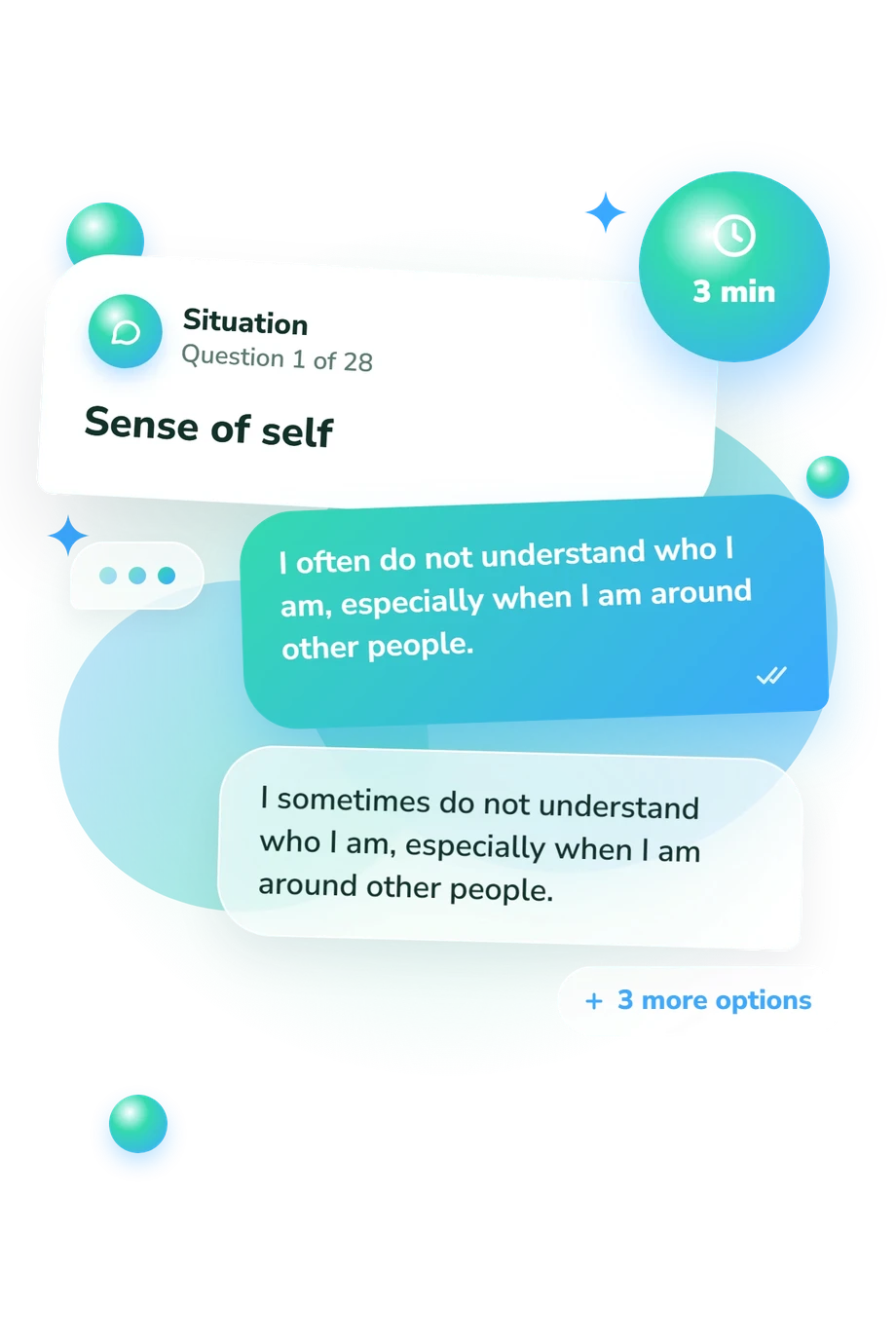
Example Questions From the Test
- I have no strengths
- I have few strengths
- I understand my strengths and weaknesses well
- I have few weaknesses or shortcomings
- I have no weaknesses or shortcomings
- I never harm myself
- I rarely harm myself
- I sometimes harm myself
- I often harm others
- I never harm others
- I rarely harm others
- I sometimes harm others
- I often harm others
Personality Disorder Severity Scale (PDS-ICD-11) Test - Description and methodology of the test
People who want a structured way to examine enduring difficulties in identity, relationships, emotional regulation, and functioning may find the Personality Disorder Severity Scale (PDS-ICD-11) Test useful. As a personality disorder severity assessment, it focuses on how broadly and seriously these difficulties affect important areas of life, helping respondents consider whether their current experiences suggest limited, moderate, or more substantial dysfunction.
What This Assessment Explores
The assessment examines personality functioning rather than a single symptom or diagnosis. It considers identity, self-esteem, goals, relationships, emotional and behavioural control, stress-related perception, harm, and everyday functioning.
The PDS-ICD-11 questionnaire links these themes to practical functioning in personal, family, social, educational, or work contexts. Its result summarises the severity of dysfunction reflected in the answers.
The main result dimensions are:
- Identity and self-direction show how stable self-understanding, self-evaluation, and goal-setting appear in the responses.
- Interpersonal functioning indicates how interest in others, perspective-taking, closeness, and conflict management affect relationships.
- Regulation and harm reflect emotional and behavioural control, stress-related distortion, and actions affecting self or others.
The Personality Disorder Severity Scale score runs from 0-32. Displayed bands are Low (subthreshold) 0-12, Moderate 13-18, and Severe to Very Severe 19-32.
Methodology and Scientific Basis
Items use brief statements with graded response choices. Most options move from less to more difficulty, while some describe rigidity, inhibition, or dependence. The final question links reported difficulty in important life domains to functioning rather than isolated symptoms.
Selected responses combine into one severity result. ICD-11 anchor points at 9, 12, 16, 19, and 22 represent progressively greater dysfunction, from subthreshold to very severe. The online result describes the pattern reflected in the answers; it does not identify a specific personality disorder.
Bach et al. (2021), Brown and Sellbom (2023), and Gutiérrez and colleagues (2023) provide evidence about the published PDS-ICD-11 instrument, including its severity approach and findings from a Spanish mixed sample; this online questionnaire is only conceptually consistent with that work and has no established norms or validation claims of its own. The World Health Organization (2024) provides classification context.
As an ICD-11 personality disorder screening measure, it supports preliminary reflection. Current stress, self-awareness, willingness to disclose, and interpretation of the choices can influence the score, so context matters when the result is considered.
- Bach, B., Brown, T. A., Mulder, R. T., Newton-Howes, G., Simonsen, E., & Sellbom, M. (2021). Development and initial evaluation of the ICD-11 personality disorder severity scale: PDS-ICD-11. Personality and Mental Health, 15(3), 223-236. 10.1002/pmh.1510
- Brown, T. A., & Sellbom, M. (2023). Further validation of the Personality Disorder Severity for ICD-11 (PDS-ICD-11) scale in a community mental health sample. Psychological Assessment, 35(8), 706-714. 10.1037/pas0001253
- Gutiérrez, F., Aluja, A., Rodríguez, C., Gárriz, M., Peri, J. M., Gallart, S., Calvo, N., Ferrer, M., Gutiérrez-Zotes, A., Soler, J., & Pascual, J. C. (2023). Severity in the ICD-11 personality disorder model: Evaluation in a Spanish mixed sample. Frontiers in Psychiatry, 13, 1015489. 10.3389/fpsyt.2022.1015489
- World Health Organization. (2024). Clinical descriptions and diagnostic requirements for ICD-11 mental, behavioural and neurodevelopmental disorders. Geneva: World Health Organization. ISBN: 9789240077263
Updated: