
Emotional Intelligence Level (LEI) Test
How the Scales are Structured
Who Usually Takes This Test?
See How You Compare
Below is a preview of how scores are typically distributed across each scale.
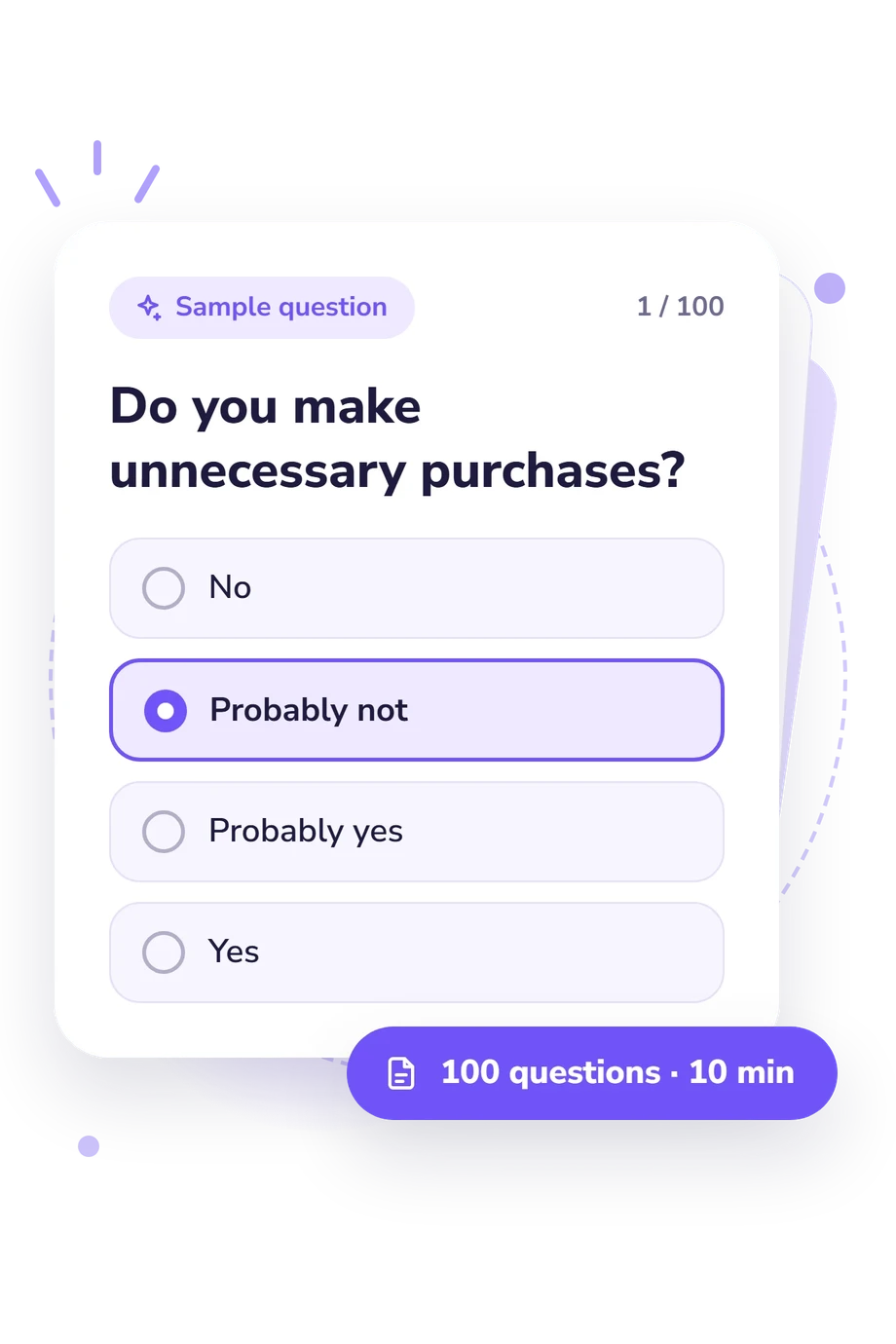
Example Questions From the Test
- No
- Probably no
- Probably yes
- Yes
- No
- Probably not
- Probably yes
- Yes
- No
- Rather no
- Rather yes
- Yes
Emotional Intelligence Level (LEI) Test - Description and methodology of the test
People who want a clearer picture of how they handle feelings, impulses, and social situations may find the Emotional Intelligence Level (LEI) Test useful. This emotional intelligence assessment focuses on everyday patterns rather than a single mood or event. It can help readers reflect on self-regulation, empathy, flexibility, and relationship behavior while deciding whether the profile matches their lived experience.
What This Assessment Explores
The questionnaire is for readers who want to examine how emotional awareness shapes communication, self-control, coping, and relationships. The sample touches on anger, apology, resentment, spontaneity, tolerance, responsibility, and social tact, linking personal emotional functioning with behavior around others.
The three displayed dimensions organize the emotional intelligence questionnaire into a profile:
- Communication (1-10) reflects understanding others’ feelings and building cooperative relationships; Low 1-4, Moderate 5-7, High 8-10.
- Personal (1-10) reflects recognizing and regulating one’s emotions, including impulse control and stress adaptation; Low 1-4, Moderate 5-7, High 8-10.
- Overall Emotional Intelligence (1-10) summarizes awareness, regulation, and interpersonal functioning; Low 1-4, Average 5-7, High 8-10.
Higher results suggest stronger skills in the named area, while lower results identify tendencies to explore. The profile is best read beside recurring behavior, not as a fixed personality label.
Methodology and Scientific Basis
The 50-item questionnaire uses self-report questions with four graded response options. Sample choices move from No to Yes or from Probably not to Probably yes, so respondents indicate degree rather than select between two positions. Everyday decisions and interpersonal situations provide varied contexts for reported tendencies.
Results appear across the three displayed scales as an emotional intelligence profile. Each score should be interpreted within its named scale and result band, not reverse-engineered from the choices: the online questionnaire does not state that it uses the published LEI norms or standardization procedure, and its response weights and conversion to final values are not specified.
Conceptually, the questionnaire is consistent with the Level of Emotional Intelligence (LEI) methodology described by Belyaev, Yanovich, and Mazurov. Antiniene and Lekaviciene address LEI adaptation procedures and methodological problems. These sources clarify the construct but do not establish that this online questionnaire reproduces the source studies’ administration.
Self-report results can shift with current stress, self-awareness, memory, and self-presentation. Interpret the profile alongside examples, using unexpected patterns to identify concrete situations worth examining in recent interactions.
- Belyaev, S. A., Yanovich, A. I., and Mazurov, M. I. (2009). Development and Standardization of the Level of Emotional Intelligence Methodology. Psychological Journal, 22(2), 9-17.
- Antiniene, D., and Lekaviciene, R. (2012). Adaptation Procedure of Level of Emotional Intelligence (LEI) Test and Its Methodology Problems. Baltic Journal of Sport and Health Sciences, 4(87), 5-12. 10.33607/bjshs.v4i87.250
Updated: