
Neuropsychic Tension Scale Test
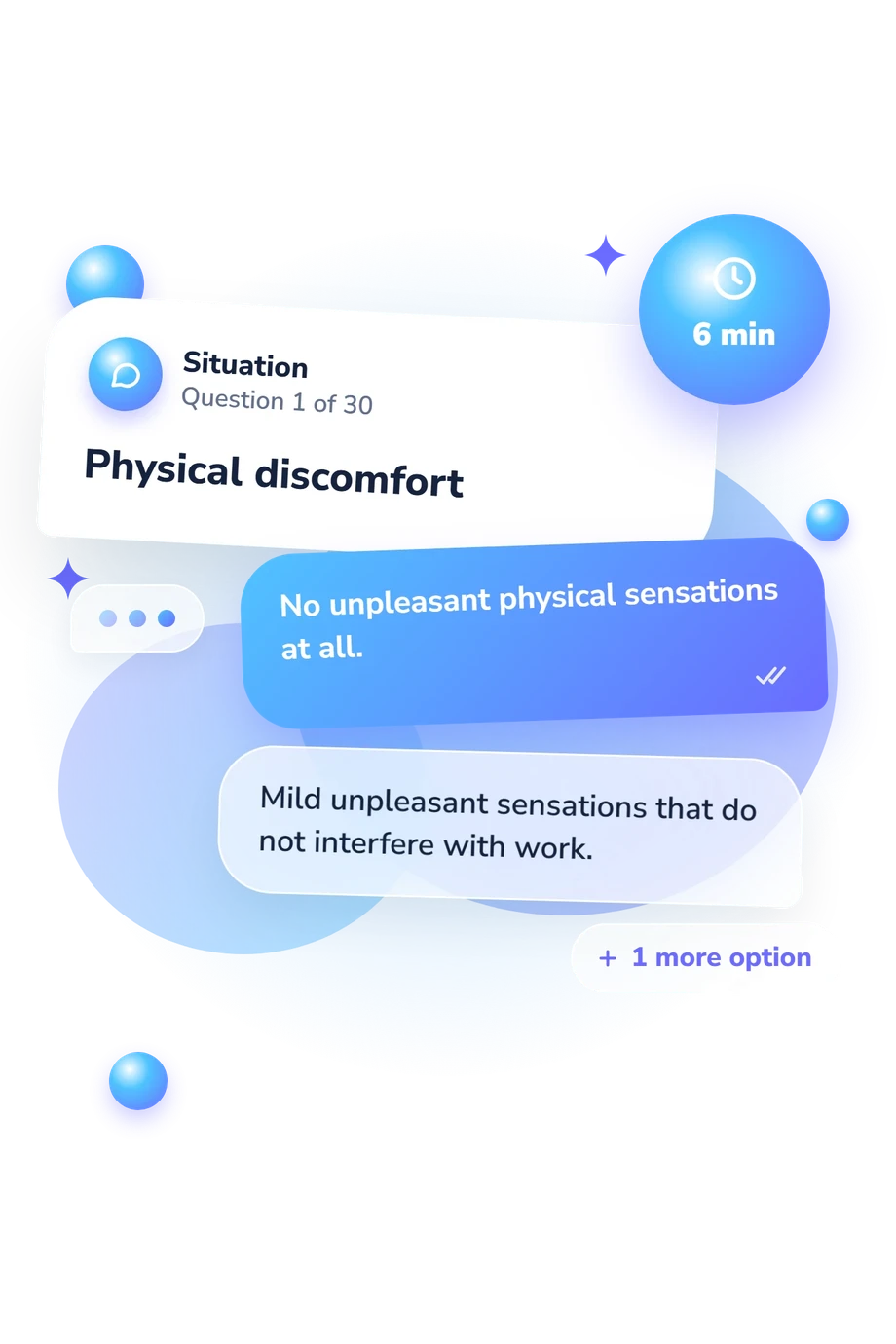
How the Scales are Structured
Who Usually Takes This Test?
See How You Compare
Below is a preview of how scores are typically distributed across each scale.
Example Questions From the Test
- No changes in body temperature sensations.
- A feeling of warmth or increased body temperature.
- A feeling of the body or limbs getting cold; chills.
- Normal sweating, without any changes.
- Moderate increase in sweating.
- Episodes of profuse, cold sweating.
- Usual condition, without any changes.
- Moderate increase in salivation.
- Feeling of dry mouth.
Neuropsychic Tension Scale Test - Description and methodology of the test
People who notice bodily unease, shifting concentration, or unusual activation in demanding situations can use the Neuropsychic Tension Scale Test to organize those experiences into a readable profile. It is intended for people seeking structured self-reflection. The test provides a neuropsychic tension assessment by showing whether the overall pattern is mild, moderate, or excessive and how tension may affect readiness to act.
What This Assessment Explores
This assessment treats tension as a whole-person response to demanding situations. Its items cover bodily discomfort, activation, sleep, mood, confidence, attention, memory, and mental performance, together with frequency, duration, and interference.
The result describes the stress response as absent, mobilizing, or distressing. Moderate tension may accompany motivation and meaningful effort, while excessive tension may involve severe discomfort and frustration and may be associated with conflict in significant relationships.
The item themes are:
- Physical signs show changes in pain, muscle tone, breathing, sweating, temperature, and other sensations.
- Mental-emotional signs show shifts in mood, confidence, sleep, speech, memory, attention, and energy.
- Course and impact show frequency, duration, and interference with activity.
The Neuropsychic Tension Scale spans 30-90: Mild 30-50, Moderate 51-70, and Excessive 71-90. It measures discomfort, anxiety, and readiness to act in stressful situations.
Methodology and Scientific Basis
Each item presents three response descriptions rather than a yes/no choice. The three choices contrast usual functioning with moderate changes and more marked changes; their direction and meaning vary by symptom or behavior. A middle option may describe increased focus, confidence, or performance, while another may describe discomfort, so the response pattern is not a uniform distress ladder.
The result combines selected responses into one overall tension level, giving a self-report tension estimate. The questionnaire is conceptually consistent with the Neuropsychic Tension Questionnaire (Nemchin, 1983), but this online version is not presented as an adaptation or validated digital reproduction. Vodopyanova (2009) offers a compatible framework for reading bodily, emotional, and cognitive reactions together.
No standardization or clinical norms are stated for this questionnaire, so the score reflects self-perception and may shift with current circumstances, self-awareness, and response style; it does not establish a diagnosis.
- Nemchin, Tigran Anatolievich. States of Neuropsychic Tension. Leningrad: Leningrad University Press, 1983, 165 pp.
- Vodopyanova, Natalia Evgenievna. Psychodiagnostics of Stress. Saint Petersburg: Piter, 2009, 329 pp. ISBN 978-5-388-00542-7.
- Popovych, Ihor, Nataliia Machynska, Nataliya Yaremchuk, Vira Korniat, and Vladyslava Kurinna. “Psycho-emotional States of Future Specialists in a Socionomic Area under Lockdown and Martial Law: Comparative Analysis.” Amazonia Investiga 11, no. 56 (2022): 150-158. 10.34069/AI/2022.56.08.16
Updated: