
Spiritual Well-Being Scale (SWBS) Test
How the Scales are Structured
Who Usually Takes This Test?
See How You Compare
Below is a preview of how scores are typically distributed across each scale.
Example Questions From the Test
- Strongly agree
- Generally agree
- Somewhat agree
- Somewhat disagree
- Generally disagree
- Strongly disagree
- Strongly agree
- Generally agree
- Somewhat agree
- Somewhat disagree
- Generally disagree
- Strongly disagree
- Strongly agree
- Generally agree
- Somewhat agree
- Somewhat disagree
- Generally disagree
- Strongly disagree
Spiritual Well-Being Scale (SWBS) Test - Description and methodology of the test
People who want a structured reflection on purpose, life satisfaction, and faith-related experience may find the Spiritual Well-Being Scale (SWBS) Test useful. This spiritual well-being questionnaire examines self-reported aspects of meaning, optimism, fulfilment, and a perceived relationship with God. The result separates related dimensions rather than reducing spirituality to one overall impression.
What This Assessment Explores
The questionnaire separates spiritual well-being into existential and religious dimensions. Existential well-being covers life satisfaction, meaning, purpose, and optimism. Religious well-being covers a perceived relationship with God, including support and connection. A high score on the religious dimension reflects a positive view of that perceived relationship, while the total indicates perceived overall well-being.
The SWBS assessment suits reflective respondents. Its scales are:
- Existential Well-Being: 10-60; Low 10-20 reflects low satisfaction and unclear purpose; Moderate 21-49 reflects moderate satisfaction and purpose; High 50-60 reflects high satisfaction and clear purpose.
- Religious Well-Being: 10-60; Dissatisfied 10-20 reflects dissatisfaction with one’s relationship with God; Moderate 21-49 reflects moderate religious well-being; Positive 50-60 reflects a positive view of that perceived relationship.
- Spiritual Well-Being: 20-120; Low 20-40, Moderate 41-99, and High 100-120 indicate spiritual well-being as an indicator of perceived overall well-being.
Methodology and Scientific Basis
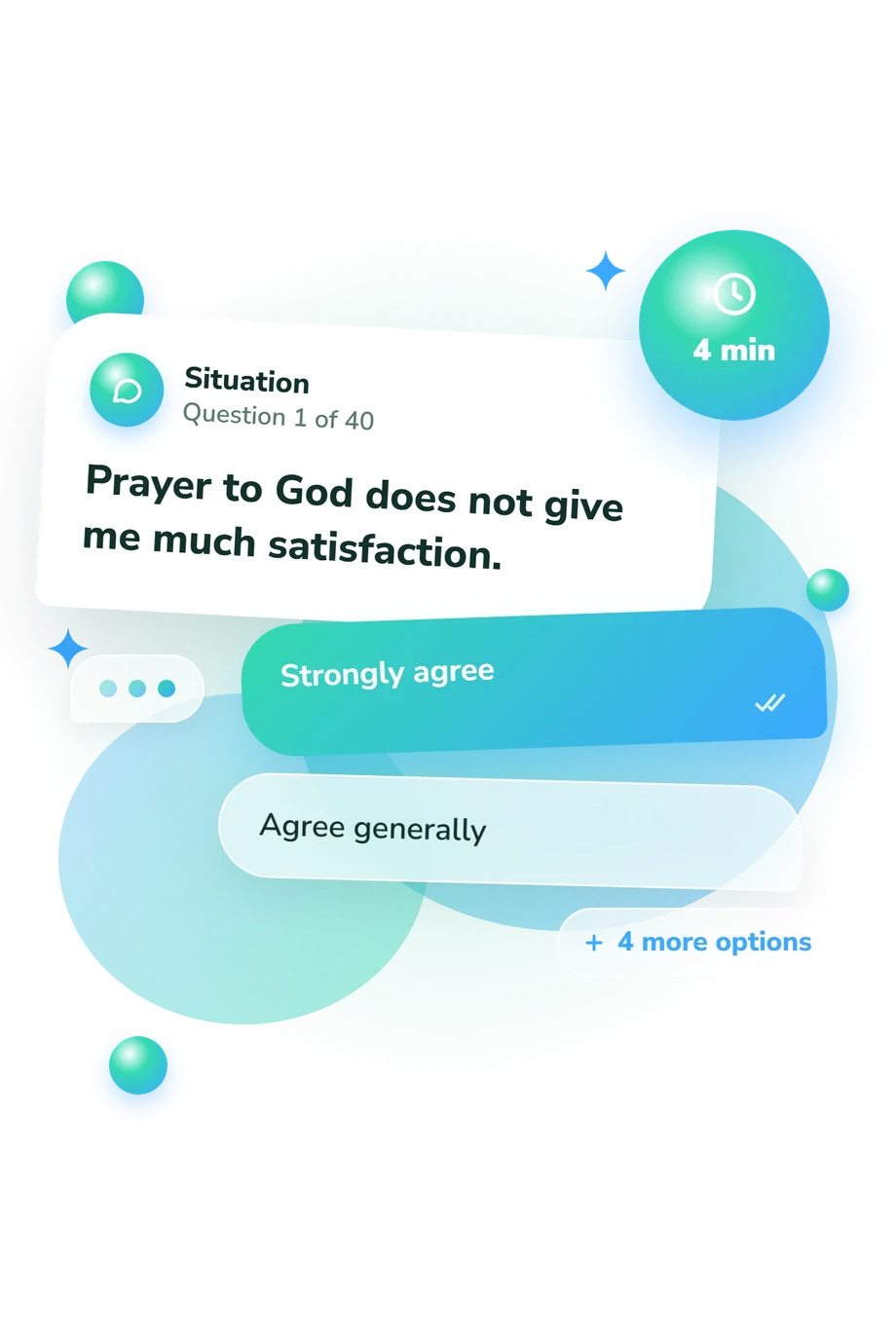
The six-point response format runs from strong agreement to strong disagreement. Items cover prayer, meaning, optimism, fulfilment, worry, loneliness, and perceived divine support, with both positively and negatively phrased experiences. The scoring arrangement, rather than any single answer, determines how these responses contribute to the profile.
The published Spiritual Well-Being Scale (SWBS), described by Paloutzian and Ellison, separates existential and religious well-being. Norms reported by Bufford, Paloutzian, and Ellison belong to that published instrument. This online questionnaire is conceptually consistent with the published SWBS, but the published instrument’s norms and validation should not be assumed to apply to this online version.
This questionnaire presents SWBS results in subscale and total bands that serve as interpretive labels; exact point assignments and the reverse-scoring procedure are not specified. Read the outcome as a current self-report profile: mood, context, religious outlook, self-awareness, and response style can affect it, so it does not establish a diagnosis or clinical status.
- Paloutzian, R. F., & Ellison, C. W. (1982). Loneliness, spiritual well-being and the quality of life. In L. A. Peplau & D. Perlman (Eds.), Loneliness: A Sourcebook of Current Theory, Research and Therapy (pp. 224-237). New York: Wiley-Interscience.
- Ellison, C. W. (1983). Spiritual Well-Being: Conceptualization and Measurement. Journal of Psychology and Theology, 11(4), 330-338. 10.1177/009164718301100406
- Bufford, R. K., Paloutzian, R. F., & Ellison, C. W. (1991). Norms for the Spiritual Well-Being Scale. Journal of Psychology and Theology, 19(1), 56-70. 10.1177/009164719101900106
Updated: