
Campbell Benevolence Scale Test
How the Scales are Structured
Who Usually Takes This Test?
See How You Compare
Below is a preview of how scores are typically distributed across each scale.
Campbell Benevolence Scale Test - Description and methodology of the test
People considering a structured way to examine their approach to other people may find the Campbell Benevolence Scale Test useful. Its paired statements address interpersonal benevolence through everyday judgments about cooperation, friendship, helping, and principles. The result can help a reader decide whether this brief format offers a meaningful starting point for reflecting on their interpersonal style.
What This Assessment Explores
The questionnaire looks beyond sociability alone. It examines expectations of goodwill, the value placed on cooperation and helping, and attitudes toward promises, personal principles, overcoming limits, and friendship in work relationships. Together, these themes describe a benevolent orientation rather than an isolated act.
To make the result easier to read, this benevolence questionnaire groups the item content into themes contributing to one overall result:
- Trust and cooperation concern expectations that other people can be reliable and mutually supportive.
- Helping and reciprocity concern whether assisting someone is viewed as meaningful or mainly risky.
- Principles, agency, and friendship cover attitudes toward promises, obstacles, and human connection as item content rather than separate scores.
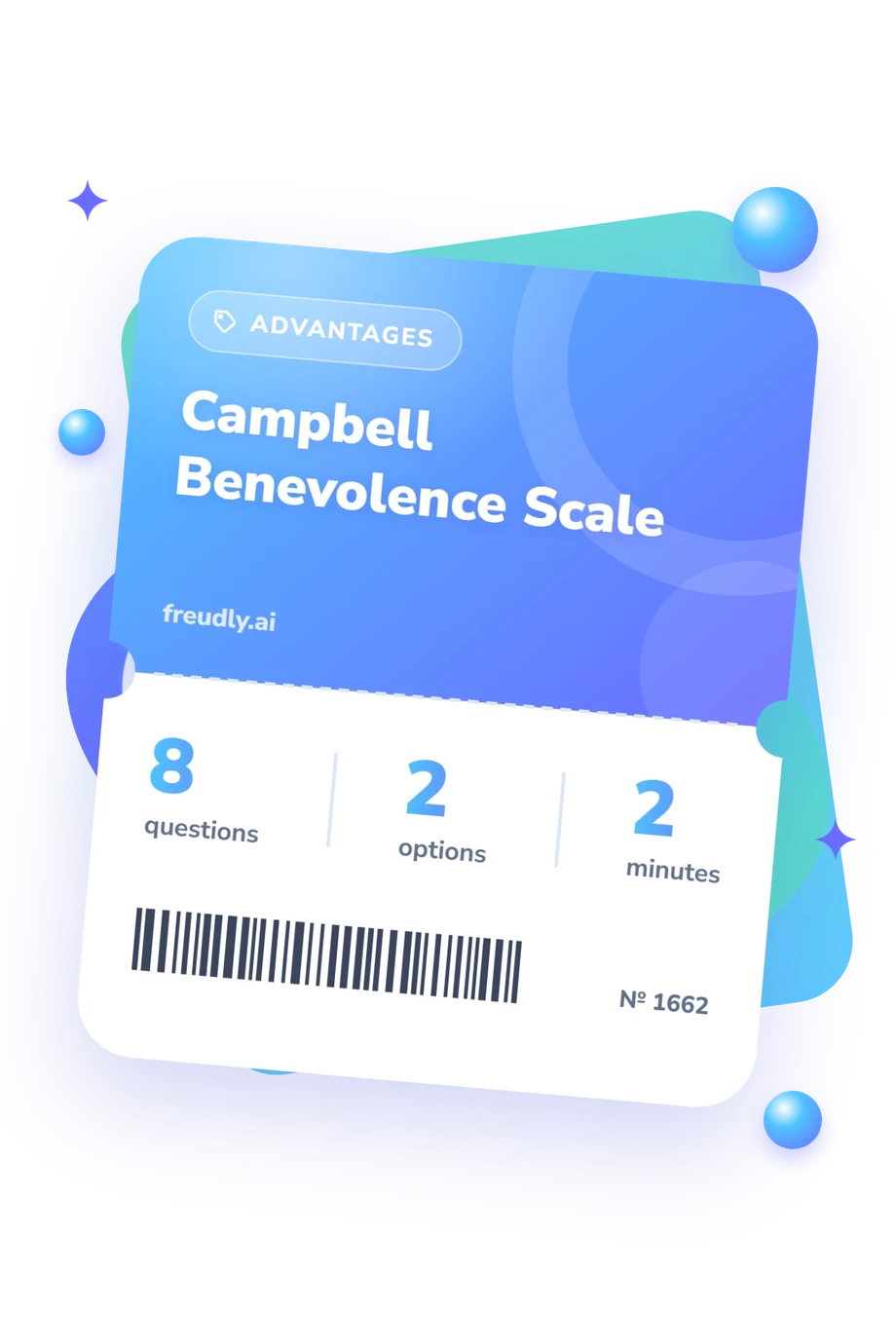
The scale is Benevolence: 0-8. Low (0-3) indicates low benevolence, Moderate (4-5) indicates moderate benevolence, and High (6-8) indicates a pronounced tendency toward friendly and positive interactions with others.
Methodology and Evidence Base
Each item presents a self-report choice between contrasting statements, so the questionnaire is a self-report benevolence measure with a forced-choice format. One option may portray people as trustworthy and mutually supportive, while the other emphasizes danger or self-protection. Other pairs contrast helping with refusal, principles with social pleasing, and agency with resignation. The questionnaire produces one displayed result; the available format does not document how points are assigned.
The online questionnaire is conceptually consistent with the Campbell Benevolence Scale described by Fetiskin and colleagues, but is not documented as a standardized reproduction or validated adaptation. It is a brief online self-report measure with one displayed score; normative data for it should not be claimed without verification.
Interpret the outcome as a self-reflection profile. Higher results indicate stronger benevolent expectations, while lower results suggest more caution or self-protection in the represented situations. Mood, relationships, and recent experiences may influence answers, and the short format cannot capture every motive or behavior. Read the result alongside real-life patterns rather than as a fixed identity.
- Fetiskin, N. P., Kozlov, V. V., & Manuilov, G. M. (2002). Social-Psychological Diagnostics of Personality Development and Small Groups. Moscow: Institute of Psychotherapy.
- Labunskaya, V. A., Mendzheritskaya, Y. A., & Breus, E. D. (2001). Psychology of Difficult Communication: Theory, Methods, Diagnostics, Correction. Moscow: Akademiya.
- Kovalenko, O. (2025). Communicative impulsivity, benevolence and the success of interpersonal communication of older adults. Quarterly Journal Fides et Ratio, 63(3), 79-93. 10.34766/d03vpy67
Updated: