
Analytic–Holistic Scale (AHS) Test
How the Scales are Structured
Who Usually Takes This Test?
See How You Compare
Below is a preview of how scores are typically distributed across each scale.
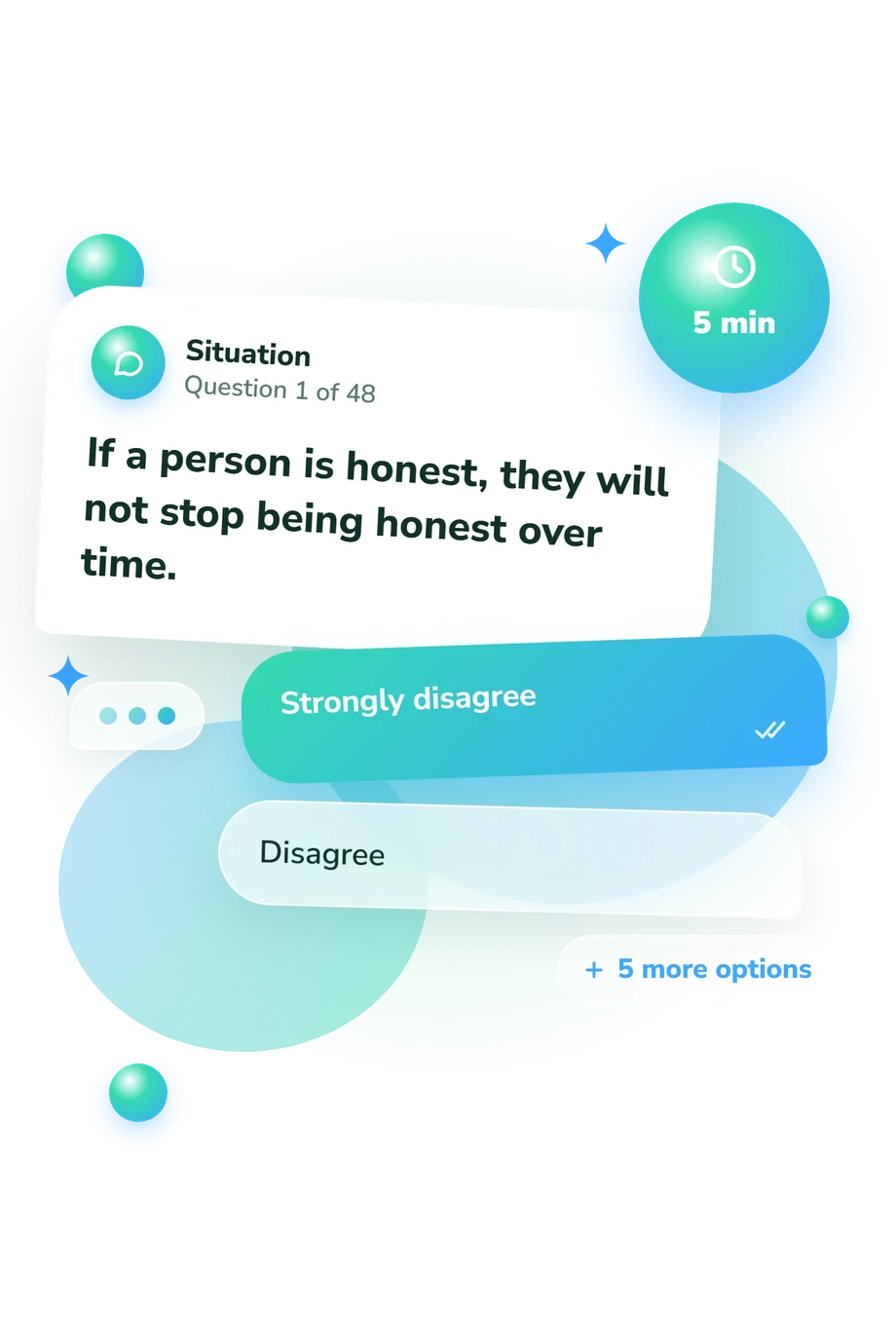
Example Questions From the Test
- Strongly disagree
- Disagree
- Disagree more than agree
- Unsure
- Agree more than disagree
- Agree
- Strongly agree
- Strongly disagree
- Disagree
- Somewhat disagree
- Unsure
- Somewhat agree
- Agree
- Strongly agree
- Strongly disagree
- Disagree
- Disagree somewhat
- Unsure
- Agree somewhat
- Agree
- Strongly agree
Analytic–Holistic Scale (AHS) Test - Description and methodology of the test
People who want to examine how they make sense of events, people, and social situations can use the Analytic-Holistic Scale (AHS) Test for structured self-reflection. Rather than assigning a permanent type, this analytic versus holistic thinking test shows whether responses lean toward separating elements and seeking clear explanations or toward noticing relationships, context, change, and multiple viewpoints. The profile can guide reflection on reasoning, communication, and judgment.
What This Assessment Explores
Responses probe beliefs about stability, interconnectedness, compromise, prediction, and context. This analytic holistic thinking questionnaire asks readers to consider how they interpret events and social situations, rather than measuring general intelligence or reasoning speed.
The profile presents four component dimensions and one overall scale:
- Perception of Change (6-42) indicates whether events seem stable and linear or changing and cyclical: More linear (6-24); More cyclical (25-42).
- Tolerance for Contradiction (6-42) indicates preference for one clear answer or for synthesizing opposites: Prefers one clear answer (6-24); Comfortable with contradictions (25-42).
- Causal Attribution (6-42) indicates whether causes are located in personal characteristics or the environment: More internal-focused (6-24); More context-focused (25-42).
- Attention Focus (6-42) indicates attention to independent elements or background context: Independent focus (6-24); Context-focused (25-42).
- Analytic-Holistic Scale (24-168) summarizes the overall style from analytic to holistic: More analytic (24-96); More holistic (97-168).
Methodology and Scientific Basis
Each statement uses a seven-point agreement response with Unsure at the midpoint; some displayed items use Strongly disagree/agree at the endpoints, while others use Completely disagree/agree. Items ask respondents to endorse views about change, causation, contradiction, compromise, wholes, parts, and context. The result reports four component scales and an overall scale with the displayed bands, which distinguish analytic-leaning from holistic-leaning responses without making either end universally better.
The named source is Analysis-Holism Scale (Choi et al., 2007), whose structure matches the four component dimensions. This questionnaire is an online presentation of that published instrument; its online version has not been separately validated. Its broader framework is analytic and holistic cognition described by Nisbett et al. (2001). Lechuga et al. (2011) offer related cross-cultural evidence for the construct, but do not validate this online questionnaire.
Read the profile as a tendency in answers at completion. Self-report can reflect current context, self-awareness, and response style; the questionnaire has no stated population norms or diagnostic cutoffs, so the result should not be treated as a clinical classification.
- Choi, Incheol, Minkyung Koo, and Jong An Choi. "Individual differences in analytic versus holistic thinking." Personality and Social Psychology Bulletin, 33(5), 691-705, 2007. 10.1177/0146167206298568.
- Lechuga, Julia, Beatriz Maldonado Santos, Azenett A. Garza-Caballero, and Ricardo Villarreal. "Holistic Reasoning on the Other Side of the World: Validation of the Analism/Holism Scale in Mexicans." Cultural Diversity and Ethnic Minority Psychology, 17(3), 325-330, 2011. 10.1037/a0023881.
- Nisbett, Richard E., Kaiping Peng, Incheol Choi, and Ara Norenzayan. "Culture and systems of thought: Holistic versus analytic cognition." Psychological Review, 108(2), 291-310, 2001. 10.1037/0033-295X.108.2.291.
Updated: