
Hamilton Rating Scale for Depression (HDRS) Test
How the Scales are Structured
Who Usually Takes This Test?
See How You Compare
Below is a preview of how scores are typically distributed across each scale.
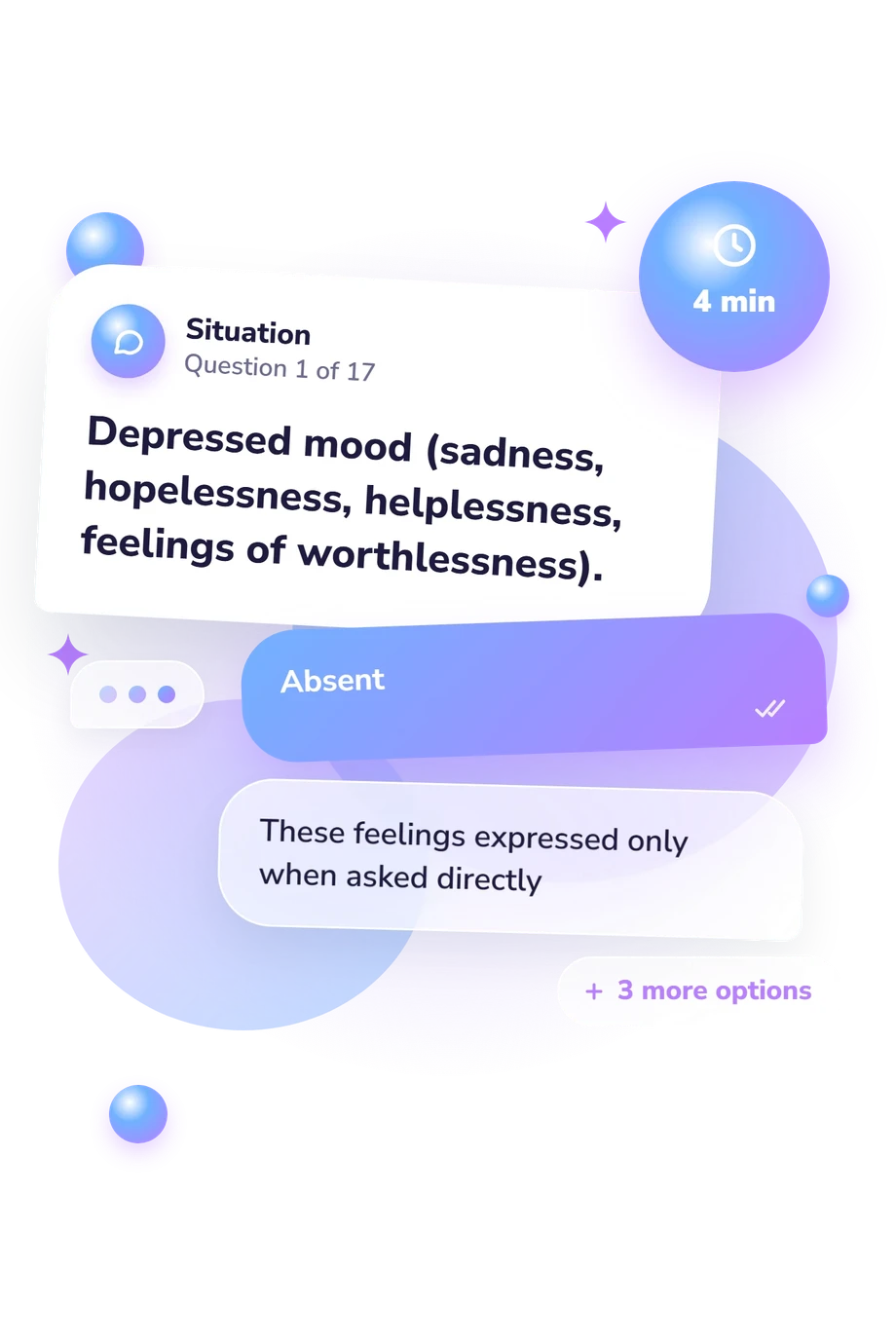
Example Questions From the Test
- Absent
- Feels life is not worth living
- Wishes of death or any thoughts of possible death
- Suicidal statements or gestures
- Suicide attempts (any serious attempt is rated 4)
- Absent
- Early morning awakening with return to sleep
- Final insomnia or early morning awakening
- Normal speech and thought
- Mild retardation during the interview
- Definite retardation during the interview
- Marked difficulty in conducting the interview
- Complete stupor
Hamilton Rating Scale for Depression (HDRS) Test - Description and methodology of the test
For readers deciding whether recent changes in mood, sleep, energy, or concentration merit closer attention, the Hamilton Rating Scale for Depression (HDRS) Test organizes those concerns. As a depression test, it helps a reader consider how current symptoms affect daily life and what may be worth discussing in a fuller assessment. Its focus is depressive experiences rather than personality, relationships, or general wellbeing.
What This Assessment Explores
Items span emotional, cognitive, behavioral, sleep-related, and physical symptoms. The displayed Hamilton Depression Rating Scale (HDRS) measures depressive severity on 0-30: 0-7 no depression, 8-13 mild, 14-18 moderate, 19-22 severe, and 23 or higher very severe. Visitor bands are None to mild (0-13), Moderate to severe (14-22), and Very severe (23-30). The original scale is commonly used to monitor symptom change and treatment response.
In context, the band describes depression symptom severity; the themes below clarify the items. The main themes are:
- Mood and guilt show sadness, hopelessness, self-reproach, and wrongdoing.
- Suicidal thoughts or intentions include thoughts of death, statements, gestures, and attempts.
- Sleep and activity reflect insomnia, reduced engagement, slowed functioning, or agitation.
- Anxiety and somatic symptoms cover tension, worry, appetite, pain, fatigue, and bodily distress.
- Weight, health concern, and insight indicate physical change, illness preoccupation, and illness awareness.
Methodology and Evidence Base
The format works as a depression severity questionnaire, with response choices moving from absent or mild symptoms toward greater severity; some distinguish observed behavior, functional loss, or serious events. Numerical values appear for many items, but the displayed range does not reveal a complete scoring rule.
The original HDRS is a clinician-rated instrument for organizing judgments about depressive symptoms. Hamilton's 1967 work describes its development, and Williams's 1988 structured interview guide clarifies administration and rating decisions. This online self-report questionnaire is conceptually consistent with that framework, but it is not the same as a clinician-led HDRS interview or a verified adaptation of that administration.
The clinician-rated HDRS evidence from Hamilton and Williams should not automatically be transferred to this digital self-report format. Read the overall band alongside the item pattern: the score does not explain cause or duration or identify which symptoms matter most for a particular person.
Self-report can be shaped by current context, recall, and willingness to disclose, so this result is a snapshot rather than a diagnosis or a substitute for broader clinical assessment.
- Hamilton, M. (1960). A rating scale for depression. Journal of Neurology, Neurosurgery, and Psychiatry, 23(1), 56-62. 10.1136/jnnp.23.1.56
- Hamilton, M. (1967). Development of a rating scale for primary depressive illness. British Journal of Social and Clinical Psychology, 6(4), 278-296. 10.1111/j.2044-8260.1967.tb00530.x
- Williams, J. B. W. (1988). A structured interview guide for the Hamilton Depression Rating Scale. Archives of General Psychiatry, 45(8), 742-747. 10.1001/archpsyc.1988.01800320058007
Updated: