
Student Trait Anxiety Scale Test
How the Scales are Structured
Who Usually Takes This Test?
See How You Compare
Below is a preview of how scores are typically distributed across each scale.
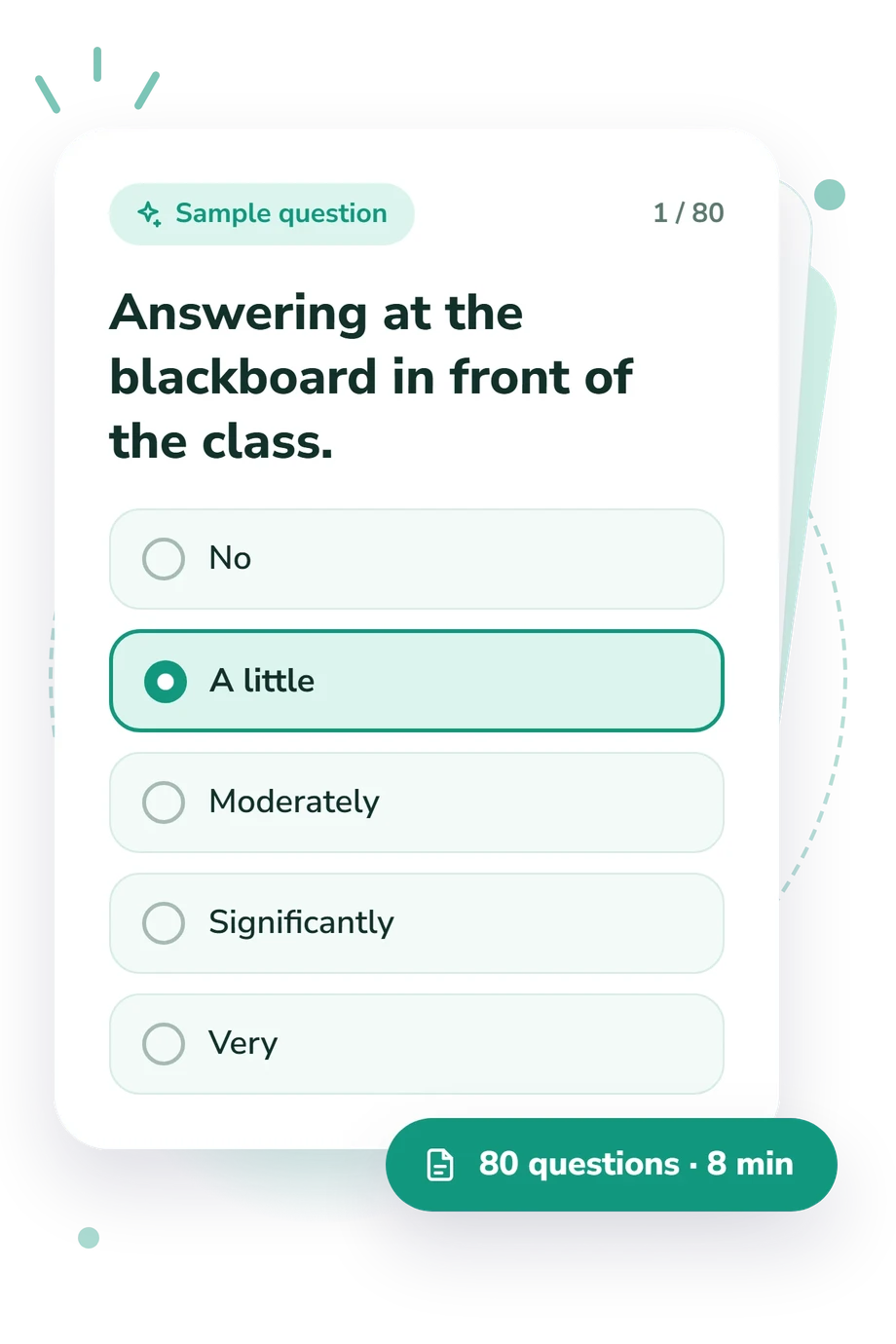
Example Questions From the Test
- No
- A little
- Moderately
- Significantly
- Very
- No
- A little
- Moderately
- Significantly
- Very
- No
- A little
- Moderately
- Significantly
- Very
Student Trait Anxiety Scale Test - Description and methodology of the test
Students who notice tension returning in similar circumstances may use this questionnaire to decide whether those reactions deserve closer attention. The Student Trait Anxiety Scale Test is especially relevant for readers reflecting on recurring reactions rather than a single stressful event. As a student anxiety assessment, it can provide a structured prompt for self-observation in everyday life.
What This Assessment Explores
The items cover public performance, evaluation, communication, family tension, academic demands, self-image, dreams, and imagined threats. As a trait anxiety questionnaire, it organizes these experiences into five dimensions:
- Magical (1-10; Low 1-3, Moderate 4-6, High 7-10) reflects anxiety linked to irrational fears, fantasies, and imagined threats.
- Interpersonal (1-10; Low 1-3, Moderate 4-6, High 7-10) shows anxiety in communication and fear of evaluation by others.
- Self-Evaluative (1-10; Low 1-6, High 7-10) indicates insecurity and tension about self-esteem and perceived worth.
- School (1-10; Low 1-3, Moderate 4-6, High 7-10) describes anxiety around academic activity and educational demands.
- Trait Anxiety (1-10; Low 1-2, Moderate 3-6, High 7-10) summarizes the student’s trait anxiety level; low scores may reflect stable calmness or defensive mechanisms, moderate scores are considered normative and necessary for adaptation and productive activity, and higher scores indicate elevated or very high anxiety.
Methodology and Evidence Base
Each item asks how much a named situation would provoke anxiety through five ordered choices: No, A little, Moderately, Significantly, or Very. Situations include public answering, grades, approaching strangers, self-comparison, and supernatural danger. The format captures graded self-report rather than a yes/no judgment.
The online questionnaire combines responses into five profile scores on 1-10 scales, but it does not document response weighting, a total-score calculation, norms, or standardization. Interpretation should follow the displayed bands rather than reconstructing a mathematical rule. The bands are reporting categories for this questionnaire, not universal clinical cutoffs.
Methodologically, the questionnaire is conceptually consistent with the Personal Anxiety Scale, which organizes anxiety by meaningful situations and broader tendency. It is not presented as an adaptation of that work. The Eismont study offers contextual evidence about different anxiety types; it does not validate this online questionnaire.
As an anxiety test for students, it is most useful for self-reflection. Current mood, self-awareness, and willingness to disclose can affect self-report; the result cannot establish a disorder or explain why a score is elevated.
- Prikhozhan, A. M. (2009). Psychology of Anxiety: Preschool and School Age (2nd ed.). Saint Petersburg: Piter. ISBN 978-5-469-01499-7.
- Eismont, E. V., Aliyeva, T. A., Lutsyuk, N. V., & Pavlenko, V. B. (2008). EEG Correlates of Different Types of Anxiety in 14- to 15-Year-Old Teenagers. Neurophysiology, 40(5-6), 377-384. 10.1007/s11062-009-9063-6
Updated: