
Perceived Stress Scale (PSS-10) Test
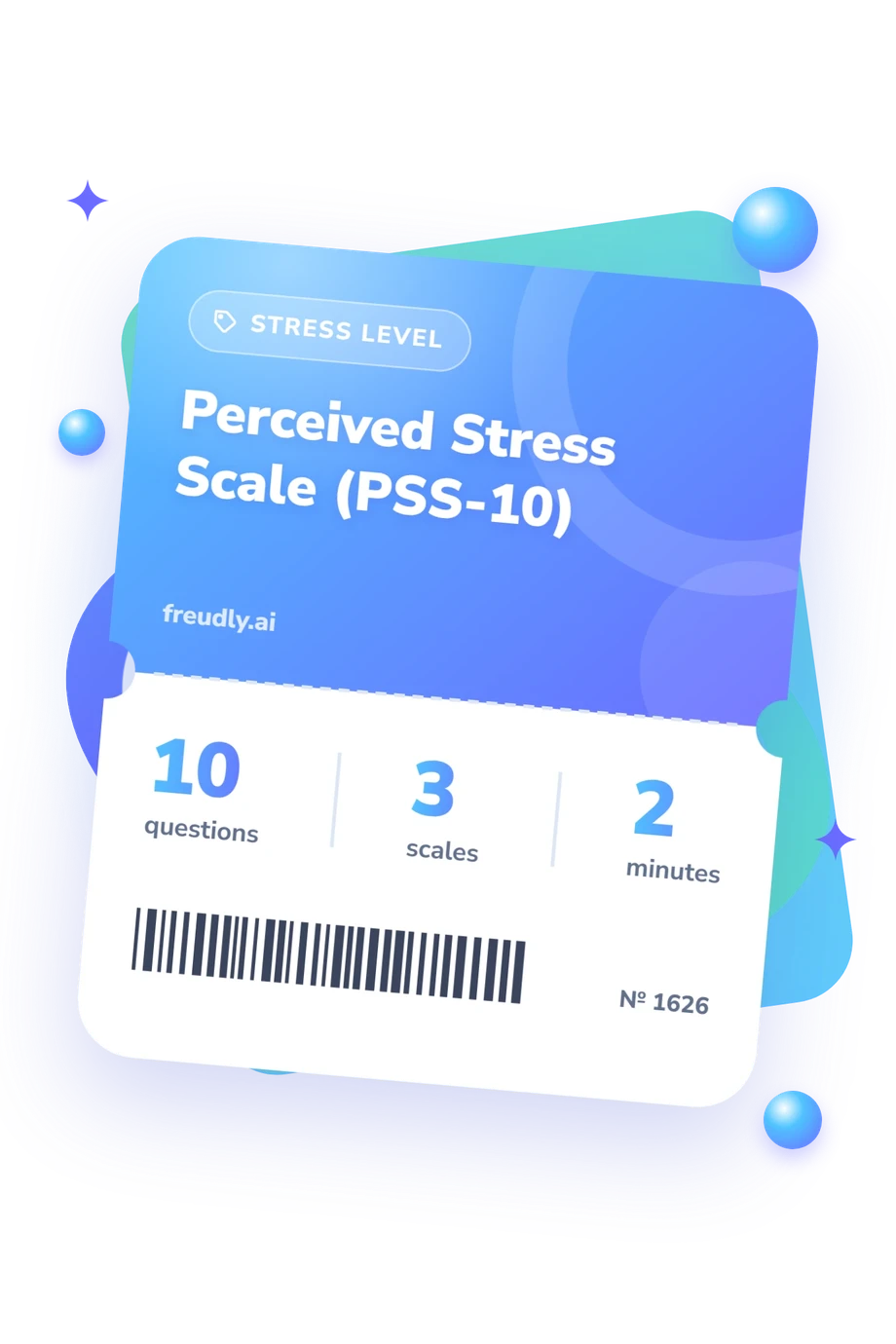
How the Scales are Structured
Who Usually Takes This Test?
See How You Compare
Below is a preview of how scores are typically distributed across each scale.
Example Questions From the Test
- Never
- Almost never
- Sometimes
- Fairly often
- Very often
- Never
- Almost never
- Sometimes
- Fairly often
- Very often
- Never
- Almost never
- Sometimes
- Fairly often
- Very often
Perceived Stress Scale (PSS-10) Test - Description and methodology of the test
People seeking a structured view of how pressure feels in everyday life can use this questionnaire to examine perceived control, emotional strain, and coping. The Perceived Stress Scale (PSS-10) Test presents a concise result profile rather than a list of stressful events. Used as a perceived stress questionnaire, it helps readers identify patterns in current routines that may deserve closer reflection.
What This Assessment Explores
The questionnaire examines how people appraise demands as unpredictable, uncontrollable, or difficult to manage. It suits self-reflection on current pressure, emotional discomfort, and confidence with responsibilities rather than cataloguing events. The result is a profile: pressure may be elevated while coping remains relatively strong, or stress and emotional strain may rise together.
The scales describe these dimensions:
- The Coping Factor (0-16) measures perceived ability to manage stress and use adaptive strategies; Low coping: 0-5, Moderate coping: 6-12, High coping: 13-16.
- The Distress Factor (0-24) reflects psychological discomfort and negative emotions during stressful events; Low distress: 0-5, Moderate distress: 6-14, High distress: 15-24.
- Perceived Stress (0-40) summarizes overall daily stress and difficulty adapting; Low stress: 0-10, Moderate stress: 11-23, High stress: 24-40.
Together, these displays show whether pressure comes with lower coping, greater distress, or both in this perceived stress test.
Methodology and Scientific Basis
Each item asks how often an experience occurred, with five choices from Never to Very often. Themes include unexpected events, nervousness, lack of control, overload, confidence, and feeling on top of things. The wording captures recent appraisal of difficulties and resources.
The repeated frequency format turns subjective appraisals into a structured pattern across recent experiences. Responses produce the three displayed scales, with each result reported in the corresponding band shown for that scale. The displayed bands are descriptive categories, not population norms.
This online questionnaire is conceptually consistent with the PSS-10 described by Cohen and Williamson (1988), but it should not be treated as a validated adaptation of that published instrument. The original PSS was introduced by Cohen, Kamarck, and Mermelstein in 1983. Smith and Emerson’s 2014 study found evidence for a two-factor structure involving general distress and ability to cope in a U.S. public-accounting sample.
Because self-report results can shift with circumstances, wording, self-awareness, and willingness to disclose, a stress coping profile is best used to identify patterns rather than establish a diagnosis.
- Cohen, S., & Williamson, G. M. (1988). Perceived stress in a probability sample of the United States. In S. Spacapan & S. Oskamp (Eds.), The Social Psychology of Health (pp. 31-67). Sage Publications.
- Cohen, S., Kamarck, T., & Mermelstein, R. (1983). A global measure of perceived stress. Journal of Health and Social Behavior, 24(4), 385-396. 10.2307/2136404
- Smith, K. J., & Emerson, D. J. (2014). An assessment of the psychometric properties of the Perceived Stress Scale-10 (PSS10) with a U.S. public accounting sample. Advances in Accounting, 30(2), 309-314. 10.1016/j.adiac.2014.09.005
Updated: