
Academic Persistence Scale Test
How the Scales are Structured
Who Usually Takes This Test?
See How You Compare
Below is a preview of how scores are typically distributed across each scale.
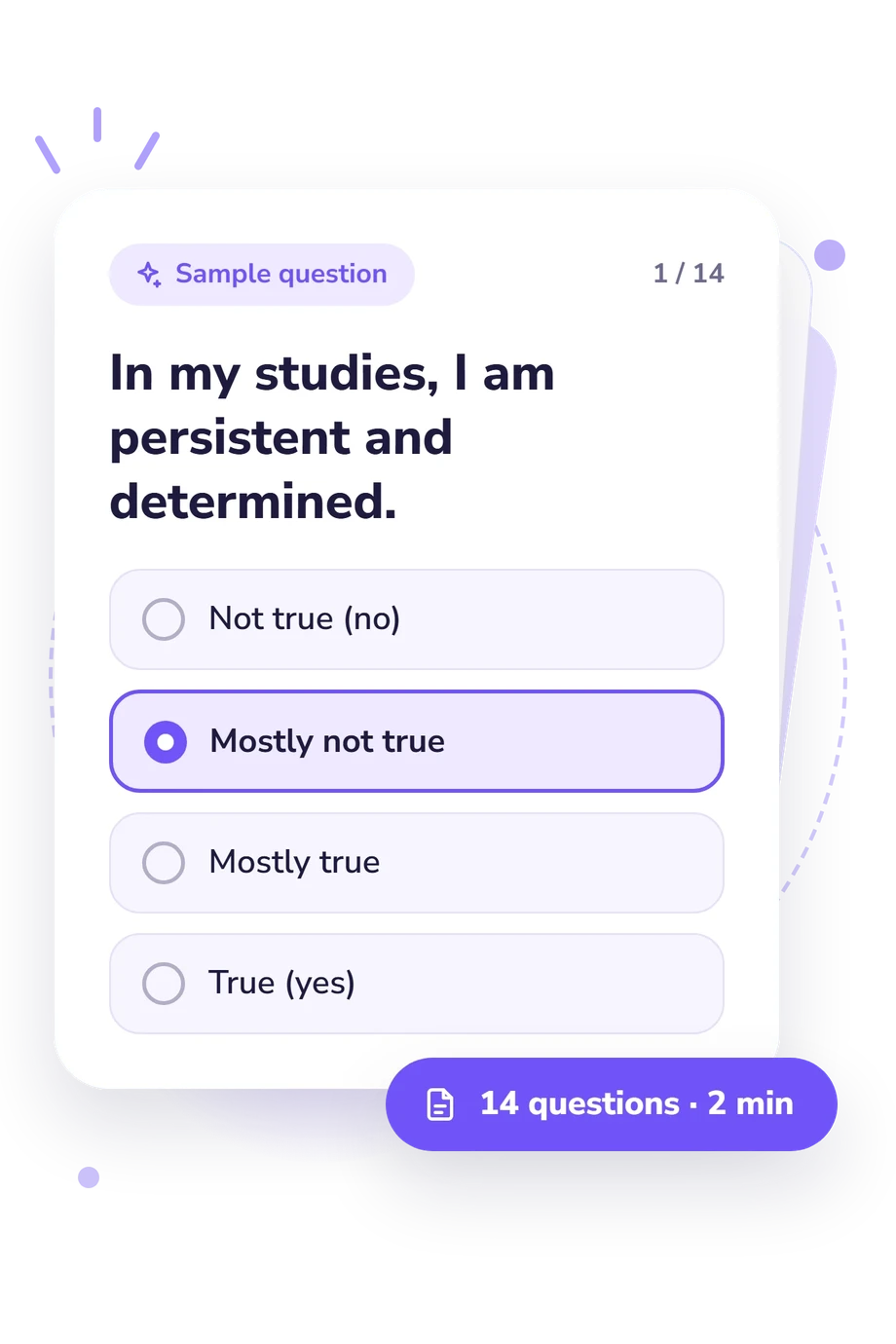
Example Questions From the Test
- Untrue (no)
- Mostly untrue
- Mostly true
- True (yes)
- False (no)
- Somewhat false
- Somewhat true
- True (yes)
- Untrue (no)
- Mostly untrue
- Mostly true
- True (yes)
Academic Persistence Scale Test - Description and methodology of the test
Students who want to understand how they respond to demanding coursework can use the Academic Persistence Scale Test as a focused self-reflection tool. This academic persistence test examines how current study patterns respond to obstacles. The result may help learners identify habits that support continued engagement when motivation falls, without treating persistence as a measure of intelligence or academic ability.
What This Assessment Explores
The assessment examines how a person approaches academic work when effort, difficulty, or unfinished tasks challenge motivation. It suits students and learners seeking a clearer picture of study habits. The result describes persistence in studies as a tendency to continue toward academic goals, not ability or intelligence.
The items address three themes:
- Effort shows how readily the respondent invests energy in study.
- Difficulty shows whether obstacles are linked with giving up or lost motivation.
- Completion shows how consistently begun homework or assignments are finished.
Persistence is scored from 1-4: Low persistence (1-2.29), Moderate persistence (2.3-3.59), or High persistence (3.6-4). Higher scores represent greater perseverance and goal-directed follow-through; lower scores may reflect motivation that drops sooner when work becomes difficult. Some statements are negatively worded, so individual answers should be considered in the context of the full result.
Methodology and Scientific Basis
The academic persistence questionnaire uses self-report statements with four ordered responses, ranging from untrue or false to true. Several items address giving up or reluctance to work hard; some statements are negatively worded, and the item-level formula is not specified.
The displayed score is one indicator. No item-level scoring formula is stated, so the range cannot show how many points each response contributes. The bands describe the pattern in the completed answers rather than a diagnostic threshold.
Evidence is closest to Academic Persistence Scale (Gordeeva & Sychev, 2024). This questionnaire is conceptually consistent with that published scale, not presented as an adaptation of it. Duckworth and colleagues’ grit framework provides related context for sustained effort, while Grit-S illustrates a brief self-report approach to perseverance-related tendencies.
Interpret the outcome as a current self-report pattern. Workload, mood, memory, self-awareness, and self-presentation can affect responses. The online questionnaire has no established norms, reliability estimates, or validation results of its own, and results should not be interpreted using those published instruments’ statistics.
- Gordeeva, T. O., & Sychev, O. A. (2024). Persistence and its diagnostics: Development of a scale of academic persistence. Psychological Journal, 45(5), 113-126. DOI 10.31857/S0205959224050148
- Duckworth, A. L., Peterson, C., Matthews, M. D., & Kelly, D. R. (2007). Grit: Perseverance and passion for long-term goals. Journal of Personality and Social Psychology, 92(6), 1087-1101. DOI 10.1037/0022-3514.92.6.1087
- Duckworth, A. L., & Quinn, P. D. (2009). Development and Validation of the Short Grit Scale (Grit-S). Journal of Personality Assessment, 91(2), 166-174. DOI 10.1080/00223890802634290
Updated: