
General Procrastination Scale (GPS) Test
How the Scales are Structured
Who Usually Takes This Test?
See How You Compare
Below is a preview of how scores are typically distributed across each scale.
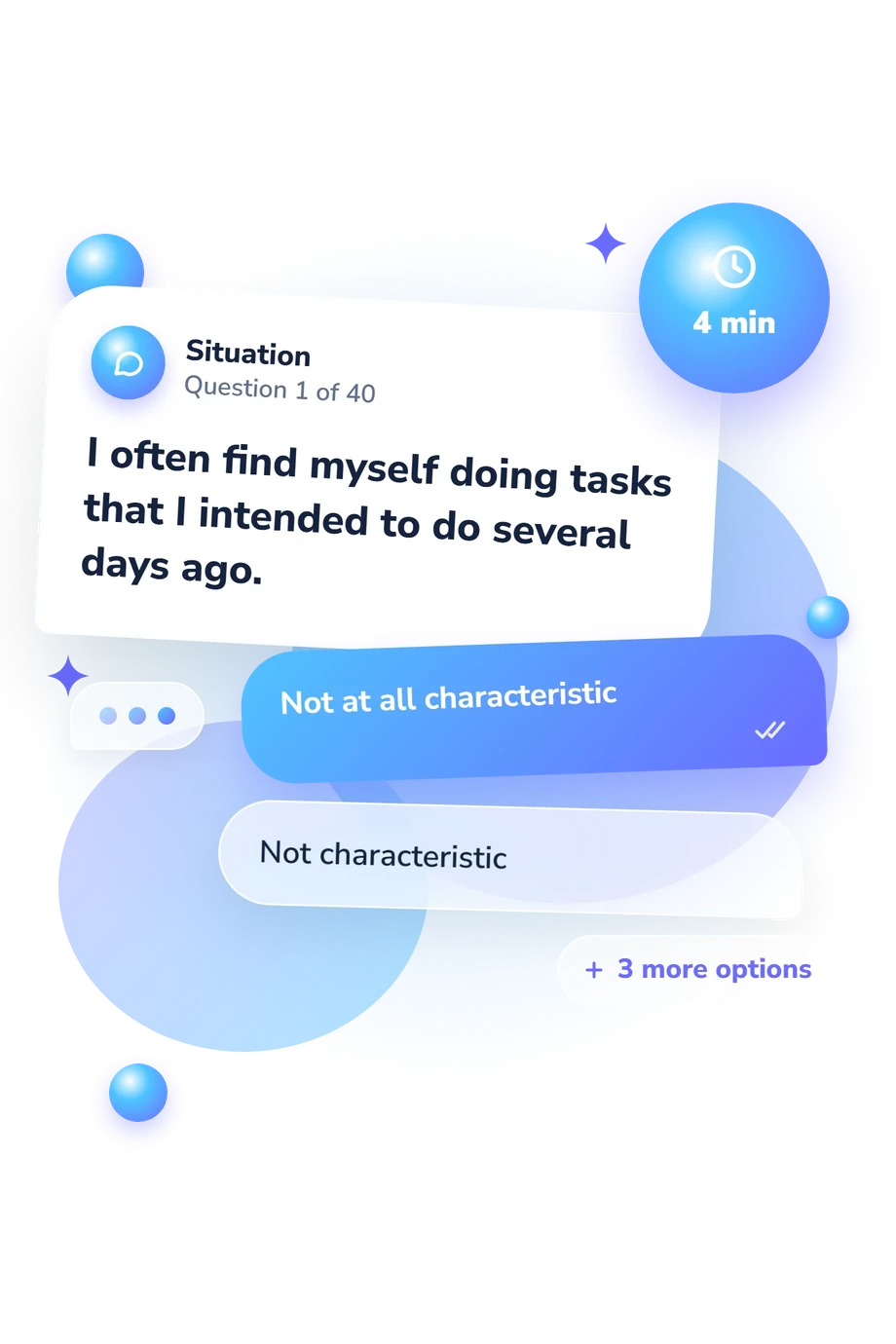
Example Questions From the Test
- Not at all characteristic of me
- Not characteristic of me
- Neutral
- Characteristic of me
- Absolutely characteristic of me
- Completely uncharacteristic
- Not characteristic
- Neutral
- Characteristic
- Absolutely characteristic
- Not at all characteristic
- Not characteristic
- Neutral
- Characteristic
- Absolutely characteristic
General Procrastination Scale (GPS) Test - Description and methodology of the test
People who want to understand a recurring habit of putting things off can use this self-report assessment to examine everyday timing patterns rather than a single missed deadline. The General Procrastination Scale (GPS) Test is intended for anyone reflecting on work, household duties, communication, decisions, and preparation. As a procrastination questionnaire, it offers a general result that can clarify whether delay appears occasional or more consistent across daily life.
What This Assessment Explores
The assessment measures a tendency to delay tasks. Items cover unfinished work, delayed correspondence, late purchases, slow decisions, missed preparation, and last-minute arrangements. Timely behaviors include prompt replies, bill payment, and completing planned duties. This breadth makes the result relevant to procrastination habits in daily life.
Three recurring areas are especially visible:
- Task follow-through shows whether intended work stays unfinished or moves into the future.
- Planning and promptness reflect how early arrangements, replies, decisions, and obligations are handled.
- Last-minute behavior captures rushing, postponed purchases, or replacing required work with other tasks.
Your result presents one scale: General Procrastination, 20-100. Low procrastination (20-42) indicates less delay, Moderate procrastination (43-67) indicates an intermediate tendency, and High procrastination (68-100) indicates more frequent postponement. Higher scores mean greater propensity to put tasks off; lower scores suggest completing tasks without delay, sometimes impulsively.
Methodology and Scientific Basis
Each item asks how characteristic a behavior is, using five options from 1 to 5 with a neutral midpoint. Responses cover both postponing and timely behavior, so individual answers should not be read alone. Higher results indicate greater procrastination, while lower results indicate more prompt completion.
The questionnaire is conceptually consistent with General Procrastination Scale (Lay, 1986), a general self-report measure developed in Lay’s work. Ferrari’s 1989 study examined the GPS and found evidence relevant to reliability over time. Sirois, Yang, and van Eerde’s 2019 GPS-9 paper concerns a later, shorter trait measure; it clarifies the construct but is not the same instrument. This online presentation should not be assumed to share every published version’s standardization, norms, or reliability estimates.
Interpret the result as a snapshot of self-perceived habits. Current workload, stress, routines, self-awareness, and the wish to present oneself favorably can affect responses. A procrastination assessment can guide practical reflection, but the score alone cannot explain causes or distinguish a stable tendency from temporary overload.
- Lay, Clarry H. (1986). At last, my research article on procrastination. Journal of Research in Personality, 20(4), 474-495. 10.1016/0092-6566(86)90127-3
- Ferrari, Joseph R. (1989). Reliability of Academic and Dispositional Measures of Procrastination. Psychological Reports, 64(3_suppl), 1057-1058. 10.2466/pr0.1989.64.3c.1057
- Sirois, Fuschia M., Yang, Sisi, and van Eerde, Wendelien. (2019). Development and validation of the General Procrastination Scale (GPS-9): A short and reliable measure of trait procrastination. Personality and Individual Differences, 146, 26-33. 10.1016/j.paid.2019.03.039
Updated: