
Utrecht Work Engagement Scale (UWES) Test
How the Scales are Structured
Who Usually Takes This Test?
See How You Compare
Below is a preview of how scores are typically distributed across each scale.
Example Questions From the Test
- Never
- Very rarely
- Rarely
- Sometimes
- Often
- Very often
- Every day
- Never
- Very rarely
- Rarely
- Sometimes
- Often
- Very often
- Every day
- Never
- Very rarely
- Rarely
- Sometimes
- Often
- Very often
- Every day
Utrecht Work Engagement Scale (UWES) Test - Description and methodology of the test
People reflecting on how work currently feels may use the Utrecht Work Engagement Scale (UWES) Test to organize experiences of energy, meaning, and immersion. A work engagement questionnaire like this is intended for employees and other working adults who want a clearer profile of motivation, concentration, and persistence. Comparing the dimensions can help a worker see which aspects of work currently feel most sustainable or demanding.
What Work Engagement Involves
Work engagement describes a positive relationship with one’s job, involving energy, connection, persistence, pride, and involvement. The items ask about meaningful work, enthusiasm, sustained effort, concentration, enjoyment, and difficulty disengaging. An employee engagement assessment can show whether experience is marked more by depleted energy, reduced meaning, limited immersion, or a stronger combination.
The three result dimensions are:
- Absorption (0-6) reflects concentration, immersion, enjoyment, and altered time awareness; Low absorption 0-2, Moderate absorption 3-4, and High absorption 5-6.
- Enthusiasm (0-6) reflects meaning, inspiration, pride, and connection with the job; Low 0-2, Moderate 3-4, and High 5-6.
- Vigor (0-6) reflects energy, effort, and persistence during difficulty; Low energy 0-2, Moderate energy 3-4, and High energy 5-6.
Together, the profile shows whether engagement is even or concentrated in one area. It describes current work-related tendencies, not a permanent trait.
Methodology and Evidence
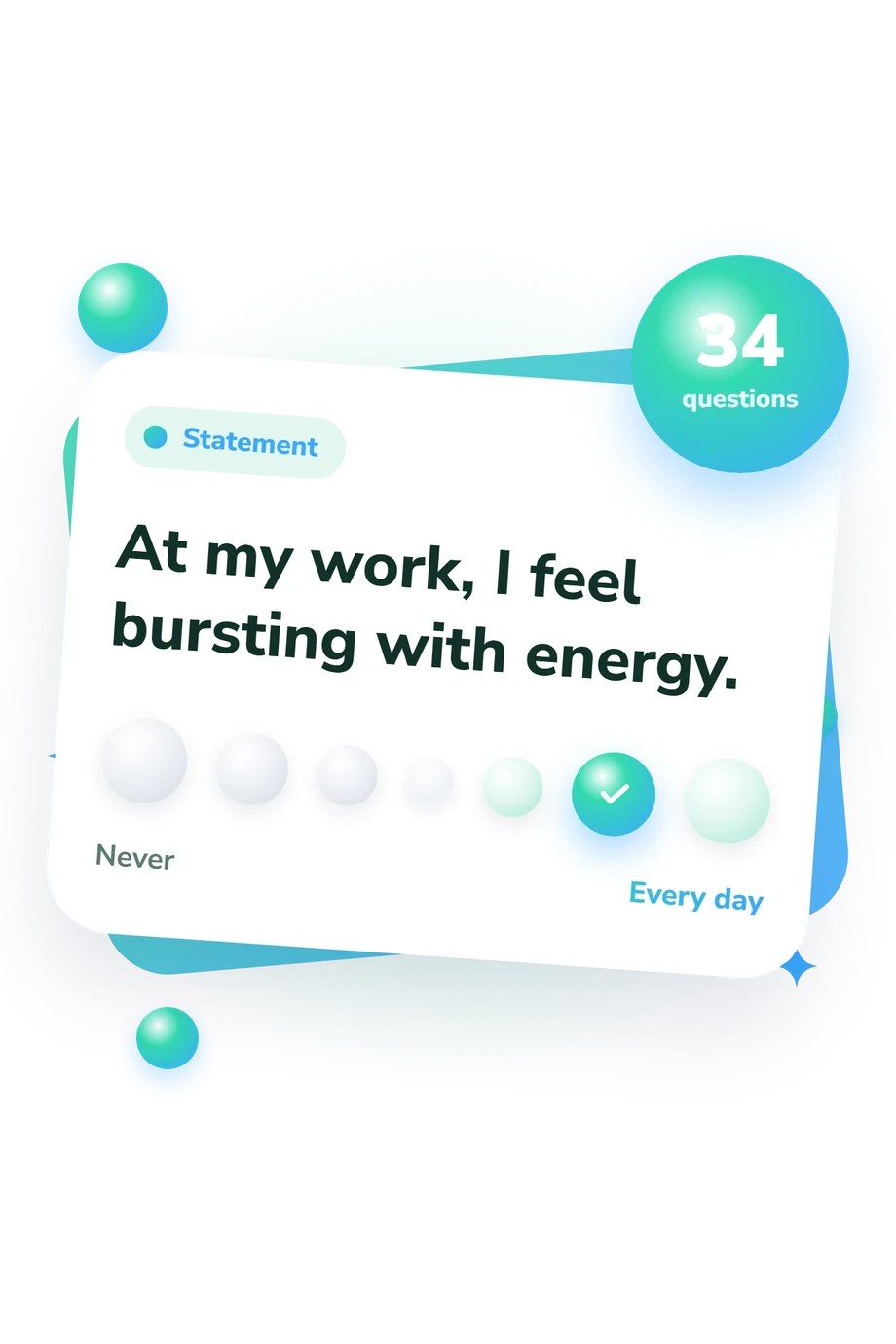
Each item uses seven frequency choices, from Never to Every day. It asks how often experiences occur rather than whether the respondent agrees with a description. Current workload can affect responses, so answer for a usual work pattern.
Responses are grouped into three dimensions, and the online result presents them as a profile in displayed categories. Response choices run from 1 to 7, while displayed scores run from 0 to 6; the questionnaire’s item-to-score conversion is not documented, so read the profile descriptively rather than reconstructing an unreported formula.
The original UWES manual by Schaufeli and Bakker and related studies provide a conceptual comparison and evidence for the source construct. Confirmatory-factor, multisample, and longitudinal studies support treating engagement as related but distinguishable dimensions. Those sources do not validate this online questionnaire, its scoring, or its scale labels; it is conceptually consistent with the UWES, not the published scale itself.
For reflection, this work engagement self-assessment highlights motivation, immersion, and stamina. Self-report varies with mood, workload, expectations, and self-awareness, so read its profile in context.
- Schaufeli, W. B., & Bakker, A. B. (2004). UWES. Utrecht Work Engagement Scale. Preliminary Manual (Version 1.1). Occupational Health Psychology Unit, Utrecht University.
- Schaufeli, W. B., Salanova, M., González-Romá, V., & Bakker, A. B. (2002). The Measurement of Engagement and Burnout: A Two Sample Confirmatory Factor Analytic Approach. Journal of Happiness Studies, 3(1), 71-92. 10.1023/A:1015630930326
- Seppälä, P., Mauno, S., Feldt, T., Hakanen, J., Kinnunen, U., Tolvanen, A., & Schaufeli, W. (2009). The Construct Validity of the Utrecht Work Engagement Scale: Multisample and Longitudinal Evidence. Journal of Happiness Studies, 10(4), 459-481. 10.1007/s10902-008-9100-y
Updated: