
Disgust Scale–Revised (DS-R) Test
How the Scales are Structured
Who Usually Takes This Test?
See How You Compare
Below is a preview of how scores are typically distributed across each scale.
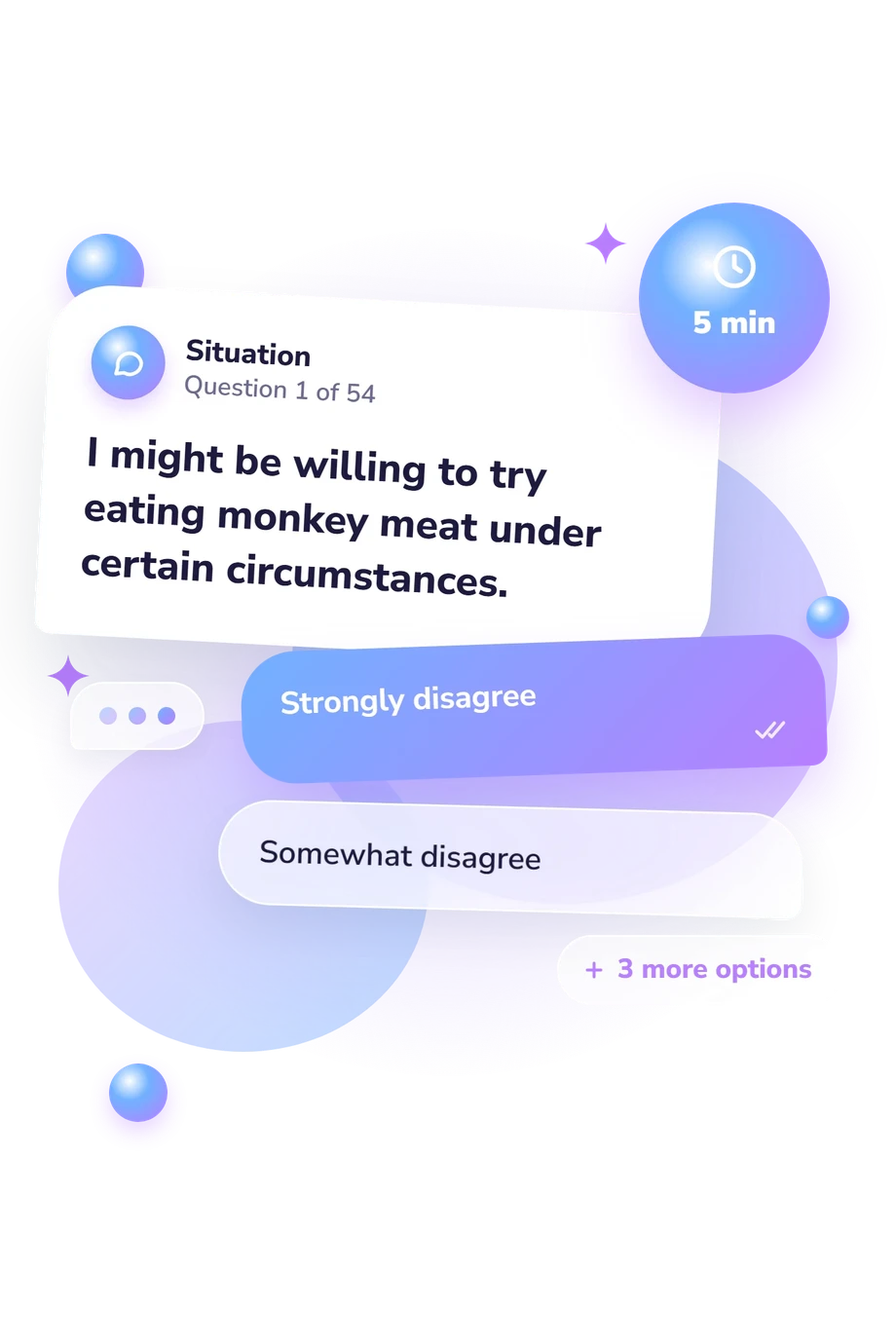
Example Questions From the Test
- Strongly disagree
- Somewhat disagree
- Not sure
- Somewhat agree
- Strongly agree
- Strongly disagree
- Somewhat disagree
- Not sure
- Somewhat agree
- Strongly agree
- Strongly disagree
- Somewhat disagree
- Unsure
- Somewhat agree
- Strongly agree
Disgust Scale–Revised (DS-R) Test - Description and methodology of the test
For readers who want to compare their own disgust profile across situations, the Disgust Scale-Revised (DS-R) Test offers a structured way to examine personal response patterns. It suits people curious about how their reactions differ from one situation to another. This disgust assessment organizes those responses into interpretable tendencies, giving the profile a more specific meaning.
What This Assessment Explores
Disgust involves related reactions rather than one feeling. Items address contamination, bodily processes and injury, animals, food, unusual combinations, and death reminders. Agreement statements capture anticipated discomfort, aversion, or avoidance, while scene ratings capture intensity. As a disgust sensitivity test, this assessment shows where responses cluster. Results are organized into three content domains plus an overall disgust-sensitivity scale:
- Contamination (0-4) measures perceived transfer between people and hygiene concerns: Low 0-1.2; Moderate 1.2-2.8; High 2.8-4.
- Animal Reminder Disgust (0-4) measures bodily, medical, odor, injury, and mortality cues: Low 0-1.4; Moderate 1.5-3; High 3.1-4.
- Core Disgust (0-4) measures oral, food, excretion, and food-source-animal cues: Low 0-1.6; Moderate 1.6-2.7; High 2.7-4.
- Disgust Sensitivity (0-4) measures general susceptibility and tolerance of disgust-eliciting cues: Low 0-1.4; Moderate 1.5-2.7; High 2.8-4.
Methodology and Evidence Base
Five response options range across agreement or disgust intensity: agreement items run from strongly disagree to strongly agree, though some include Not sure, Unsure, or Cannot answer; scenarios run from not disgusting at all to extremely disgusting. This disgust scale questionnaire captures discomfort, aversion, avoidance, and reaction intensity.
The questionnaire reports results across dimensions, but does not state how answers become points or whether items receive different weights. Those rules should not be inferred from the ranges. Read the profile comparatively: a higher value indicates more of the tendency represented by that dimension. Bands provide descriptive ranges for interpreting the profile.
Its evidence base is conceptually consistent with the Disgust Scale-Revised (DS-R) described by Olatunji and colleagues (2007), which examined item structure and refinement. The three-domain framework aligns with Olatunji et al. (2008), while disgust sensitivity traces to Haidt, McCauley, and Rozin (1994). This online presentation should not be assumed to share the instruments’ norms, reliability, or validity. Self-report results can vary with context, self-awareness, and response style, so profile is best used for reflection rather than diagnosis.
- Olatunji, B. O., Williams, N. L., Tolin, D. F., Abramowitz, J. S., Sawchuk, C. N., Lohr, J. M., & Elwood, L. S. (2007). The Disgust Scale: Item Analysis, Factor Structure, and Suggestions for Refinement. Psychological Assessment, 19(3), 281-297. 10.1037/1040-3590.19.3.281
- Olatunji, B. O., Haidt, J., McKay, D., & David, B. (2008). Core, Animal Reminder, and Contamination Disgust: Three Kinds of Disgust with Distinct Personality, Behavioral, Physiological, and Clinical Correlates. Journal of Research in Personality, 42(5), 1243-1259. 10.1016/j.jrp.2008.03.009
- Haidt, J., McCauley, C. R., & Rozin, P. (1994). Individual Differences in Sensitivity to Disgust: A Scale Sampling Seven Domains of Disgust Elicitors. Personality and Individual Differences, 16(5), 701-713. 10.1016/0191-8869(94)90212-7
Updated: