
Rosenberg Trust Scale Test
How the Scales are Structured
Who Usually Takes This Test?
See How You Compare
Below is a preview of how scores are typically distributed across each scale.
Example Questions From the Test
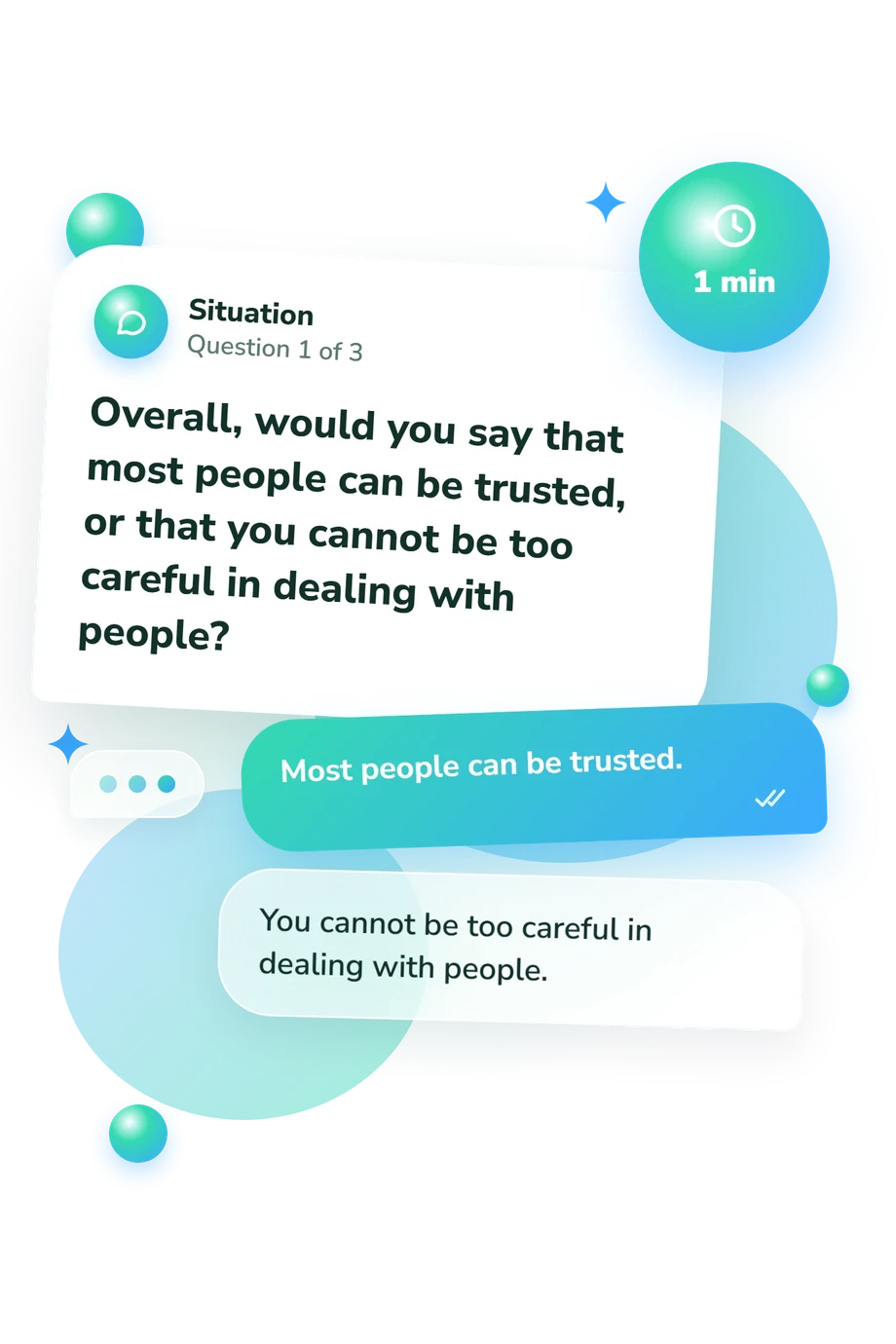
- Most people can be trusted.
- You cannot be too careful in dealing with people.
- People try to be helpful to others.
- People think only about themselves.
- Would try to take advantage of you if they had the chance.
- Would be honest.
Rosenberg Trust Scale Test - Description and methodology of the test
People who want to examine their assumptions about other people may use the Rosenberg Trust Scale Test as a brief self-report exercise. It suits readers interested in an interpersonal trust test that summarizes a general outlook rather than reactions to one relationship, encounter, or recent event. The result supports focused self-reflection about how openness, caution, and expectations shape everyday interactions.
What This Assessment Measures
Rather than rating a particular person, the questionnaire examines whether people are generally viewed as trustworthy, helpful, honest, or likely to take advantage. Its themes concern broad social expectations rather than specific situations, while the result reflects the general judgments elicited by the items and may characterize interpersonal interaction patterns.
The three items treat generalized trust as one overall dimension. The Trust scale (0-3) is shown in these bands:
- Low trust (0-1) indicates guarded expectations of unreliability or exploitation.
- Balanced trust (2-2) indicates openness tempered by ordinary caution.
- High trust (3-3) indicates strong expectations of helpfulness, honesty, and confidence in others.
The score does not explain the causes of those judgments or predict conduct in every setting.
Methodology and Evidence Base
Each item presents a forced choice between two broad views of other people. One option conveys trust or helpfulness; the other emphasizes caution, selfish motives, or possible exploitation. Together, the prompts form a compact self-report snapshot rather than a detailed interview or multi-domain personality profile.
The questionnaire displays one Trust score and a result band, but the item-to-point weighting is not stated. The displayed questionnaire does not provide normative reference data or a clinical cutoff, so the result should be interpreted descriptively unless stronger documentation is available.
The three prompts correspond to the generalized-trust items associated with Rosenberg and discussed by Smith (1996); this online presentation should not be assumed to share the published measure’s norms or validation. Robbins (2023) provides broader context for measuring generalized trust, but it does not validate this three-item online questionnaire.
Because the assessment is brief, its result can reflect current mood, recent social experiences, and willingness to answer candidly. A single score cannot capture cultural expectations, relationship-specific trust, or changes across situations.
- Smith, Tom W. (1996). Factors Relating to Misanthropy in Contemporary American Society. GSS Topical Report No. 29. Chicago: National Opinion Research Center, University of Chicago.
- Rosenberg, Morris. (1956). Misanthropy and Political Ideology. American Sociological Review, 21(6), 690-695. 10.2307/2088419
- Robbins, Blaine G. (2023). Valid and Reliable Measures of Generalized Trust: Evidence from a Nationally Representative Survey and Behavioral Experiment. Socius: Sociological Research for a Dynamic World, 9. 10.1177/23780231231192841
Updated: