
Freudly+971 508685814hello@freudly.ai
Freudly
spiral dynamics

Level of Consciousness (Child) Test
Take the online Level of Consciousness (Child) Test - AI psychologist FreudlyYou can take Level of Consciousness (Child) Testhere. Online version of a simple and accurate psychological test with interpretation.en
Understand how a child sees the world and what drives choices in about 3 minutes. Get a clear read on values, thinking style, and likely growth areas to guide support at home or school.
Start Online Test
Questions: 153 minutes
08:30
October 2, 2025
October 2, 2025
Material has been updated
October 2, 2025
Material has been published
19,876 views
1,547 completions
1,283 likes
Verified by Daniel Hall
Psychologist with 25 years of experience
Share
Scale Explorer

How the Scales are Structured

example score
49/100
Turquoise (T)
Measures the extent to which a child shows holistic, unity-oriented thinking, compassion, and a sense of interconnectedness with others and the world.
Emerging
Developing
Strong
033: Emerging | 3466: Developing | 67100: Strong
A score of 49 falls in the Developing range, suggesting a moderate tendency toward holistic, compassionate, interconnected perspectives that may appear in some situations more than others.
example score
63/100
Yellow (Y)
Measures the degree of systemic, integrative thinking and flexible problem-solving through seeing connections and synthesizing knowledge.
Developing
Emerging
Strong
039: Developing | 4069: Emerging | 70100: Strong
A score of 63 suggests an emerging Yellow pattern, with growing ability to integrate perspectives and adapt strategies while still consolidating consistent systems-level thinking.
example score
79/100
Green (G)
Measures the extent to which a child shows Green-level values such as empathy, fairness, cooperation, and harmony-focused thinking.
Emerging Green
Developing Green
Strong Green
039: Emerging Green | 4069: Developing Green | 70100: Strong Green
A score of 79 falls in the Strong Green range, suggesting the child often prioritizes empathy, inclusion, and collaborative solutions when interacting with others.
example score
78/100
Orange (O)
Measures the extent to which a child shows Orange-level values such as achievement focus, strategic thinking, efficiency, and innovation.
Low Orange
Moderate Orange
High Orange
033: Low Orange | 3466: Moderate Orange | 67100: High Orange
A score of 78 indicates a high Orange orientation, suggesting strong motivation toward achievement, goal-focused problem-solving, and practical results.
example score
20/100
Blue (B)
Measures how strongly a child tends toward rule-following, respect for authority, and preference for order and duty (Blue values).
Low Blue
Moderate Blue
High Blue
033: Low Blue | 3466: Moderate Blue | 67100: High Blue
A score of 20 falls in the Low Blue range, suggesting rules, discipline, and deference to authority are not a primary driver compared with other motivations.
example score
50/100
Red (R)
Measures the child’s tendency toward impulsive, power-oriented, rule-resistant behavior and focus on immediate gratification.
Low Red
Moderate Red
High Red
033: Low Red | 3466: Moderate Red | 67100: High Red
A score of 50 indicates a moderate presence of Red traits, suggesting the child sometimes seeks autonomy and immediate rewards and may test limits, but this is not consistently dominant.
example score
60/100
Purple (P)
Measures the extent to which a child’s worldview emphasizes belonging, tradition, and security through group rituals and shared meanings.
Low
Moderate
High
033: Low | 3466: Moderate | 67100: High
A score of 60 suggests a moderately strong Purple orientation, with notable importance placed on group belonging, familiar routines, and feeling protected by shared traditions.
example score
41/100
Beige (B)
Measures the extent to which a child’s thinking and motivation are driven by immediate, instinctive survival and basic physical needs.
Low Beige
Moderate Beige
High Beige
033: Low Beige | 3466: Moderate Beige | 67100: High Beige
A score of 41 suggests a moderate Beige expression, indicating that present-focused, concrete, need-driven responses may show up in some situations but are not consistently dominant.
Start Online Test
just completed the test
DATA-BASED USER COHORTS

Who Usually Takes This Test?

Curious parents of kids
44%OF USERS
Parents of 7–12-year-olds take it to understand what motivates their child and how to support the next step in maturity.
Teachers and school staff
33%OF USERS
Educators use it to tailor classroom expectations and communication to a child’s current worldview and values.
Child psychologists and counselors
23%OF USERS
Practitioners take it as a quick screening tool to guide conversations about behavior, needs, and development.
BASED ON AGGREGATED, ANONYMIZED DATA FROM TENS OF THOUSANDS OF FREUDLY USERS.
Benchmarking

See How You Compare

Once you complete the test, your results are compared with real-world data from people in your country.
Below is a preview of how scores are typically distributed across each scale.
Turquoise (T)
Turquoise (T)
Average
27
Normal range
8.845.2
min.
0
max.
100
This curve shows how scores are typically distributed.
Once you complete the test, your result will appear on the scale so you can see how you compare.
Yellow (Y)
Yellow (Y)
Average
36.9
Normal range
19.754.1
min.
0
max.
100
This curve shows how scores are typically distributed.
Once you complete the test, your result will appear on the scale so you can see how you compare.
Green (G)
Green (G)
Average
48.5
Normal range
32.264.9
min.
0
max.
100
This curve shows how scores are typically distributed.
Once you complete the test, your result will appear on the scale so you can see how you compare.
Orange (O)
Orange (O)
Average
73.7
Normal range
57.889.7
min.
0
max.
100
This curve shows how scores are typically distributed.
Once you complete the test, your result will appear on the scale so you can see how you compare.
Blue (B)
Blue (B)
Average
61.2
Normal range
4577.5
min.
0
max.
100
This curve shows how scores are typically distributed.
Once you complete the test, your result will appear on the scale so you can see how you compare.
Red (R)
Red (R)
Average
60.4
Normal range
4773.7
min.
0
max.
100
This curve shows how scores are typically distributed.
Once you complete the test, your result will appear on the scale so you can see how you compare.
Purple (P)
Purple (P)
Average
43.4
Normal range
30.356.6
min.
0
max.
100
This curve shows how scores are typically distributed.
Once you complete the test, your result will appear on the scale so you can see how you compare.
Beige (B)
Beige (B)
Average
64
Normal range
47.580.5
min.
0
max.
100
This curve shows how scores are typically distributed.
Once you complete the test, your result will appear on the scale so you can see how you compare.
Featured On
SAMPLE QUESTIONS

Example Questions From the Test

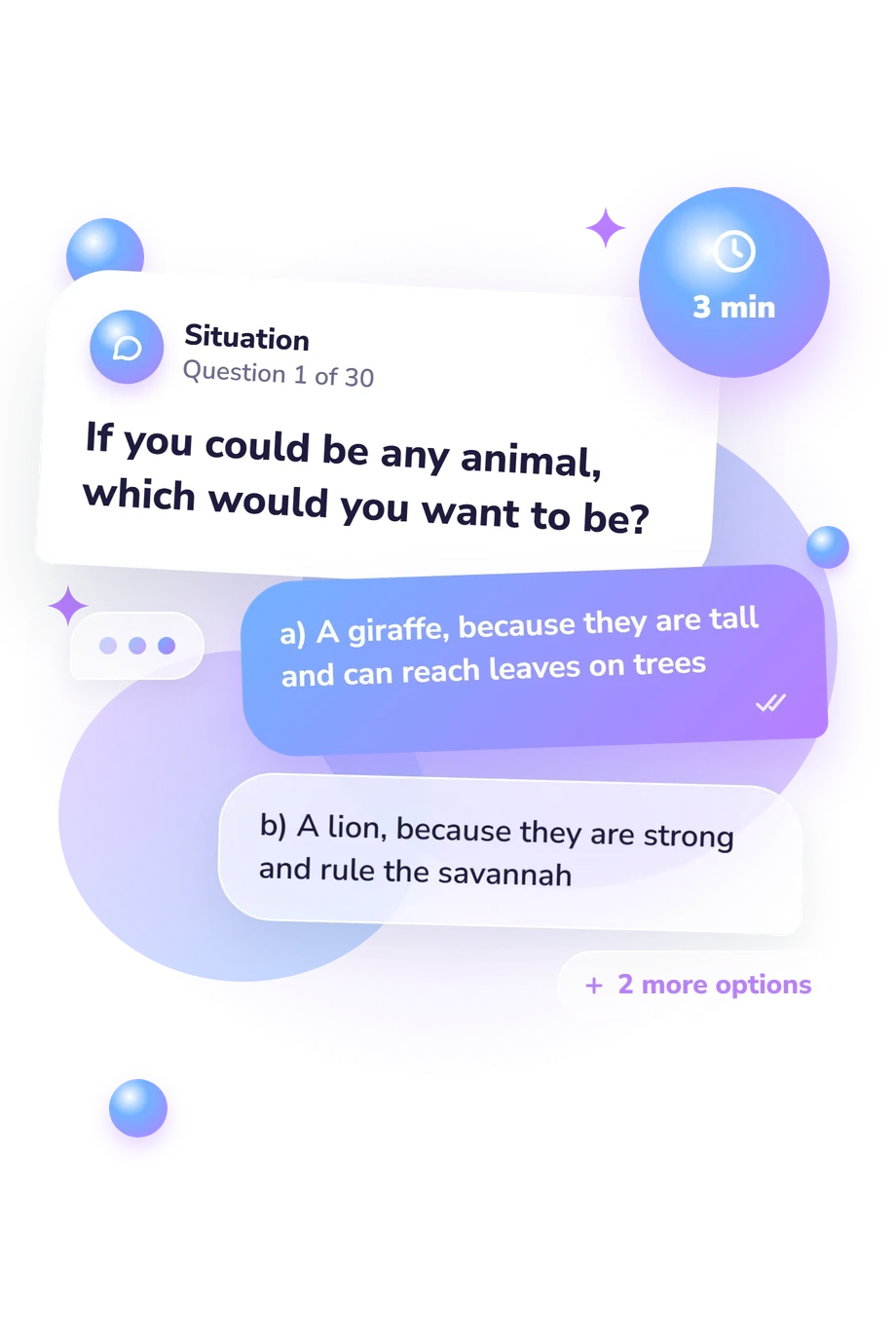
This test consists of a series of questions, each designed to assess your level of awareness across different areas of life. Please answer each question honestly and sincerely, without attempting to meet any particular expectations. For each question, no more than three response options may be selected.
    • a) A giraffe, because they are tall and can reach leaves on trees
    • b) A lion, because they are strong and rule the savanna
    • c) Pigeons, because they are always together with their flock
    • d) A human, because they are smart and can do many interesting things
    • They are important because they help us live safely and in harmony.
    • I follow rules only when I do not want to be punished.
    • I prefer to do what I like, even if I break the rules.
    • I think all people are equal and no one should be above others.
    • I prefer to be myself and do what I enjoy.
    • I think we are all connected and should help each other.
    • I want to be stronger and more powerful than other people.
    • I do not trust others; I need to protect myself.
WHAT THE TEST MEASURES
About This Assessment
Level of consciousness (childhood) Test

Level of Consciousness (Child) Test - Symptoms and Signs

spiral dynamics
personality type

This brief screening tool is designed to support structured observation of a child’s current orientation to rules, needs, and decision-making. Level of Consciousness (Child) is administered as a short self-report questionnaire intended to summarize broad patterns in how a child describes motivations and perspective-taking.

The measure includes 15 items and typically takes about 3 minutes to complete. It is attributed to Mary Ainsworth.

Results from Level of Consciousness (Child) are best interpreted as descriptive indicators to inform conversation and planning in educational or supportive settings, rather than as a standalone diagnostic determination. Use should consider developmental level, language comprehension, and contextual factors that may influence responses.

Author: Mary Ainsworth
Literature: Zelazo, P. D., & Carlson, S. M. Hot and cool executive function in childhood and adolescence: Development and plasticity. Child Development Perspectives. 2012.
Popular tests
Comments
Leave a Comment