
Children's Hopelessness Scale (HSC) Test
How the Scales are Structured
Who Usually Takes This Test?
See How You Compare
Below is a preview of how scores are typically distributed across each scale.
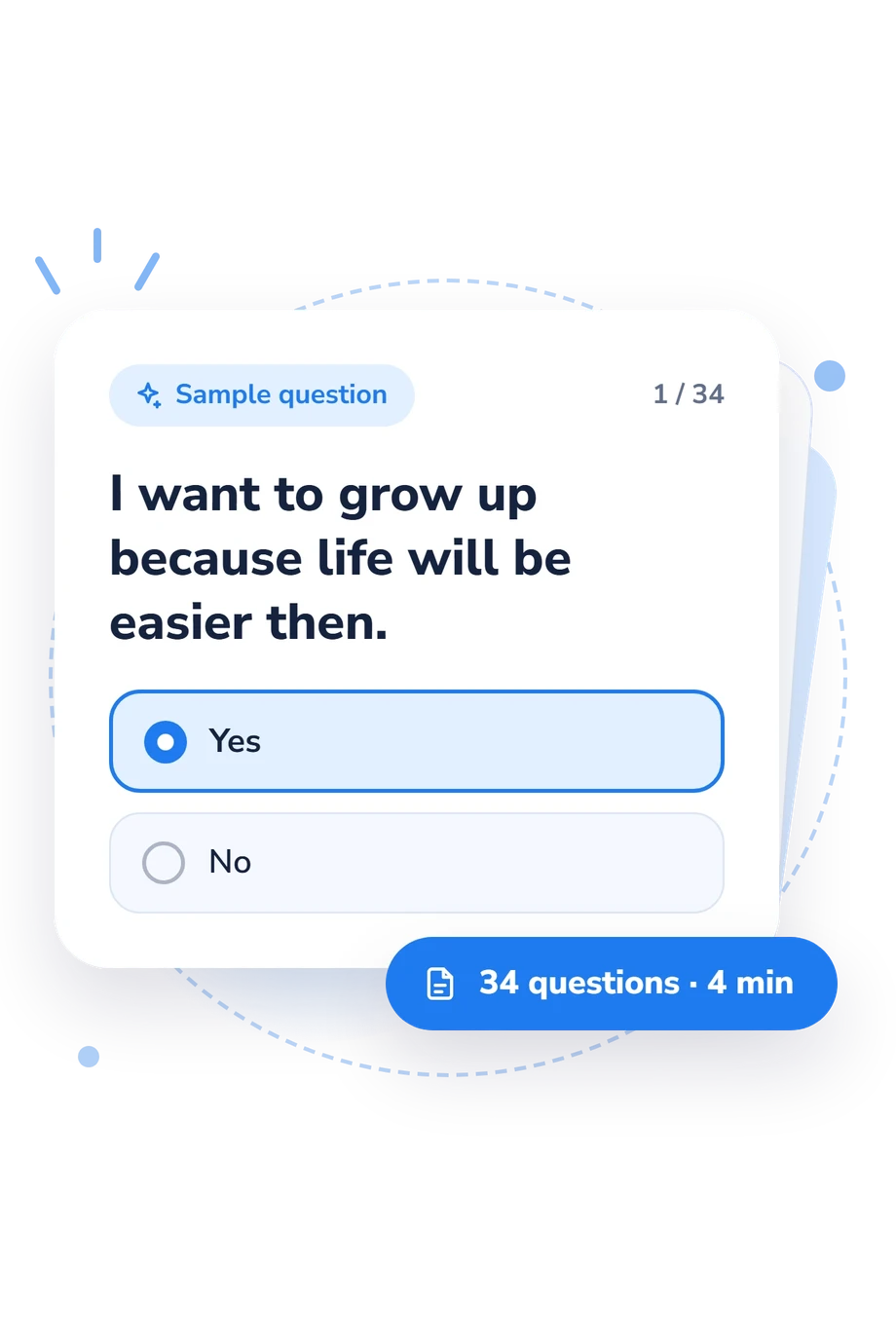
Example Questions From the Test
- Yes
- No
- Yes
- No
- Yes
- No
Children's Hopelessness Scale (HSC) Test - Description and methodology of the test
For adolescents and the adults supporting them, this assessment offers a structured way to examine beliefs about effort, possibility, and change. The Children's Hopelessness Scale (HSC) Test gives those reflections a consistent format without reducing a young person to a single label. As a questionnaire about hopelessness in adolescence, it can organize themes worth discussing with a trusted adult or clinician.
What This Test Measures
The items address expectations about present and future life. They ask whether an adolescent expects improvement, imagines a future, believes effort will pay off, or anticipates disappointment. Effort, time, and goals are themes in the statements, not separate scores; the result is organized into two displayed attitudes.
These are the two scales:
- Positive Attitude (0-8) measures positive orientation toward the future. Low 0-2, Moderate 3-5, and High 6-8 indicate increasing optimism and constructive problem solving.
- Negative Attitude (0-9) measures negative attitudes toward present and future life. Low 0-2, Moderate 3-5, and High 6-9 indicate stronger negative expectations that may accompany depressive symptoms and increased suicide risk; the published scale also has prognostic value for estimating the likelihood of developing depression in adolescents, a claim not independently established by this online result.
This frames adolescent hopelessness as themes for discussion.
Methodology and Evidence Base
The self-report format uses a binary Yes/No choice for each statement, making the task straightforward without rating scales or extended written answers. Responses are organized into the two displayed dimensions. The online version has no stated standardized item-level scoring rule or norms, so individual answer weights should not be inferred; its displayed bands provide the available descriptive interpretation.
The questionnaire is conceptually consistent with the published Hopelessness Scale for Children (HSC), described by Kazdin and colleagues in 1983. A 1986 study by Kazdin, Rodgers, and Colbus examined its psychometric characteristics and concurrent validity, while a 1988 study by Spirito, Williams, Stark, and Hart studied psychometric properties in normal and emotionally disturbed adolescents. Those studies concern the published instrument, not this online version, so they do not validate or norm its results.
Stress, self-awareness, and honest responding can affect results. The format can organize reflection, but the profile should be read alongside the young person's circumstances and wider assessment rather than treated as a diagnosis.
- Kazdin, A. E., French, N. H., Unis, A. S., Esveldt-Dawson, K., & Sherick, R. B. (1983). Hopelessness, depression, and suicidal intent among psychiatrically disturbed inpatient children. Journal of Consulting and Clinical Psychology, 51(4), 504-510. 10.1037/0022-006X.51.4.504
- Kazdin, A. E., Rodgers, A., & Colbus, D. (1986). The Hopelessness Scale for Children: Psychometric characteristics and concurrent validity. Journal of Consulting and Clinical Psychology, 54(2), 241-245. 10.1037/0022-006X.54.2.241
- Spirito, A., Williams, C. A., Stark, L. J., & Hart, K. J. (1988). The Hopelessness Scale for Children: Psychometric properties with normal and emotionally disturbed adolescents. Journal of Abnormal Child Psychology, 16(4), 445-458. 10.1007/BF00914174
Updated: