
Freudly+971 508685814hello@freudly.ai
Freudly
addiction

Chen Internet Addiction Scale (CIAS) Test
Take the online Chen Internet Addiction Scale (CIAS) Test - AI psychologist FreudlyYou can take Chen Internet Addiction Scale (CIAS) Testhere. Online version of a simple and accurate psychological test with interpretation.en
Understand how online habits may be affecting your life in about 5 minutes. This 26 item check spots key addiction signs and helps guide counseling, risk screening, and tracking progress over time.
Start Online Test
Questions: 265 minutes
08:30
October 2, 2025
October 2, 2025
Material has been updated
October 2, 2025
Material has been published
13,596 views
907 completions
782 likes
Verified by Daniel Hall
Psychologist with 25 years of experience
Share
Scale Explorer

How the Scales are Structured

example score
20/48
Negative Consequences (RP) (NC)
Assesses the extent to which internet use is linked to intrapersonal difficulties and time-management problems that create negative life impact.
Low impact
Moderate impact
High impact
1223: Low impact | 2435: Moderate impact | 3648: High impact
A score of 20 falls in the Low impact range, suggesting relatively limited negative consequences from internet use in terms of personal well-being and time management.
example score
23/56
Composite Symptoms (IAS) (CS)
Integral symptoms (IAS) measures overall severity of key internet-addiction manifestations across compulsivity, withdrawal, and tolerance.
Low symptoms
Moderate symptoms
High symptoms
1427: Low symptoms | 2841: Moderate symptoms | 4256: High symptoms
A score of 23 falls in the Low symptoms range, suggesting relatively mild overall expression of compulsive use, withdrawal reactions, and tolerance.
example score
12/20
Time Management (TM) (TM)
Assesses how internet use affects planning and following a daily routine, including control over time spent online.
Low impact
Moderate impact
High impact
59: Low impact | 1014: Moderate impact | 1520: High impact
A score of 12 falls in the Moderate impact range, suggesting some difficulty keeping routines and limiting online time consistently.
example score
19/28
Intrapersonal and Health-Related Problems (IH) (IaHRP)
Assesses how internet use is associated with intrapersonal difficulties and impacts psychological and physical well-being.
Low impact
Moderate impact
High impact
713: Low impact | 1420: Moderate impact | 2128: High impact
A score of 19 falls in the Moderate impact range, suggesting noticeable intrapersonal or health-related strain associated with internet use without being in the highest range.
example score
9/16
Tolerance (TOL) (T)
Measures the extent to which a person needs increasing amounts of time online to achieve the same level of satisfaction.
Low tolerance
Moderate tolerance
High tolerance
47: Low tolerance | 811: Moderate tolerance | 1216: High tolerance
A score of 9 falls in the Moderate tolerance range, suggesting some tendency to need more time online to feel similarly satisfied compared with earlier levels.
example score
14/20
Withdrawal Symptoms (WIT) (WS)
Assesses the intensity of discomfort (e.g., irritability or anxiety) when internet access is limited or unavailable.
Low
Moderate
High
59: Low | 1014: Moderate | 1520: High
A score of 14 falls in the Moderate range, suggesting noticeable withdrawal-related discomfort when unable to use the internet.
example score
12/20
Compulsive Symptoms (COM) (CS)
Measures the extent to which a person feels compelled to stay online and has difficulty controlling the urge to remain connected.
Low
Moderate
High
59: Low | 1014: Moderate | 1520: High
A score of 12 falls in the Moderate range, suggesting a noticeable tendency toward compulsive internet use that may sometimes be hard to regulate.
example score
74/104
Internet Addiction Scale (IAS)
Measures the severity of internet addictive behavior by capturing core symptoms (tolerance, withdrawal, compulsivity) and related negative consequences.
Low
Moderate
High
2642: Low | 4364: Moderate | 65104: High
A score of 74 falls in the High range, suggesting a pronounced tendency toward problematic internet use with stronger symptoms and impacts.
Start Online Test
just completed the test
DATA-BASED USER COHORTS

Who Usually Takes This Test?

Heavy daily internet users
41%OF USERS
People who spend many hours online and worry it’s starting to affect their sleep, mood, or productivity.
Teens and young adults
34%OF USERS
Students and young people whose school, relationships, or routines are slipping because they can’t easily disconnect.
Parents and counselors
25%OF USERS
Adults who want a quick, structured check of online behavior patterns to identify risk and track changes over time.
BASED ON AGGREGATED, ANONYMIZED DATA FROM TENS OF THOUSANDS OF FREUDLY USERS.
Benchmarking

See How You Compare

Once you complete the test, your results are compared with real-world data from people in your country.
Below is a preview of how scores are typically distributed across each scale.
Negative consequences (RP) (Nc()
Average
27.3
Normal range
20.733.9
min.
12
max.
48
This curve shows how scores are typically distributed.
Once you complete the test, your result will appear on the scale so you can see how you compare.
Integral symptoms (IAS) (Is()
Average
32.4
Normal range
2539.8
min.
14
max.
56
This curve shows how scores are typically distributed.
Once you complete the test, your result will appear on the scale so you can see how you compare.
Time Management (TM) (TM()
Average
10.5
Normal range
8.212.8
min.
5
max.
20
This curve shows how scores are typically distributed.
Once you complete the test, your result will appear on the scale so you can see how you compare.
Issues (IH) (I()
Issues (IH) (I()
Average
16.4
Normal range
13.619.3
min.
7
max.
28
This curve shows how scores are typically distributed.
Once you complete the test, your result will appear on the scale so you can see how you compare.
Tolerance (TOL) (T()
Average
12.3
Normal range
1014.5
min.
4
max.
16
This curve shows how scores are typically distributed.
Once you complete the test, your result will appear on the scale so you can see how you compare.
Withdrawal Symptoms (WIT) (WS()
Average
16
Normal range
1418
min.
5
max.
20
This curve shows how scores are typically distributed.
Once you complete the test, your result will appear on the scale so you can see how you compare.
Compulsive Symptoms (COM) (CS()
Average
14.7
Normal range
12.416.9
min.
5
max.
20
This curve shows how scores are typically distributed.
Once you complete the test, your result will appear on the scale so you can see how you compare.
Internet Addiction Scale (IAS)
Average
50.1
Normal range
37.762.5
min.
26
max.
104
This curve shows how scores are typically distributed.
Once you complete the test, your result will appear on the scale so you can see how you compare.
Featured On
SAMPLE QUESTIONS

Example Questions From the Test

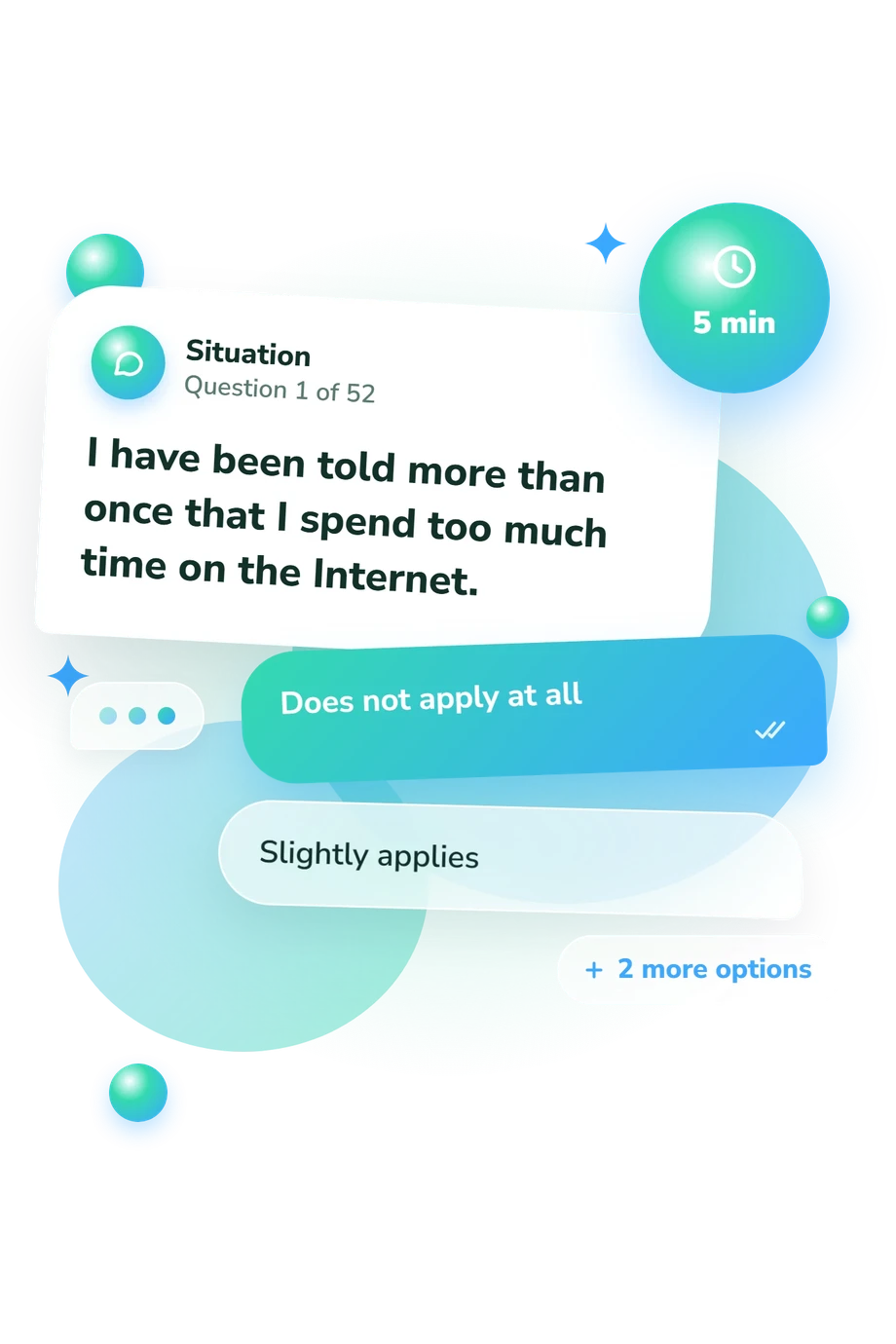
Below is a list of activities or descriptions of Internet-related situations that may apply to individuals with experience using the Internet. Please read each item carefully and select the response that most accurately reflects your Internet use over the past 6 months.
    • Not at all applicable
    • Slightly applicable
    • Partially applicable
    • Completely applicable
    • Not at all true
    • Slightly true
    • Somewhat true
    • Completely true
    • Does not apply at all
    • Slightly applies
    • Somewhat applies
    • Completely applies
WHAT THE TEST MEASURES
About This Assessment
Chen's Internet Addiction Scale, CIAS Test

Chen Internet Addiction Scale (CIAS) Test - Symptoms and Signs

addiction
cyberpsychology
computer addiction

This self-report measure is designed to screen for problematic patterns of internet use and related functional impairment. The Chen Internet Addiction Scale (CIAS) assesses core features commonly associated with excessive online behavior, including diminished control, increasing use over time, distress when unable to access the internet, and interference with daily routines.

The questionnaire includes 26 items and typically takes about 5 minutes to complete. Responses are scored to yield an overall index and domain-level indicators that can support clinical formulation, risk identification, and monitoring of change over time. The Chen Internet Addiction Scale (CIAS) is intended to complement, not replace, a comprehensive clinical interview and consideration of contextual factors (e.g., developmental stage, comorbid symptoms, and psychosocial stressors).

Author: Kimberly S. Young
Literature: Young, K. S. Internet addiction: The emergence of a new clinical disorder. CyberPsychology & Behavior. 1998.
Popular tests
Comments
Leave a Comment