
Hedonic and Eudaimonic Motives for Activities Scale (HEMA-R) Test
How the Scales are Structured
Who Usually Takes This Test?
See How You Compare
Below is a preview of how scores are typically distributed across each scale.
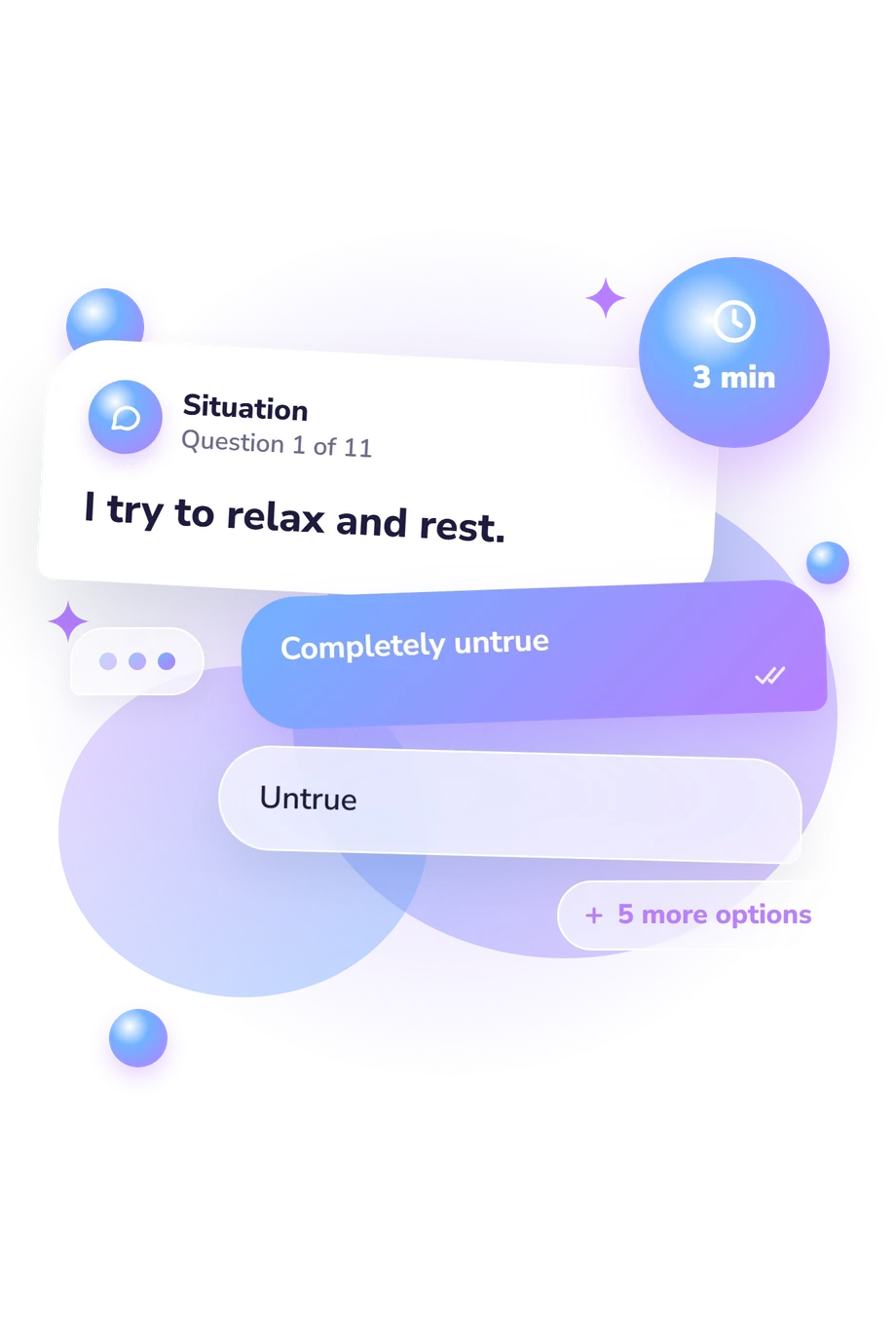
Example Questions From the Test
- Completely untrue
- Untrue
- Somewhat untrue
- Neither true nor untrue
- Somewhat true
- True
- Completely true
- Completely untrue
- Untrue
- Mostly untrue
- Neither true nor untrue
- Mostly true
- True
- Completely true
- Completely untrue
- Untrue
- Mostly untrue
- Neither true nor untrue
- Mostly true
- True
- Completely true
Hedonic and Eudaimonic Motives for Activities Scale (HEMA-R) Test - Description and methodology of the test
People who want to understand why they pursue comfort, enjoyment, or personal development can use this assessment to examine the motives behind ordinary activities. The Hedonic and Eudaimonic Motives for Activities Scale (HEMA-R) Test offers a structured way to reflect on those patterns. The HEMA-R questionnaire helps readers consider whether immediate pleasure, relief from tension, or meaningful growth tends to shape their choices.
What This Assessment Explores
This assessment estimates comfort-seeking, pleasure-seeking, and eudaimonic motivation as distinct tendencies that may co-occur in everyday activity. It suits people reflecting on why certain choices appeal and what they seek from activity, without ranking one motive as better. As a hedonic motivation test, it distinguishes comfort-seeking, which concerns rest, calm, and tension avoidance, from pleasure-seeking, which concerns fun and pleasant experiences, while also examining development and meaning.
The three displayed dimensions are:
- Hedonic Comfort Motivation (3-21) reflects the wish to relax, rest, and avoid tension: Low comfort-seeking 3-9; Moderate comfort-seeking 10-15; High comfort-seeking 16-21.
- Hedonic Pleasure Motivation (3-21) reflects the pursuit of fun and pleasant experiences: Low pleasure-seeking 3-9; Moderate pleasure-seeking 10-15; High pleasure-seeking 16-21.
- Eudaimonic Motivation (5-35) reflects growth, authenticity, self-development, valued goals, and deeper meaning: Lower eudaimonic focus 5-15; Balanced eudaimonic focus 16-25; Strong eudaimonic focus 26-35.
Methodology and Scientific Basis
Each statement is rated on a seven-point true-or-untrue scale with a central fourth option; anchor wording varies across items. The items address rest, fun, learning, acting according to beliefs, striving toward ideals, realizing abilities, and doing something beneficial for others. This format asks about motives and aspirations in activities, including how strongly respondents endorse trying to pursue these aims rather than whether they achieve them.
Scores form a profile across separate dimensions. Higher results indicate a stronger orientation toward the relevant motive, so the interpretation concerns tendencies rather than a single label or overall verdict. The test’s eudaimonic motivation result should be interpreted alongside its comfort and pleasure results and the respondent’s circumstances.
The assessment is conceptually consistent with HEMA-R (Giuntoli et al., 2021), Huta and Ryan’s distinction between hedonic and eudaimonic motives, and Ryan and Deci’s review of hedonic and eudaimonic well-being. Research on the published HEMA-R supports this model, while the displayed bands are descriptive categories for this profile rather than clinical norms; mood, recent experiences, wording interpretation, and response candor can affect self-report, so the result is a current motivational snapshot.
- Giuntoli, Laura, Federica Condini, Francesco Ceccarini, Veronika Huta, and Giulio Vidotto. The Different Roles of Hedonic and Eudaimonic Motives for Activities in Predicting Functioning and Well-Being Experiences. Journal of Happiness Studies. 2021;22:1657-1671. 10.1007/s10902-020-00290-0
- Huta, Veronika. Eudaimonic and Hedonic Orientations: Theoretical Considerations and Research Findings. In: Vittersø, Joar, editor. Handbook of Eudaimonic Well-Being. Cham: Springer; 2016. p. 215-231. 10.1007/978-3-319-42445-3_15
- Huta, Veronika, and Richard M. Ryan. Pursuing Pleasure or Virtue: The Differential and Overlapping Well-Being Benefits of Hedonic and Eudaimonic Motives. Journal of Happiness Studies. 2010;11(6):735-762. 10.1007/s10902-009-9171-4
- Ryan, Richard M., and Edward L. Deci. On Happiness and Human Potentials: A Review of Research on Hedonic and Eudaimonic Well-Being. Annual Review of Psychology. 2001;52:141-166. 10.1146/annurev.psych.52.1.141
Updated: