
Maternal Ambivalence Scale (MAS) Test
How the Scales are Structured
Who Usually Takes This Test?
See How You Compare
Below is a preview of how scores are typically distributed across each scale.
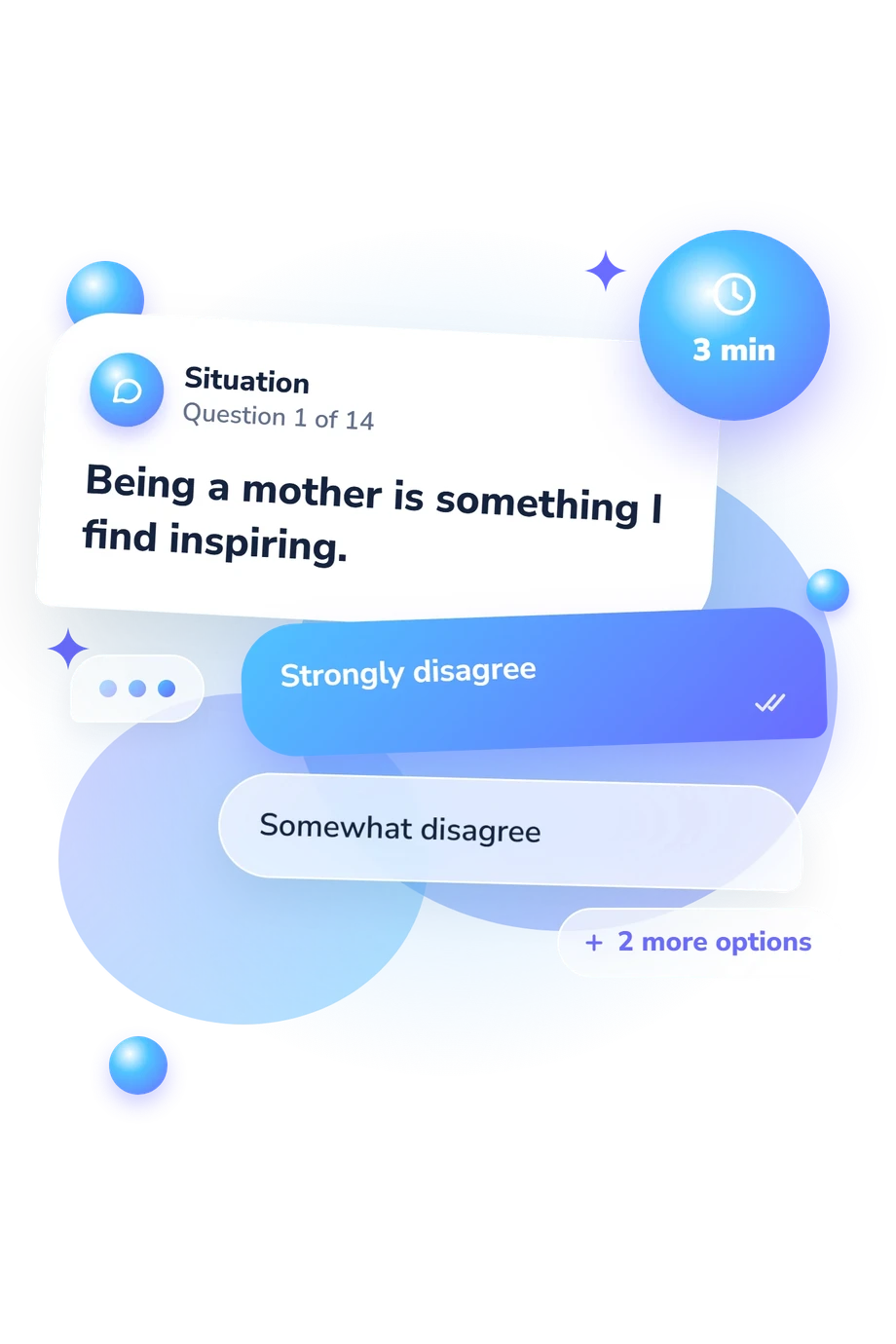
Example Questions From the Test
- Strongly disagree
- Somewhat disagree
- Somewhat agree
- Strongly agree
- Strongly disagree
- Rather disagree
- Rather agree
- Strongly agree
- Strongly disagree
- Somewhat disagree
- Somewhat agree
- Strongly agree
Maternal Ambivalence Scale (MAS) Test - Description and methodology of the test
People considering motherhood, living with uncertainty about it, or trying to understand conflicting reactions can use the Maternal Ambivalence Scale (MAS) Test to map desire, acceptance of the maternal role, doubts, and willingness to disclose them. A motherhood self-assessment can clarify which aspects of motherhood feel settled and which remain emotionally difficult, without forcing those experiences into a simple yes-or-no choice.
What This Assessment Explores
It examines maternal-role conflict: desire alongside fear, regret, uncertainty, or low confidence. It asks how readily doubts might be disclosed to family, friends, or a partner, linking experience with concealment. A maternal ambivalence assessment describes patterns, not a single emotional verdict.
Its dimensions are:
- Concealment (4-16) measures hiding ambivalence socially: Low concealment 4-7, Moderate concealment 8-11, High concealment 12-16.
- Rejection (4-16) measures difficulty accepting the maternal role and perceived lack of resources: Low rejection 4-7, Moderate rejection 8-11, High rejection 12-16.
- Doubts (4-16) measures uncertainty about wanting and feeling motivated to be a mother: Low doubts 4-7, Moderate doubts 8-11, High doubts 12-16.
- Maternal Ambivalence (14-56) measures the intensity of conflicting feelings and experiences related to motherhood; higher total scores indicate greater ambivalence. Low ambivalence 14-27, Moderate ambivalence 28-41, High ambivalence 42-56.
Methodology and Scientific Basis
Each statement uses a four-point agreement scale, so responses are graded rather than binary. Answers combine into three component scores and one overall score, which are compared with displayed bands. The ranges describe this questionnaire’s interpretation; they do not reveal each answer’s point contribution or whether items are reverse-scored.
This maternal ambivalence test is an online translation or adaptation of the published Maternal Ambivalence Scale described in a 2022 study; its 14-item structure and four dimensions match this questionnaire. Cutler and colleagues frame ambivalence about motherhood as competing wishes and circumstances, while Brockington and colleagues place maternal emotional experience in broader interview-based assessment. Psychometric work reported for the source instrument does not establish validation, reliability estimates, or population norms for this online version.
Present circumstances and sensitive feelings can shape self-report. A higher total indicates greater ambivalence; component scores follow their definitions, reflecting keeping ambivalence from others, difficulty accepting the maternal role, or uncertainty about wanting motherhood. Results do not explain causes, predict behavior, or establish a clinical condition. Read patterns across scales when uncertainty or distress feels substantial.
- Martín-Sánchez, Magdalena Belén, Verónica Martínez-Borba, Patricia Catalá, Jorge Osma, Cecilia Peñacoba-Puente, and Carlos Suso-Ribera. "Development and psychometric properties of the maternal ambivalence scale in Spanish women." BMC Pregnancy and Childbirth 22, no. 1 (2022): 625. 10.1186/s12884-022-04956-w
- Cutler, Abigail, Blair McNamara, Neena Qasba, Holly Powell Kennedy, Lisbet Lundsberg, and Aileen Gariepy. "I Just Don't Know": An Exploration of Women's Ambivalence about a New Pregnancy. Women's Health Issues 28, no. 1 (2018): 75-81. 10.1016/j.whi.2017.09.009
- Brockington, Ian, Prabha Chandra, Alessandra Bramante, Hettie Dubow, Walaa Fakher, Lluïsa Garcia-Esteve, Kristina Hofberg, Suaad Moussa, Bruma Palacios-Hernández, Ylva Parfitt, and Pey-Ling Shieh. "The Stafford Interview: A comprehensive interview for mother-infant psychiatry." Archives of Women's Mental Health 20, no. 1 (2017): 107-112. 10.1007/s00737-016-0683-8
Updated: