
UCLA Loneliness Scale (UCLA) Test
How the Scales are Structured
Who Usually Takes This Test?
See How You Compare
Below is a preview of how scores are typically distributed across each scale.
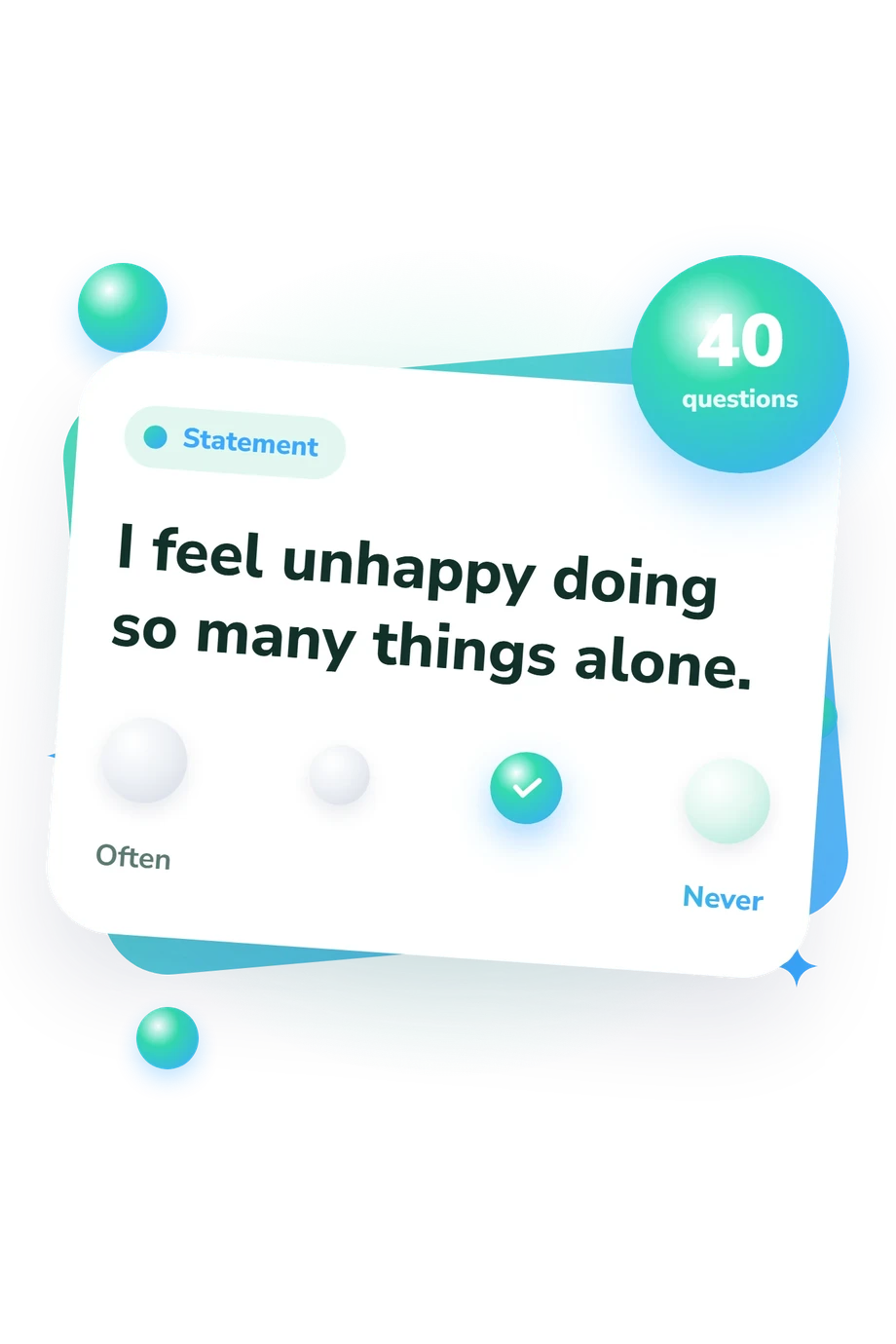
Example Questions From the Test
- Often
- Sometimes
- Rarely
- Never
- Often
- Sometimes
- Rarely
- Never
- Often
- Sometimes
- Rarely
- Never
UCLA Loneliness Scale (UCLA) Test - Description and methodology of the test
For readers who want a clearer picture of their social experience, the UCLA Loneliness Scale (UCLA) Test offers a structured way to consider whether connection, companionship, and emotional closeness feel available. It can help distinguish social distance, uncertain support, and disconnection in shared settings when relationships feel hard to read. This loneliness assessment presents the result as a profile of perceived experience rather than a fixed identity.
What This Assessment Explores
Loneliness is treated as a subjective experience expressed through thoughts, feelings, and patterns of social contact. The statements address companionship, understanding, closeness, exclusion, friendship, and relationship quality. The UCLA test for loneliness presents overall subjective loneliness alongside cognitive, behavioral, and emotional manifestations.
The result is organized into four scales:
- Loneliness Scale (0-60) assesses overall subjective loneliness across emotional, cognitive, and behavioral manifestations; bands are Low loneliness 0-28 and High loneliness 29-60.
- Perceived Lack of Understanding by Others (0-9) measures feeling misunderstood or unsupported; bands are Low 0-5 and High 6-9.
- Impaired Social Contacts (0-30) reflects isolation, detachment, passivity, and difficulty maintaining contact; bands are Lower disruption 0-15 and Higher disruption 16-30.
- Negative Affect (0-21) captures feeling closed off, unwanted, isolated, or rejected; bands are Low 0-9 and High 10-21.
Together, these scales show which aspects of loneliness stand out.
Methodology and Scientific Basis
Each statement is answered by frequency: Often, Sometimes, Rarely, or Never; the choices may also be numbered. The online questionnaire combines responses into the displayed scales, but it does not provide a scoring key for item weighting or reversal. Interpretation should follow the reported scales and bands rather than an assumed point-by-point formula.
The online questionnaire is conceptually consistent with the published UCLA Loneliness Scale measures, including the self-report measure described by Russell et al. (1978), but it should not be treated as a reproduction or validated adaptation of any one version. Russell, Peplau, and Cutrona (1980) examined concurrent and discriminant validity, and Russell (1996) reported reliability, validity, and factor structure for Version 3.
For someone completing the online loneliness questionnaire, higher displayed values generally indicate greater experience in the relevant domain. The displayed bands sort results into lower and higher ranges; they are not universal clinical cutoffs or population norms. Scores may vary with circumstances and depend on how accurately respondents can report their current experience, so they describe a self-report profile rather than establishing a diagnosis or replacing broader assessment.
- Russell, D. W., Peplau, L. A., & Ferguson, M. L. (1978). Developing a measure of loneliness. Journal of Personality Assessment, 42(3), 290-294. 10.1207/s15327752jpa4203_11
- Russell, D. W., Peplau, L. A., & Cutrona, C. E. (1980). The revised UCLA loneliness scale: Concurrent and discriminant validity evidence. Journal of Personality and Social Psychology, 39(3), 472-480. 10.1037/0022-3514.39.3.472
- Russell, D. W. (1996). UCLA Loneliness Scale (Version 3): Reliability, validity, and factor structure. Journal of Personality Assessment, 66(1), 20-40. 10.1207/s15327752jpa6601_2
Updated: