
Career Adapt-Abilities Scale (CAAS) Test
How the Scales are Structured
Who Usually Takes This Test?
See How You Compare
Below is a preview of how scores are typically distributed across each scale.
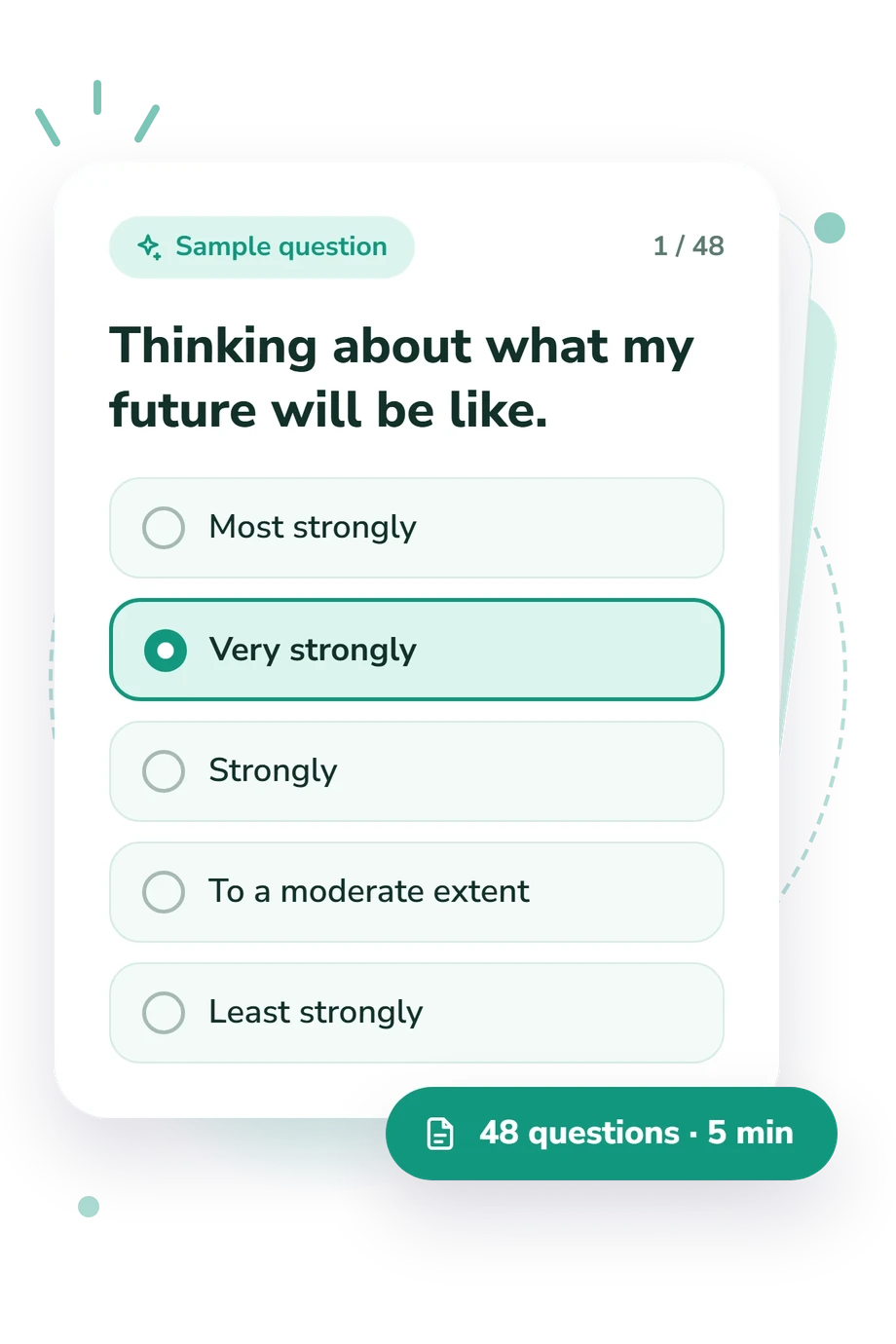
Example Questions From the Test
- Strongest
- Very strong
- Strong
- Moderate
- Least
- Strongest
- Very strong
- Strong
- Moderate
- Least
- To the greatest extent
- To a very great extent
- To a great extent
- To a moderate extent
- To the least extent
Career Adapt-Abilities Scale (CAAS) Test - Description and methodology of the test
People considering a change in direction, entering a new field, or reviewing their professional priorities can use the Career Adapt-Abilities Scale (CAAS) Test to examine how they approach career-related transitions. This career adaptability assessment focuses on patterns that support planning, decision-making, exploration, and persistence. The result maps how future orientation, agency, exploration, and confidence appear in your reported approach to career-related choices and transitions.
What This Assessment Explores
The questionnaire examines readiness for predictable and unexpected career tasks and challenges. Its items cover future orientation, responsibility, exploration, performance, and persistence; the last two are themes, not separate displayed scales. For many readers, this career development questionnaire clarifies approaches to choices, transitions, and growth. The displayed results comprise four dimensions and one combined score:
- Concern (6-30) measures future orientation and preparation: Low 6-15; Moderate 16-26; High 27-30.
- Control (6-30) measures responsibility for career development: Low 6-17; Moderate 18-26; High 27-30.
- Curiosity (6-30) measures occupational exploration and information gathering: Low 6-16; Moderate 17-26; High 27-30.
- Confidence (6-30) measures awareness of the ability to make well-considered decisions, achieve goals, and cope with stress: Low 6-16; Moderate 17-25; High 26-30.
- Career Adaptability (24-120) measures readiness for career challenges: Lower adaptability 24-69; Moderate adaptability 70-101; High adaptability 102-120.
Methodology and Scientific Basis
Each prompt asks the respondent to rate how strongly a statement describes them, using five ordered choices from strongest endorsement to least. The items address future preparation, independent decisions, opportunity seeking, skill development, efficient work, and problem solving. The questionnaire presents four six-item dimensions and a combined score; responses are aggregated into displayed ranges, while its option-weighting rule is not specified.
Conceptually, this questionnaire is consistent with the Career Adapt-Abilities Scale (CAAS), a published instrument developed within career construction theory. Research on that instrument reports reliability, measurement equivalence, and vocational identity. That evidence supports the framework, not automatically each online wording, translation, or result band. Here, displayed bands are descriptive labels for interpreting results.
Use this career adaptability test to interpret reported readiness within lower, moderate, or higher ranges. A higher combined score indicates greater reported readiness for career-development challenges; the profile shows where readiness is stronger or less developed. Reading it as a profile of reported career adaptability can support reflection and planning. Self-report remains sensitive to current circumstances, mood, and self-awareness.
- Savickas, M. L., & Porfeli, E. J. (2012). Career Adapt-Abilities Scale: Construction, reliability, and measurement equivalence across 13 countries. Journal of Vocational Behavior, 80(3), 661-673. 10.1016/j.jvb.2012.01.011
- Porfeli, E. J., & Savickas, M. L. (2012). Career Adapt-Abilities Scale-USA Form: Psychometric properties and relation to vocational identity. Journal of Vocational Behavior, 80(3), 748-753. 10.1016/j.jvb.2012.01.009
Updated: