
Obsessive Compulsive Drinking Scale (OCDS) Test
How the Scales are Structured
Who Usually Takes This Test?
See How You Compare
Below is a preview of how scores are typically distributed across each scale.
Example Questions From the Test
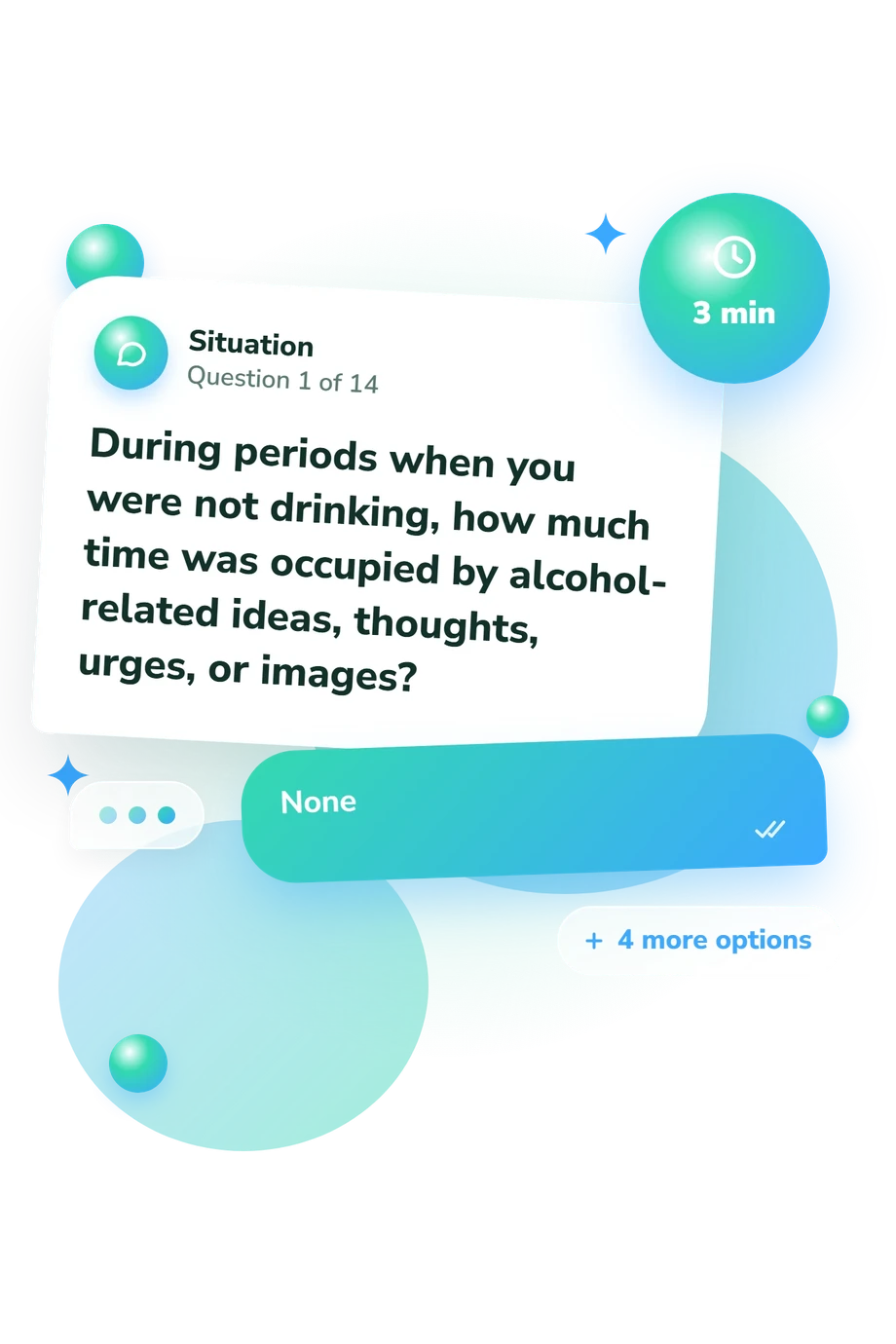
- None
- Less than 1 hour per day
- 3 hours per day
- 8 hours per day
- More than 8 hours per day
- Did not drink at all
- Less than 1 drink per day
- 2 drinks per day
- 7 drinks per day
- 8 or more drinks per day
- Did not drink at all
- No more than 1 day per week
- 3 days per week
- 5 days per week
- 7 days per week
Obsessive Compulsive Drinking Scale (OCDS) Test - Description and methodology of the test
People who are unsure how strongly drinking-related concerns shape everyday choices may use the Obsessive Compulsive Drinking Scale (OCDS) Test to organize that self-reflection. It can help a respondent consider whether preoccupation, anxiety, or loss of control is affecting work, relationships, or ordinary routines. Craving-related items sit alongside prompts about functioning, consumption, and control, making this alcohol craving test a broader profile of drinking-related difficulty.
What This Assessment Explores
Alcohol-related preoccupation and behavior are examined together. The items address time spent thinking about alcohol, distress when not drinking, resistance to thoughts or drinking, craving strength, consumption, and disruption to work or social life. As a compulsive drinking questionnaire, it suits people seeking a structured reflection on dependence-related patterns rather than a consumption-only snapshot.
The result reports three scores: two component scales and one overall score:
- Compulsion (0-20) assesses compulsive alcohol-related behavior; Low 0-6, Moderate 7-13, High 14-20 show increasing difficulty controlling it.
- Obsession (0-20) assesses intrusive, repetitive alcohol-related thoughts; Low 0-6, Moderate 7-13, High 14-20 show increasing preoccupation that may indicate dependence.
- Total Score (0-40) reflects overall obsessive-compulsive alcohol symptoms; Low 0-13, Moderate 14-26, High 27-40 show progressively greater thoughts, compulsive behavior, and reduced control.
Together, the profile indicates how prominent and disruptive these patterns are in the respondent’s current account.
Methodology and Scientific Basis
Each item uses ordered self-report choices that move from little or no alcohol-related difficulty toward more frequent thoughts, stronger urges, greater distress, impaired functioning, or weaker control. The content can be read as two broad groups: obsessive experiences during sobriety and compulsive drinking behavior, with several items also asking about consumption and consequences.
This online OCDS alcohol assessment is conceptually consistent with the published OCDS, the self-rated instrument described by Anton, Moak, and Latham. Later work by Anton and colleagues examined its outcome use and factor structure, including the relationship between obsessive and compulsive components. Those studies support the published instrument, but they do not by themselves establish independent norms or validation for this online presentation.
The questionnaire does not state a separate answer-to-point conversion or weighting rule, so readers should use the reported result rather than infer one. Because this is self-report rather than a diagnostic interview, recall, current context, honesty, and self-awareness can affect scores, and a higher band signals greater severity within this questionnaire rather than a diagnosis.
- Anton RF, Moak DH, Latham P. The Obsessive Compulsive Drinking Scale: A Self-Rated Instrument for the Quantification of Thoughts about Alcohol and Drinking Behavior. Alcoholism: Clinical and Experimental Research. 1995;19(1):92-99. 10.1111/j.1530-0277.1995.tb01475.x
- Anton RF, Moak DH, Latham PK. The Obsessive Compulsive Drinking Scale: A New Method of Assessing Outcome in Alcoholism Treatment Studies. Archives of General Psychiatry. 1996;53(3):225-231. 10.1001/archpsyc.1996.01830030047008
- Roberts JS, Anton RF, Latham PK, Moak DH. Factor Structure and Predictive Validity of the Obsessive Compulsive Drinking Scale. Alcoholism: Clinical and Experimental Research. 1999;23(9):1484-1491. 10.1111/j.1530-0277.1999.tb04671.x
Updated: